
Isotopes are atoms of the same element that have the same atomic number but different mass numbers. This difference occurs because the atoms contain the same number of protons and electrons but different numbers of neutrons in their nuclei. Due to this, isotopes show similar chemical properties but may have different physical properties, such as mass and density.
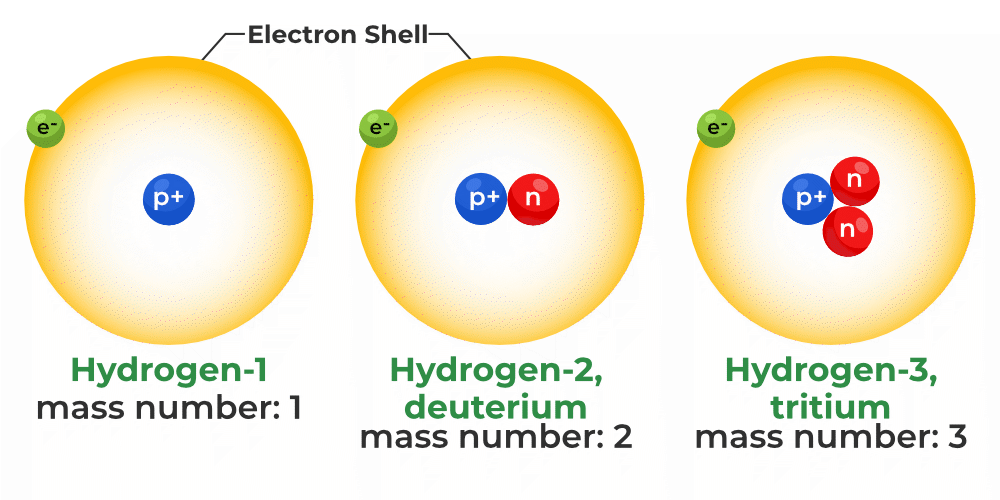
Example: The element Hydrogen has three common isotopes: protium (¹H), deuterium (²H), and tritium (³H). All of them have 1 proton, but they differ in the number of neutrons present in the nucleus.
Properties of Isotopes
These properties help in understanding how isotopes behave in chemical reactions and physical processes.
- All isotopes of an element have the same atomic number because they contain the same number of protons in their nucleus.
- Isotopes have different mass numbers because the number of neutrons present in their nuclei is different.
- Isotopes show almost the same chemical properties since chemical reactions mainly depend on the number of electrons, which is the same in isotopes of an element.
- The physical properties, such as mass, density, and rate of diffusion, may differ because isotopes have different masses.
- Since isotopes have the same atomic number, they occupy the same position in the periodic table.
Types of Isotopes
Isotopes can be classified into different types based on their stability. Some isotopes remain stable for a long time, while others are unstable and emit radiation to become stable.
1) Stable Isotopes
- Stable isotopes are those isotopes whose nuclei remain stable and do not emit radiation.
- They exist naturally and remain unchanged for a long period of time.
Example: ¹²C of Carbon and ¹H (protium) of Hydrogen
2) Radioactive Isotopes (Radioisotopes)
- Radioactive isotopes are unstable isotopes that emit radiation in order to become stable.
- This process is called radioactivity.
- These isotopes are used in fields such as medicine, research, and carbon dating.
Example: ¹⁴C of Carbon and ³H (tritium) of Hydrogen are radioactive isotopes.
Examples of Isotopes
Many elements have different isotopes that vary in their mass number due to a different number of neutrons. Some common examples of isotopes of elements are:
1) Isotopes of Hydrogen
- Hydrogen has three naturally occurring isotopes.
- Isotopes of hydrogen are 1H protium, 2H deuterium, and 3H tritium.
- Protium and deuterium are stable isotopes, while tritium is a radioactive isotope.
2) Isotopes of Carbon
- Carbon-13 has 7 neutrons, and carbon-14 has 8 neutrons, while both contain 6 protons.
- Carbon-12 is a stable isotope, while carbon-14 is a radioactive isotope (radioisotope).
- Other than this, many synthetic carbon isotopes are synthesized in a lab environment and can only be sustained for a very brief period of time (on the order of 200 ms).

3) Isotopes of Oxygen
- There are only three stable isotopes of oxygen, which are 16O, 17O, and 18O.
- Oxygen has three stable isotopes: 16O, 17O, and 18O.
- Other isotopes of oxygen can be produced in laboratories, but they are unstable and exist only for a short time.

Uses of Isotopes
Some of the important uses or applications of isotopes are
- Isotopes are used in various industrial applications, like detecting leaks in pipelines and testing the integrity of materials for various use cases.
- Different isotopes of uranium and plutonium are used in nuclear reactors to make nuclear energy.
- Isotopes are useful in chemical analysis because they behave chemically similar to the original element.
- As a result, isotopes are employed in the element's chemical analysis.
- Additionally, they are employed in analytical processes like nuclear magnetic resonance and mass spectrometry.