
According to Dalton's atomic theory, all substances are made up of atoms, which are indestructible and indivisible building blocks. While the atoms of one element were all the same size and mass, other elements had atoms of different sizes and weights.
- Atomic theory is a fundamental concept in science that describes matter as composed of discrete units called atoms.
- Atoms are the smallest particles of an element that maintain the chemical properties of that element.
- According to Dalton, atoms are indivisible particles and do not have internal structure.
- This theory explains the behavior of atoms in chemical reactions, where they rearrange to form new substances without being destroyed or fundamentally altered.
Postulates of Dalton's Atomic Theory
To explain the nature of matter, Dalton’s Atomic Theory proposed the following postulates:
1. Matter is Made of Tiny Particles Called Atoms
- Dalton stated that all matter is composed of extremely small particles called atoms.
- These atoms are the basic building blocks of matter.
2. Atoms are Indivisible and Indestructible
- According to Dalton, atoms cannot be divided, created, or destroyed in a chemical reaction.
- They remain unchanged during chemical reactions.
- Modern science has shown that atoms can be divided into subatomic particles, but in chemical reactions, atoms remain intact.
3. All Atoms of the Same Element are Identical
- Dalton proposed that all atoms of a given element have the same mass and chemical properties.
- For example, all atoms of Hydrogen are identical in mass and properties.
4. Atoms of Different Elements Have Different Masses and Properties
- Atoms of different elements differ in mass and chemical properties.
- For example, atoms of Oxygen are different from atoms of hydrogen.
5. Atoms Combine in Simple Whole Number Ratios
- Atoms combine with each other in simple whole-number ratios to form compounds.
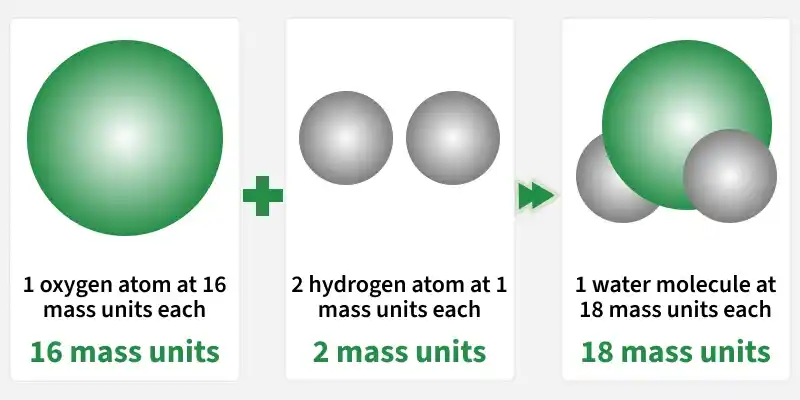
- Hydrogen and oxygen combine in a 2:1 ratio.
Example:
2H_2 + O_2 \rightarrow 2H_2O
6. In a Chemical Reaction, Atoms are Rearranged
- During a chemical reaction, atoms are neither created nor destroyed.
- They are only rearranged to form new substances.
- Carbon and oxygen atoms rearrange to form carbon dioxide.
Example:
C + O_2 \rightarrow CO_2
Advantages of Dalton's Atomic Theory
The key advantages of this atomic theory include:
- Dalton's theory provides a basic idea to differentiate between elements and compounds.
- Dalton’s atomic theory doesn't violate the law of multiple proportions, the law of conservation of mass, and the law of constant proportions.
Disadvantages of Dalton's Atomic Theory
Despite its importance, the theory could not explain some experimental observations:
- Dalton stated that atoms are indivisible, but later discoveries showed that they can be divided into subatomic particles such as electrons, protons, and neutrons.
- Dalton states that atoms of a given element have exactly the same masses. But, it is known that even atoms of the same element can have different masses just like isotopes.
- Dalton states that atoms of different elements can have different masses. But, it is known that even atoms of different element can have same masses just like isobars.
Dalton formulated his theory based on two laws:
- Law of Conservation of Mass: Matter can neither be created nor destroyed, but it can be converted from one form to another in a closed system. We use the law of conservation of mass to balance linear equations.
- Law of Constant Composition: The law of constant composition says that a pure compound will always have the same proportion of the same elements. For example, table salt, which has the molecular formula NaCl contains the same proportions of sodium and chlorine instead of the fact, how much salt we want to make.
Limitations of Dalton's Atomic Theory
Although it laid the foundation of modern chemistry, it has some limitations:
- Combination Ratios: Dalton suggested that elements combine in simple whole-number ratios to form compounds. However, many complex organic compounds, like sugar (C11H222O11), do not conform to simple stoichiometric ratios.
- Allotropes: The theory does not explain allotropes different forms of the same element with distinct properties, such as carbon manifesting as both diamond and graphite.