
Potential energy is the energy stored in an object due to its position, arrangement, or state. Unlike kinetic energy, which is associated with motion, potential energy remains stored until it is converted into another form of energy. It can exist in different forms depending on the situation, such as gravitational potential energy (due to height), electrical potential energy (due to charges), chemical potential energy (stored in bonds), and elastic potential energy (due to deformation or internal stress).
Examples in everyday life include a bicycle at the top of a hill, a book placed on a table, and a stretched spring.
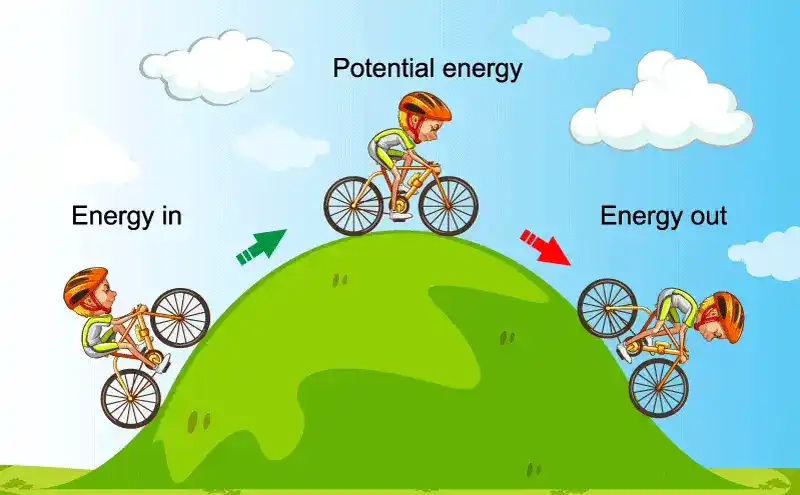
Examples in everyday life include a bicycle at the top of a hill, a book placed on a table, and a stretched spring. A bicycle at the top of a hill has gravitational potential energy because it is raised above the ground. This energy is stored due to its position. The higher the bicycle is, the more potential energy it has. When the bicycle starts moving downhill, this stored energy is converted into kinetic energy, causing it to move faster.
Formula of Potential Energy
The potential energy of a body depends on the force acting on it and its displacement. For gravitational force, the potential energy is given by:
Where:
- m is the mass of the body.
- g is the acceleration due to gravity.
- h is the height of the body above the reference level
Unit
Potential energy is measured in joules (J), which is the SI unit of energy. It has the same unit as work and kinetic energy, since all forms of energy share the same unit. 1 Joule = 1 kg⋅m²⋅s⁻²
The dimensional formula of potential energy is [MLT⁻²].
Types of Potential Energy
There are two main types of potential energy, and they are:
1. Gravitational Potential Energy
Gravitational potential energy is the energy possessed by an object when it is raised to a certain height against the force of gravity. It depends on the mass of the object and the height to which it is raised.
Thus, a heavier object or an object placed at a greater height has more gravitational potential energy.
In celestial motion, gravitational potential energy also plays an important role. For example, the Earth revolves around the Sun due to gravitational interaction, where the balance between gravitational potential energy and kinetic energy helps maintain its orbit.
Formula
Let us consider a ball of mass m at a height of h from the ground. Now, as we know, the force required to raise the object is equal to its weight.
W = F = mg
Where:
- W is the weight of the object
- F is the force due to gravity
- m is the mass of the object
- g is the acceleration due to gravity
Now, the gravitational potential energy is equal to the net force required to pull the ball towards the ground, which is given by
Work done = Force required × Displacement of the ball
Ugrav = PEgrav
= F × h
= mg × hThus, Gravitational potential energy formula is,
Ugrav = PEgrav = mgh
Hence, it can be said that the gravitational potential energy of an object is due to its mass, its acceleration due to gravity, and its height above the earth's surface.
2. Elastic Potential Energy
Elastic potential energy is the energy stored in an object when it is stretched or compressed, such as in rubber bands, springs, trampolines, and bungee cords. The amount of elastic potential energy depends on how much the object is deformed and its stiffness.
Elastic Potential Energy Formula
Elastic potential energy can be calculated using the following formula:
U = \frac{1}{2} k x^2 Where:
- U is the elastic potential energy
- k is the spring constant
- x is the displacement (extension or compression) of the spring
Related Articles:
Solved Problems
Question 1: Find the potential energy of an object of mass 10 kg when it is raised at a height of 6 m above the ground. Take g = 10 m s⁻².
Solution: Given
Mass of the object m = 10 Kg
Height above the ground h = 6 m
Potential energy Ep = ?
We Know that
Ep = mgh
Ep = 10 × 10 × 6
Ep = 600 J
The Potential Energy of the object is 600 J
Question 2: A Ball of mass 22 kg is at a certain height above the ground. If the potential energy of the object is 880 J, find the height at which the object is with respect to the ground. Take g = 10 m s⁻².
Solution: Given,
Mass of the Ball, m = 22 kg
Potential energy, Ep = 880 J
Height above the ground h = ?
We Know that
Ep = mgh
880 = 22 × 10 × h
h = 880/220
h = 4 m.
The height of the object is 4 m.
Question 3: An asteroid is coming toward the earth. Its height above the ground is 1000 km. Its estimated potential energy is almost 3.72 × 10¹³ J. Find out the mass of the asteroid.
Solution: Given,
Potential energy Ep = 3.72 × 10¹³ J
Height of the asteroid, h = 1000Km = 106 m
Mass of the asteroid, m =?
We know that
Ep = mgh
3.72 × 1013 = m × 10 × 106
m = 3.72 × 10⁶ Kg
Mass of asteroid is 3.72 × 10⁶ Kg
Question 4: A spring has a strength length of 0.7 m. Take k = 16. What is its elastic potential energy?
Solution: Given
k = 16
Length = 0.7 m
Elastic Potential Energy = 1/2 kx2
U = ½ kx2
U = ½ × 16× 0.7× 0.7
U = 3.92 J
Question 5: A spring with spring force constant k = 12 has an elastic potential energy of 24 J. Find out the change in the length of the spring in m.
Solution: Given,
k = 12
U = 24 J
Length in m = ?
U = ½ kx2
24 = ½ ×12 × x2
x = 2 m
Thus, the change in the length of the spring is 2 m.
Unsolved Problems
Question 1: A body of mass 15 kg is lifted to a height of 12 m. Calculate its gravitational potential energy. Take g = 9.8 m/s2.
Question 2: An object has a potential energy of 490 J when placed at a certain height. If its mass is 5 kg, find the height above the ground. Take g=9.8 m/s2
Question 3: A spring with spring constant k=20 N/m is stretched by 0.5 m. Find the elastic potential energy stored in the spring.
Question 4: An object of unknown mass is raised to a height of 8 m and gains a potential energy of 784 J. Calculate the mass of the object. Take g=9.8 m/s2
Question 5: A spring stores 50 J of elastic potential energy when compressed by a certain length. If the spring constant is k=25 N/m, find the compression of the spring.