
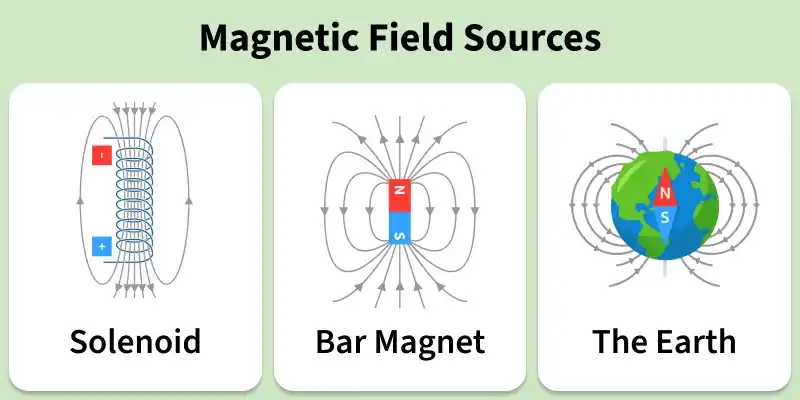
A magnetic field is an invisible region around a magnet, electric current, or moving charged particle where magnetic forces can be felt.
In electromagnetism, it’s described as a field that exerts forces on other moving charges and magnetic materials like iron.
Unit
The SI unit for the magnetic field is the tesla (T).
- B-Field: It is the magnetic field defined by the force it exerts on a moving charged particle.
- H-Field: It is defined as the magnetic field within a material, rather than in a vacuum.
B-Field is measured in Tesla (T) while H-Field is measured in Ampere/meter (A/m).
In the CGS system, the unit of measurement for the B-field is the gauss (G) (1 T = 10000 G), while the H-field is measured in Oersted (Oe) (1 Oersted = 1000/4π A/m ≈ 79.577 A/m).
Magnetic Vector Field
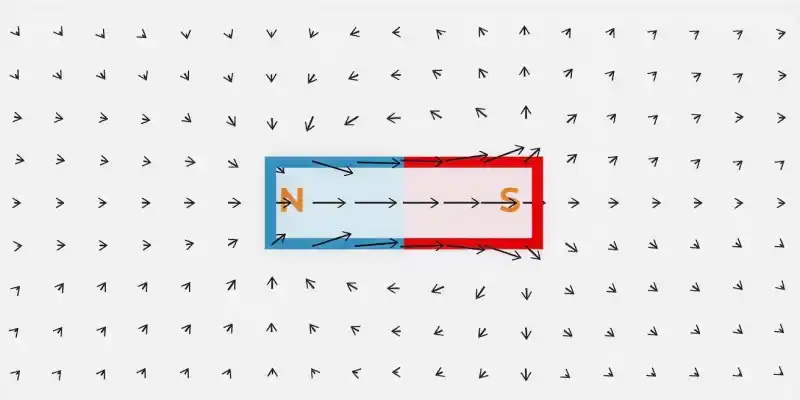
A magnetic field is a vector field, meaning it has both magnitude and direction at every point in space and is represented by the vector B. The direction of the magnetic field at a point is given by the direction a north pole would move (from north to south outside the magnet).
The magnitude of the field is indicated by the length of the vector, while its orientation shows the direction of the magnetic field at that point.
Magnetic Field Lines
Another representation of the magnetic field can be done using the magnetic field lines, which are shown in the figure below. The strength of the magnetic field is shown here by the closeness of magnetic field lines.
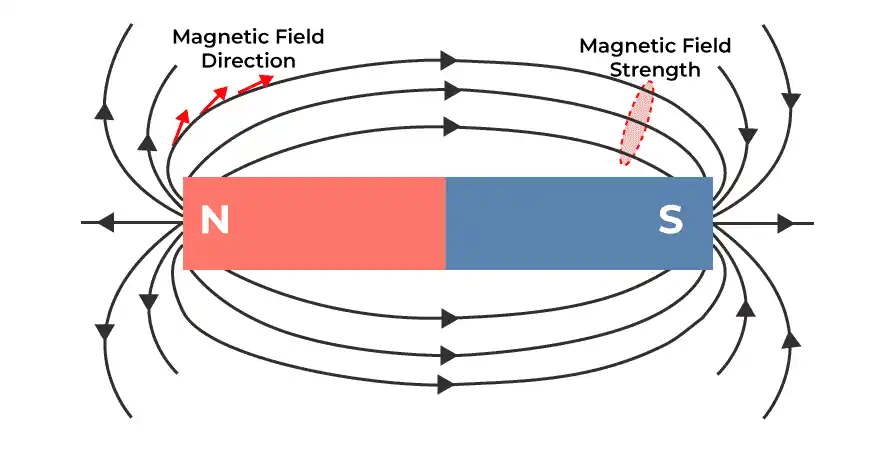
Example: The magnetic field is stronger at the poles because the lines are more crowded in that area.
Properties
- Magnetic field lines never intersect each other, as the magnetic field at any point has a unique direction, and the tangent at any point gives the direction of the field.
- Magnetic field lines always form closed and continuous loops, indicating that they do not have a beginning or end.
- The density (closeness) of field lines represents the strength of the magnetic field, with maximum strength at the poles where lines are most crowded.
- Outside the magnet, field lines emerge from the north pole and enter the south pole, while inside the magnet, they flow from south to north, completing the loop.
Magnetic Field Intensity
- It is the measure of the strength of a magnetic field.
- Represented by the vector H.
- Defined as magnetomotive force (MMF) per unit length required to produce a magnetic field in a material.
- A vector quantity.
- SI unit is ampere per meter (A/m).
- Dimensional formula is [M⁰L⁰T⁰I¹].
- Related to magnetic flux density (B) and magnetisation (M) through a standard relation.
B = \mu (H + M)
- B = Magnetic flux density
- H = Magnetic field intensity
- M = Magnetisation
- μ = Magnetic permeability