
Electric flux helps us understand and quantify the electric field passing through a given surface. It provides a means to describe the flow of electric field lines through an area.
- Forms the basis of Gauss's Law to calculate the net charge enclosed inside a given Gaussian surface, which says that the flux through a surface will be the result of the total (or net) charge enclosed inside it.
- It is a scalar quantity, representing the total number of electric field lines passing through a given surface.
- Denoted by a Greek letter, Φ, which is pronounced as "phi."
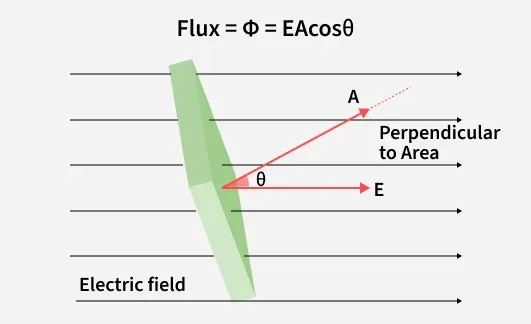
Electric flux is the estimation of the total number of electric field lines (imaginary lines considered around a charged particle, these are thought to originate from the positive electric charges and thought to sink in negative electric charges), passing through a given closed surface.
Formula
The electric flux depends on the different parameters, namely, the strength of the electric lines of forces, the area of the surfaces, and it also depends on the orientation between the surface area and the electric lines of forces. These quantities together yield electric fields through the surface, and they are related as:
Φ = E • A OR Φ = E A cos θ
- Φ denotes the electric flux,
- E denotes the electric field strength,
- A denotes the area of the closed surface, and
- θ denotes the angle between the electric field lines and the area vector.
Factors Affecting Electric Flux
Some of the factors affecting electric flux are:
- Electric Field Strength (E): Φ ∝ E, thus it increases with the increase in electric field lines.
- Area of the Surface (A): Φ ∝ A, thus its magnitude increases with the increase of the area.
- cos θ: It attains the maximum value of 1 for θ = 0, and the minimum value of -1 for θ = 180.
SI Unit of Electric Flux
The unit of electric flux can be derived from putting the units of different values in the formula for calculating electric flux.
Φ = E × A × cos θ
Therefore,
Unit of (Φ) = Unit of (E) × Unit of (A) × Unit of cos θ
OR Unit of (Φ) = (V/m) × (m2) × 1
OR Unit of (Φ) = V-m.
Thus, the SI unit of electric flux is V-m (Volt-meter).
Dimensional Formula of Electric Flux
Since electric flux depends on some parameters, therefore dimensional formula of electric flux can be derived by putting the dimensional formula of the quantities together in the formula of electric flux.
[Φ] = [E] • [A]
[Φ] = [MLT-3A-1] • [L2] = [ML3T-3A-1]
Therefore, the dimensional formula of electric flux is [ML3T-3A-1].
Types of Electric Flux
Since the electric flux also depends on the angle between the field lines and the area vector, it can have a negative or positive value.
- Positive Electric Flux: When the electric field lines pass outward through a closed surface, the electric flux is considered positive. This occurs when the electric field lines are in the same direction as the outward-pointing normal vector to the surface.
- Negative Electric Flux: When the electric field lines pass inward through a closed surface, the electric flux is considered negative. This happens when the electric field lines are in the opposite direction to the outward-pointing normal vector to the surface.
Properties of Electric Flux
Electric flux has several key properties that help in understanding and analysing electric fields. Some of the significant properties of electric flux are mentioned below:
- Electric flux is a scalar quantity; it has only magnitude with no direction. It quantifies the total number of electric field lines passing through a given surface, irrespective of its direction.
- The electric flux through a surface is directly proportional to the strength of the electric field passing through the surface (E). A stronger electric field will result in higher electric flux through the surface.
- It also depends on the angle between the area vector and the field lines.
- Electric flux follows the principle of superposition, i.e the total flux through a surface is the sum of the individual fluxes through different parts of the surface.
Electric Flux Through Different Surfaces
From the discussion so far, we have got to know the relation between flux (Φ), Field Strength (E), and net area in the direction of the field (A cosθ) as Φ = E A cos θ. So it far clear that electric flux through the surfaces depends on the area of the surface. Also, according to the Gauss law, the total flux passing through a closed surface depends on the net enclosed charge.
Φ = qenclosed / ε0
Where qenclosed is the total charge enclosed in the surface.
Now, we will discuss the electric flux through closed and open surfaces, and look at what they are:
- Flux through Closed Surfaces
- Flux through Open Surfaces
- Electric Flux Through Special Geometries
1. Flux through Closed Surfaces
Any surface that completely encloses a three-dimensional region is closed. Examples of closed surfaces include cubes, spheres, cylinders, etc. Closed surfaces, according to Gauss's Law, are critical in understanding the relationship between the total electric flux passing through a surface and the charge enclosed within it.
According to Gauss's Law that the total electric flux through a closed surface is proportional to the total charge enclosed by that surface, divided by the permittivity of the medium. The symmetric nature of closed surfaces simplifies the calculation of electric flux, enabling the straightforward application of Gauss's Law.
Φ = qenclosed/ε
where,
- q is the total charge enclosed inside a closed surface, and
- ε is the permittivity of the medium.
2. Flux through Open Surfaces
Unlike the closed surfaces, the open surface doesn't have a closed boundary and thus doesn't enclose a volume. The direct application of Gauss's Law becomes difficult in the case of open surfaces, and thus determining the flux through an open surface requires integration of the dot product of the electric field and the surface area vector over the entire surface.
These calculations are more complex than those of the closed surfaces due to the lack of symmetry, and they involve integrating over irregularly shaped surfaces. Open surfaces include planes, sheets, rings, etc.
The flux Φ through an open surface can be determined using the integral calculation:
Φ = ∲ E ․ dA
Where
- E is the electric field,
- dA is the small area element from the surface, and
- The dot product of the electric field and the differential area vector is integrated over the entire open surface to calculate the total flux.
3. Electric Flux Through Special Geometries
Electric Flux through various special geometries is listed in the following table:
Geometry | Flux Expression | Explanation |
|---|---|---|
Cuboid | Φ = q0/ ε0 | where q0 is the total charge enclosed inside the cuboid, and ε0 is the permittivity of the free space. |
One Face of Cuboid | Φ = q0/ 6ε0 | The flux will be equal in all directions, hence 1/6 from each surface. |
Cylinder | Φ = q0/ ε0 | where q0 is the charge enclosed inside the cylinder, |
Cylinder Length placed in the field of strength E | Φ = 2 × π × r × l | where r is the radius of the base, and L is the length of the cylinder. |
Sphere | Φ = q0/ε0 | When the total enclosed charge is q0. |
A plain sheet placed in an electric field of strength | Φ = E × A | This is an open surface, where A is its area, and E is the field strength. |
Circular disc placed in an electric field of strength | Φ = E × 2πr2 | where r is the radius of the disc placed in a uniform field of strength E |
Electric Flux Density
Electric field density is yet another important concept in electromagnetism, which allows us to understand and predict how electric fields interact within substances, including insulators, conductors, and dielectrics. It signifies the amount of electric flux passing through a specific area within the material. It is also defined as the sum of the free charge effect (expressed through the electric field, E) and the impact of the material's polarisation (P) due to an external electric field. It is also referred to as electric displacement.
Formula of Electric Flux Density
Electric flux is denoted by the symbol D. The formula for electric flux can be given as,
D = ε0E + P
Where,
- D is the electric flux density vector,
- ε0 is the permittivity of free space,
- E is the electric field strength and,
- P is the polarisation vector, representing the dipole moment induced in the material per unit volume due to an external electric field.
SI Unit of Electric Flux Density
The SI unit of electric flux density can be derived from putting the units of different values in the formula for electric flux density.
D = ε0E + P
Putting,
- farads per meter (F/m) as unit of ε0
- volts per meter (V/m) as a unit of E and,
- Polarisation has a unit coulombs per square meter (C/m2).
The expression will yield the unit of Electric Flux density as C/m2.
The SI unit of electric flux density is coulombs per square meter (C/m²).
Dimensional Formula of Electric Flux Density
The formula for Electric Flux Density can also be represented as,
D = Φ․A
Putting the dimensions of each quantity together, we can get the dimensional formula of Electric Flux Density,
[D] = [Φ]․[A]
[D] = [ML3T-3A-1]/[L2]
Hence, the dimensional formula of the Electric Flux Density Dimensional as [ML1T-3A-1].
Applications of Electric Flux
Electric flux is the basis behind various concepts in physics, including:
- Electric flux plays a key role in Gauss's law, which relates the total electric flux through a closed surface and the total charge enclosed inside the surface.
- Electric flux is also used to understand the behaviour of capacitors, which store electrical energy.
- Electric flux is used in the study of electromagnetic induction. When a magnetic field passes through a closed loop, it induces an electric field, and the concept of flux helps in understanding the induced electromotive force.
- Electric flux plays a crucial role in the study of dielectric materials.
Solved Problems
1. The surface area of 5 m² when an electric field of 2 N/C makes an angle of 180 degrees with the surface. What is the flux passing through the surface?
Given, A = 5 m2, E = 2 N/C and θ = 180
putting everything in the formula, Φ = E A cos θ
Φ = 2 × 5 × cos(180) = 10 × -1 = -10,
where the negative sign indicates that the electric field lines are leaving the surface.
2. Derive the unit of electric flux.
Since,
Φ = E • A
Putting the unit of E as Volt per meter (V/m) and the unit of A as m2,
The unit of Φ = V/m × m2
Unit of Φ= V-m.
3. Derive the dimensional formula for electric flux.
We know the unit of Φ as V-m, putting the dimensions of the quantity in the formula the we get.
Dimensional formula of electric flux = [MLT-3A-1] × [L2]
Dimensional formula of electric flux = [ML3T-3A-1].
Practice Problems
Problem 1: Calculate the electric flux through a surface of area 1.414 m² when an electric field of 5 N/C makes an angle of 45 degrees with the surface.
Problem 2: A plane surface has an electric field of 100 N/C directed perpendicular to it. Calculate the electric flux through the surface if the area is 10 m².
Problem 3: Given a surface of area 5 m2 and the electric field in the region as 10 N/C. The flux passing through the surface is 0. What is the angle between the area vector and the electric field vector?
Problem 4: Can an object having a considerable area when placed in a considerable electric field have 0 electric flux passing through it? If yes, explain.