
When studying electric circuits, terms like 'voltage drop' and 'potential difference' often come up, and it's easy to assume they mean the same thing since both are measured in volts. However, while they might seem similar, there are key differences that set them apart. Here, we'll explore how voltage drop and potential difference are distinct concepts, each playing a unique role in the behavior of electrical circuits."
What is Voltage Drop?
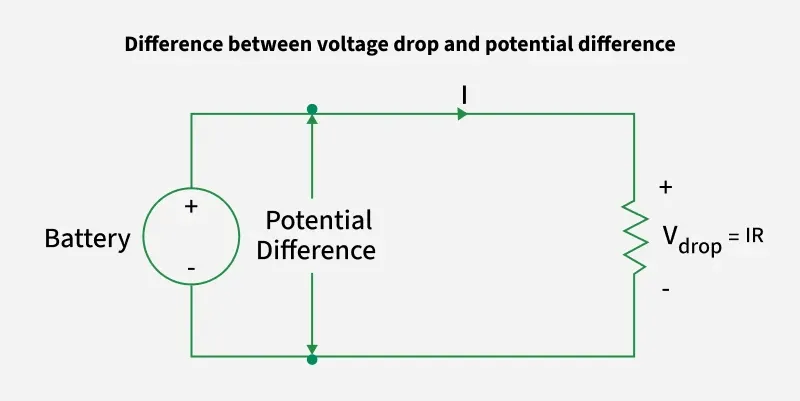
Voltage Drop is defined as the decrease in the electric potential along the path of current that is flowing in an electric circuit. Voltage drop can be assigned at each point in the electric circuit that is proportional to the electrical elevation.
- The amount of energy delivered per second to any component in the circuit is equal to the voltage drop from each point of the component's terminal.
- It can be measured across the circuit using a voltmeter.
Formula of Voltage Drop,
V = IR
where,
V = voltage
I = current in amperes (A)
R = Resistance in ohms (Ω)
What is Potential Difference?
Potential Difference is defined as the difference between two points in an electric circuit. In other words, it is the arithmetical difference between a higher voltage and a lower voltage. It is the amount of work done in moving a unit charge from one point to another point.
- It can be measured across the circuit using a voltmeter. Potential Differences between two points in an electric circuit can be known with help of a cell or battery.
- One volt is the potential difference between two points in an electric circuit carrying current when '1 Joule' of work is done to move a '1Coulomb' of charge from one point to another point.
Formula of Potential Difference,
V = W/Q
Where,
W = Work done in (Joules)
Q = Charge in (Coulombs)
1 Volt = 1 Joule/1 Coulomb.
Difference between Voltage Drop and Potential Difference
Voltage Drop | Potential Difference | |
|---|---|---|
| 1. | Voltage Drop is defined as the decrease in the electric potential along the path of current that is flowing in an electric circuit | Potential Difference is defined as the difference between two points in an electric circuit. In other words, it is the arithmetical difference between a higher voltage and a lower voltage. |
| 2. | Formula: V = IR | Formula: V = W/Q |
| 3. | It is the drop across a particular electrical circuit. | It is the difference between two points in a circuit. |
| 4. | It occurs due to an impeding element like resistors, capacitors and inductors. | It does not depend on resistors, capacitor or inductors |
| 5. | Voltage drop is the loss in the voltage due to impedance | Potential difference is the difference between voltage values at two different places. |
| 6. | Voltage drop occurs due to when there is a flow of electric current through the element. | Potential difference occurs due to there is no flow of current in the circuit. |
| 7. | Voltage drop means the amount of voltage by which the voltage across load resistor is less than the source voltage. | Potential difference means the difference in the amount of energy which carries the charge between two points of a circuit. |
Solved Examples
Example 1: A current of 6 A flies through a circuit that carries a resistance of 10 Ω. Find the voltage drop across the circuit?
Answer:
Given that,
I = 6 A.
R = 10 Ω.
Formula, V = IR
V = 6 × 10
V = 60 V
Therefore, voltage required for the circuit is 60 V.
Example 2: The bulbs of 30 Ω and 20Ω are connected in series and a current of 8A is flowing through the circuit. Find the voltage drop across the circuit.
Answer:
Given that R = 30 + 20 = 50Ω .
I = 8A
Formula, V = IR
V = 8 × 50 = 400 V
Therefore, voltage required for the circuit is 400 V.
Example 3: How much energy is consumed for 2coulombs of charge passing through a 10v battery.
Answer:
Given that, Q = 2C
V = 10V
Formula, V = W/Q
10 = W/2
W = 10 × 2 = 20 J
Therefore, the energy required is 20 J.
Example 4: On moving a charge of 25 coulombs, 5 J of work is done. Then calculate the potential difference between the two points.
Answer:
Given that,
Q = 25 C
W = 5 J
Formula, V = W/Q
V = 25/5 = 5
Therefore, the potential difference required is 5 V.
Example 5: Calculate the work done to move a charge of 6C between two points A and B if the points have a potential difference of 4 V.
Answer:
Given that.
Q = 6 C
V = 4 V
Formula, V = W/Q
4 = W/6
⇒W = 4 × 6 = 24J
Therefore, the work required to move the charge is 24J.
Conclusion
Voltage drop refers to the reduction in electric potential experienced by charge carriers as they move along the path of an electric current in a circuit. On the other hand, potential difference is the difference in electric potential between two points in a circuit, commonly referred to as voltage.
Related Reads,