
The attractive force between any two objects is directly proportional to the product of their masses and inversely proportional to the square of the distance separating them.
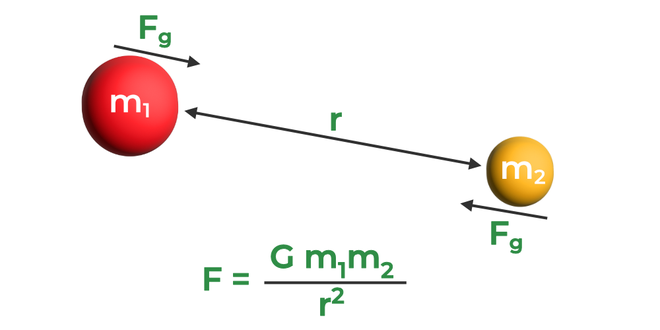
Newton's Law of Gravitation or Newton’s Law of Universal Gravitation (or Universal Laws of Gravitation) is the Law that leads to the further study of Gravitation and states that all the objects in the universe having any masses always attract each other with a force of attraction. This force of attraction is called the Gravitational Force (F) which is,
- Directly proportional to the product of the masses (m1 and m2) of the two objects in contact with other, and
- Inversely proportional to the square of the distance (r) between their centres.
The expression or the relation for the above-stated law is given by the gravitational force formula, discussed below:
Gravitational Force Formula
The Law of Gravitation gives the Gravitational Force (F) between two bodies of masses (m1 and m2) at a distance r, apart from their centers, is given as:
F ∝ m_1.m_2 F ∝ 1/r2
Now, combining the above two relations as,
F ∝ m1m2 / r2
F = Gm1m2 / r2
where G is the proportionality constant known as Gravitational Constant (= 6.67 ×10⁻¹¹N⋅ m2/kg2).
Gravitational Force Unit and Dimensional Formula
- SI unit of Gravitational Force is Newton (N).
- Dimensional Formula of Gravitational Force is [M1L1T-2].
Properties of Gravitational Force
Here are some important characteristic features of Gravitational Force,
- Gravitational forces are always attractive and the weakest of all the fundamental forces.
- It is a type of Non-Contact Force, as it does not require any physical contact or touch to be experienced by a system of objects.
- Gravitational Force is a Long-range force and does not require any medium.
- The Gravitational Force value at the surface of the Earth is constant.
Newton’s Thought Experiment on Gravitation
Sir Isaac Newton imagined a thought experiment to illustrate the function of Gravity beyond just objects falling to the ground. He visualized a cannon situated on top of a very tall mountain, high above the Earth's atmosphere, and thought about what would happen if it fired cannonballs with various speeds.
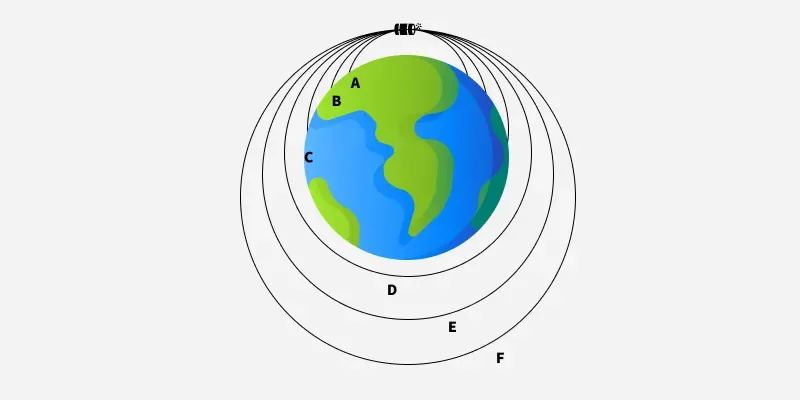
1. Firing at Low Speed:
When the cannonball is fired at a low speed, it will travel in a curved path and return back to Earth, similar to a regular projectile.
2. Firing at a Higher Speed:
If fired with increased speed, the cannonball will cover more distance before hitting the ground, since Earth’s curvature makes the surface "fall away" beneath it.
3. Firing at Just the Right Speed (Orbital Motion):
If the cannonball is fired quickly enough, it will continuously "fall" toward Earth without ever touching the surface. This is due to the Earth's surface curving away at the same rate. The cannonball will continue to travel in orbit around Earth, similar to how the Moon operates.
4. Firing Even Faster (Escape Velocity):
If the cannonball is fired at a higher speed, it will entirely escape Earth’s gravitational pull and move into outer space. This speed is called Escape velocity.
Significance of This Thought Experiment:
- Gravity draws objects toward the Earth, but if an object possesses sufficient sideways velocity, it will keep falling without ever touching down, creating an orbit.
- The Moon stays in orbit around Earth because it is constantly "falling" toward it while moving forward fast enough to avoid hitting the surface.
- Planets revolve around the Sun for the same reason—gravity pulls them toward it, but their motion keeps them from falling in.
Examples of Gravitational Force
Some everyday life examples of gravitational force can be discussed as,
1. Gravitational Force of Earth
Every object is subject to the gravitational pull of Earth, a phenomenon known as gravity. We cannot freely float in the air because of gravity, which keeps us on the ground. The force that the Earth and we both apply to the planet is equal. The Earth, however, remains unaffected because of its immense size. If a hung object is let go, it will fall naturally in the direction of the Earth's centre.
2. Gravitational Force Between Earth and Moon
Due to the gravitational pull of the Earth and the Moon, the Moon revolves around the Earth. To compute this force, we put their masses and the separation between their two centres into the gravitational force formula. Then, the gravitational force between the earth and the moon was found to be 2 × 10²⁰ N.
3. Gravitational Force of the Sun
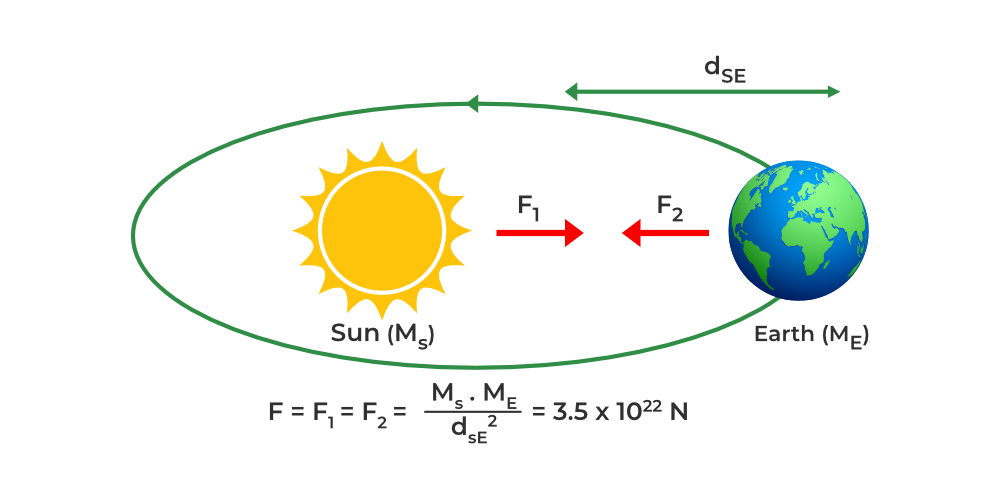
Because of its massive mass, the Sun exerts a gravitational force whose range is extremely wide. This attracting force causes all planets to orbit the Sun in an elliptical shape. The gravitational force formula can be used to determine the gravitational force acting on Earth from the Sun and was found to be 3.5 × 10²² N.
Difference between Gravity and Gravitational Force
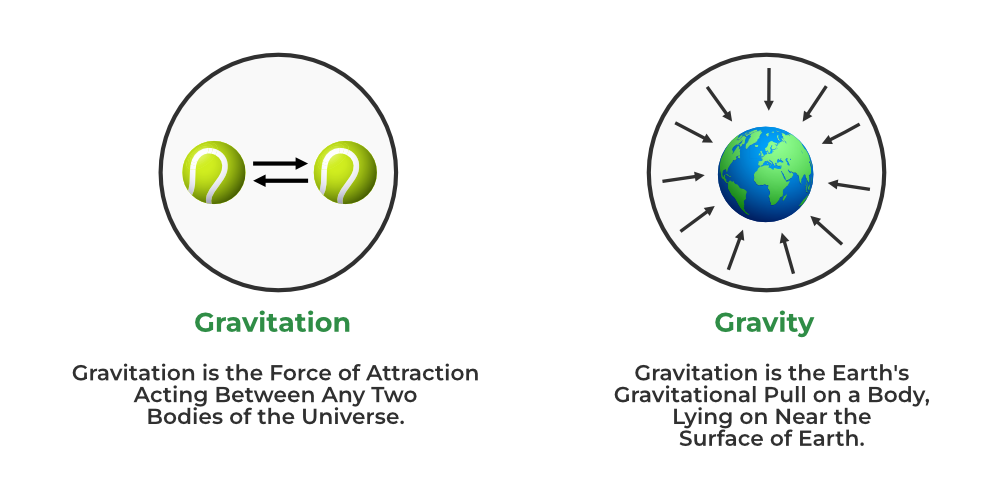
Let's discuss the key differences between gravity and gravitational force in detail as mentioned in the table below:
| Gravity | Gravitational Force |
|---|---|
| Force exerted by the Earth on objects near it | Force of attraction between any two masses in the universe |
| It is a special case of gravitational force | It is a universal force |
| Acts towards the center of the Earth | Acts along the line joining the centers of two masses |
| Example: An apple falling from a tree | Example: Attraction between Earth and Moon |
| Its value is often expressed using g (acceleration due to gravity) | Given by Newton’s law of gravitation |
| Depends mainly on Earth's mass and distance from its center | Depends on masses of both bodies and distance between them |
Related Article:
Solved Problems
Question 1: Find the gravitational force of attraction between two elephants, one of mass 1000 kg and the other of mass 800 kg, if the distance between them is 5 m.
Solution: Given: m1 = 1000 kg, m2 = 800 kg, r = 5 m
The formula for gravitational force is given as: Fg =
\frac{Gm_1m_2}{r^2} Here, G = 6.67 ×10⁻¹¹N⋅ m2/kg2
Substituting the values in the formula, we have:
Fg =
\frac{6.67 ×10^{−11}N⋅ m^2/kg^2)(1000 kg)(800 kg)}{5^2} Fg= 2.1 × 10⁻⁶ N
Question 2: Find the gravitational force of attraction between a man of mass of 50 kg and a bus of mass 1500 kg, if the distance between them is 10 m.
Solution: Given: m1 = 50 kg, m2 = 1500 kg, r = 10 m
The formula for gravitational force is given as: Fg =
\frac{Gm_1m_2}{r^2} Here, G = 6.67 ×10⁻¹¹N⋅ m2/kg2
Substituting the values in the formula, we have:
Fg =
\frac{6.67 ×10^{−11}N⋅ m^2/kg^2)(50 kg)(1500 kg)}{10^2} Fg = 5.0025 × 10⁻⁸ N
Question 3: Suppose the gravitational force between two bodies at a certain distance is 4 N. Find the force of attraction if the distance between them is doubled.
Solution: Newton’s law of gravitation states that the gravitational force between two point like objects is directly proportional to the product of their masses and inversely proportional to the square of the distance between them.
Fg =
\frac{Gm_1m_2}{r^2} Equation shows that, for given masses, if r is replaced by 2r, the force becomes 1/4th original force. Therefore, force of attraction will become 4/4 =1 N.
Question 4: The mass of the Earth is 6 × 1024 kg. The distance between the Earth and the Sun is 1.5 × 10¹¹m. If the gravitational force between the two is 3.5 × 10²²N, what is the mass of the Sun?
Solution: Given: me = 6 × 1024 kg, r = 1.5 × 10¹¹ m and F = 3.5 × 10²² N
Formula for gravitational force is given as: Fg =
\frac{Gm_1m_2}{r^2} .⇒ 3.5 × 10²² N =
\frac{6.67×10^{-11}×6×10^{24}×m_{sun}}{(1.5×10^{11})^2} ⇒ Mass of sun =
\frac{3.5×10^{22}×2.25×10^{22}}{40.02×10^{13}} = 1.967 × 1030 kg
Unsolved Problems
Question 1: Two bodies of mass 100 kg and 300 kg are placed 6 m apart. Find the gravitational force between them.
Question 2: The gravitational force between two objects is 9 N. What will be the force if the distance between them becomes half?
Question 3: Two objects attract each other with a force of 5 N when placed at a distance of 2 m. Find the force when the distance becomes 4 m.
Question 4: Two masses m1 = 400 kg and m2 = 600 kg are separated by a distance of 5 m. If the distance is increased by 3 m, calculate the new force and find the ratio of initial to final force.
Question 5: The gravitational force between two bodies is 20 N when the distance is 2 m. If the masses of both bodies are doubled and the distance is also doubled, find the new force.