A Wheatstone Bridge is an electrical instrument used to measure an unknown resistance accurately.
It works by balancing two arms of a bridge circuit. When the bridge is balanced, no current flows through the galvanometer, and the unknown resistance can be calculated. Due to its high accuracy and sensitivity, it is also known as a resistance bridge.
Working Principle
The Wheatstone Bridge works on the principle of null deflection, which means that no current flows through the galvanometer when the bridge is balanced, and hence the galvanometer shows no deflection.
In an unbalanced condition, there is a potential difference across the galvanometer, causing it to deflect. As the variable resistor is adjusted, the bridge gradually reaches a balanced state. At this point, the potential difference across the galvanometer becomes zero, no current flows through it, and the bridge is said to be in equilibrium.
Construction
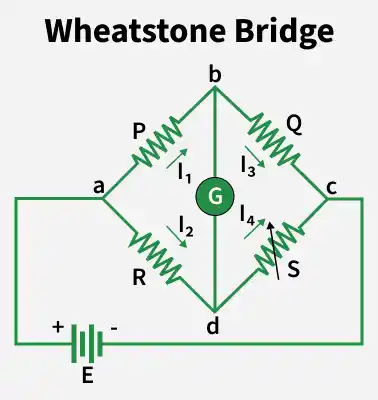
A Wheatstone Bridge is constructed using four resistors, P, Q, R, and S, which are arranged along the four sides AB, BC, AD, and DC of a quadrilateral ABCD. A cell E, along with a key K1, is connected between points A and C, while a sensitive galvanometer G with key K2 is connected between points B and D.
Point A is at the potential of the positive terminal of the cell, and point C is at the potential of the negative terminal. When key K2 is open, resistors P and Q are connected in series, and similarly, R and S are also in series. These two combinations (arm ABC and arm ADC) are connected in parallel with each other.
Since the galvanometer is connected across the diagonal BD, forming a bridge between the two arms, the arrangement is known as a Wheatstone Bridge.
When the bridge is in an equilibrium state, that is, there is no deflection in the galvanometer. That is, in the equilibrium state of the bridge, the ratio of the resistances of any two adjacent arms is equal to the ratio of the remaining two adjacent sides.
Derivation
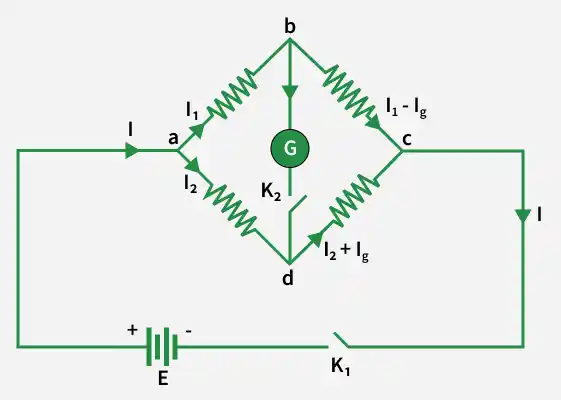
When the cell key K1 is pressed, a current III flows through the circuit and splits at point A into two parts: I1 through resistance P (arm AB) and I2 through resistance R (arm AD).
At point B, current I1 further divides into two parts: Ig through the galvanometer (arm BD) and (I1 − Ig) through resistance Q (arm BC). At point D, currents I2 and Ig combine, so the current through resistance S (arm DC) becomes (I2 + Ig).
Applying Kirchhoff’s laws:
For loop ABDA:
I1P + IgG - I2R = 0 . . . (1)
For loop BCDB:
(I1 - Ig)Q - (I2 + Ig)S - IgG = 0 . . . (2)
In the balanced (equilibrium) condition of the Wheatstone Bridge, no current flows through the galvanometer, so Ig = 0.
Substituting Ig = 0 in equations (1) and (2):
I1P = I2R
I1Q = I2S
Dividing the above equations:
\frac{I_1 P}{I_1 Q} = \frac{I_2 R}{I_2 S}
\frac{P}{Q} = \frac{R}{S}
Thus, in the balanced condition of the Wheatstone Bridge, the ratio of resistances of two arms is equal to the ratio of the other two arms.
Wheatstone Bridge Formula
The Wheatstone Bridge Formula for the calculation of the unknown resistor is as follows:
R = \frac{PS}{Q}
where,
P and Q are the resistance of ratio arm
S is the known resistance of the standard arm
R is the unknown resistance
Applications
Measurement of Resistance: The primary use of the Wheatstone Bridge is to measure unknown resistances with high accuracy.
Meter Bridge: A practical application of the Wheatstone Bridge, the meter bridge allows measurement of unknown resistance using simple materials and a galvanometer.
Measurement of Capacitance, Inductance, and Impedance: With suitable modifications, the Wheatstone Bridge can measure electrical quantities such as capacitance, inductance, and impedance.
Measurement of Physical Parameters: Combined with operational amplifiers, the Wheatstone Bridge can measure various physical quantities like temperature, strain, and light intensity.
Calibration and Laboratory Experiments: It is commonly used in labs for calibration of instruments and experimental determination of electrical parameters.
Limitations
Unsuitable for Very Low Resistances: The bridge is not ideal for measuring very low resistances because the resistance of connecting leads and contacts can introduce significant errors. For such cases, a Kelvin’s Double Bridge is preferred.
Unsuitable for Very High Resistances: For high-resistance measurements (in megaohms or gigaohms), the resistance of the bridge itself becomes very high, making the galvanometer extremely sensitive to minor imbalances. This limits its practical use for very high resistances.
Temperature Dependence: The resistance of conductors varies with temperature. The heating effect of current can change the conductor’s resistance, leading to measurement errors. For high currents, this error can become significant, which is a limitation in the design of the Wheatstone Bridge.
Current Limitation: Excessive current through the bridge can heat the components, further affecting accuracy.
Solved Problems
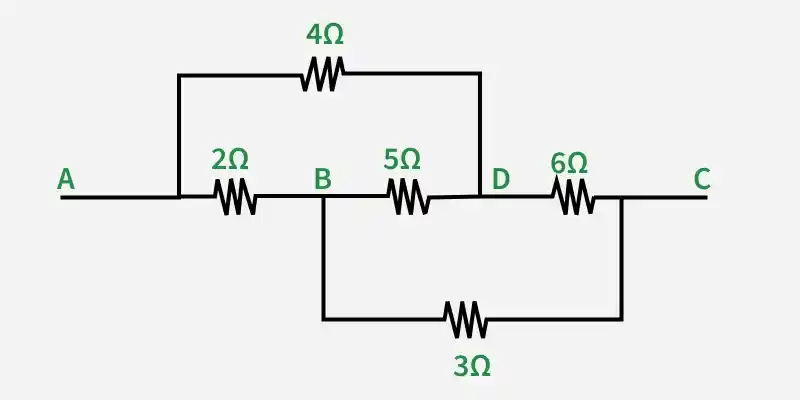
Question 1: Find the equivalent resistance between points A and C in the circuit shown in the figure below:
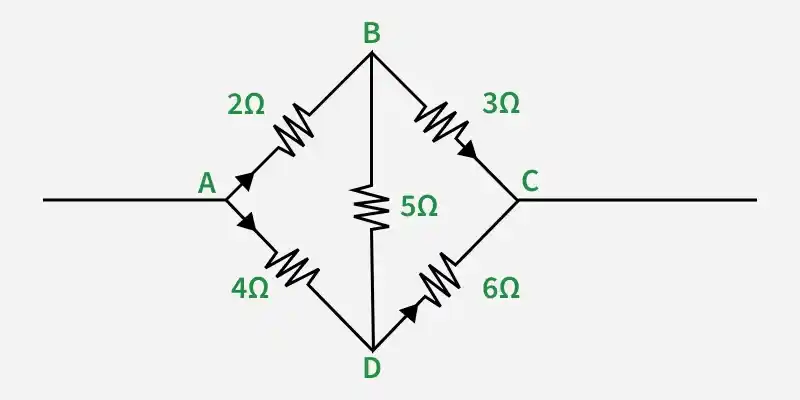
Solution: The equivalent circuit of the circuit shown in the above figure is given as:
Since, 2/3 = 4/6
This is the circuit of a balanced Wheatstone bridge.
In the balanced state, VB = VD (where V represents potential)
So no current will flow through the 5 Ω resistance.
Now the equivalent resistance of sides AB and BC is R' = 2 + 3 = 5 Ω.
The equivalent resistance of AD and DC arm R" = 4 + 6 = 10 Ω
If the equivalent resistance between the points A and C is R, and R is parallel combination of resistance R' and R",
⇒ 1 / R = (1 / R') + (1 / R'')
⇒ 1/R = (1/5) + (1/10)
⇒ 1/R = (2 + 1) / 10
⇒ R = 10/3
⇒ R = 3.33 Ω
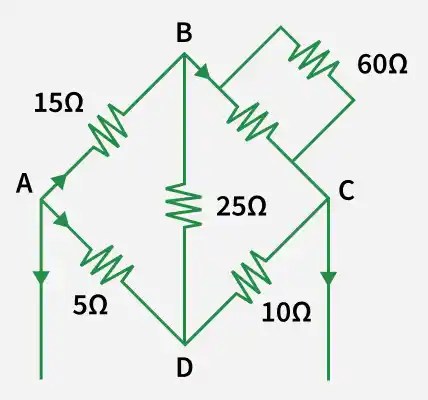
Question 2: The electric circuit of a balanced Wheatstone bridge is shown in Figure. Calculate the resistance x.
Solution: Let the total resistance in arm BC be R. Since the bridge is balanced, therefore:
15/R = 5/10
⇒ R = (15 × 10)/5 = 30 Ω
Now, as R is parallel combination of 60 Ω and X.
⇒ 1/R = (1/X) + (1/60)
⇒ 1/30 = 1/X + (1/60)
⇒ 1/X = 1/30 - 1/60
⇒ 1/X = (2 - 1)/60 = 1 / 60
⇒ X = 60 Ω
Question 3: What is a Meter Bridge and what kind of precautions dowe need to perform measurements using a Meter Bridge?
Solution: A Meter bridge is a device based on the principle of the Wheatstone bridge, with the help of which the resistance and specific resistance of a conductor can be determined. In this, a 1-meter long wire acts as the proportional side.
Precautions while using Meter Bridge are:
The ends of all the connection wires should be cleaned with sandpaper.
The current should not flow in the circuit for a long time otherwise, its resistance increases due to the heating of the bridge wire. Therefore, the key in the cell circuit should be plugged in only when observations are to be made.
The jockey should not be run by rubbing it on the meter bridge wire otherwise, the thickness of the wire will not remain the same at all places.
A shunt with a galvanometer should be used initially while adjusting, but the shunt should be removed near the position of zero deflection.
Only such a resistance plug should be removed from the resistance box so that the position of zero deflection is approximately in the middle of the bridge wire. In this case, the sensitivity of the bridge is maximum and the percentage error is minimum.
All other plugs in the resistance box, except those that have been removed, should be tightly packed.
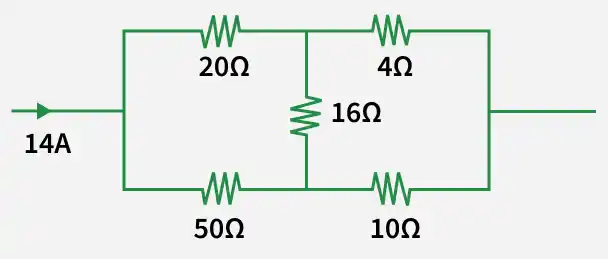
Question 4: In the following figure, find the current through the 4Ω resistor (Given:- total current flowing in the circuit is 14 ampere) ?
Solution: Since, Q / P = S / R
⇒ 4 / 20 =10 / 50
It is an example of balanced wheat-stone bridge.
So, No current will flow through 16 Ω resistance.
As we know that current divide in inverse ratio, current through 4Ω resistance is,
= (50+10) : (20+4) = (60:24) = 5:2
Therefore Current would divide in the ratio 5:2 i.e, 5 units flow in the top branch and 2 units in the bottom branch of the total current
Now,
Current across 4Ω resistor = 14 x 5/ (2+5) = 10 A
Unsolved Problems
Question 1: A Wheatstone Bridge has resistances P = 30 Ω, Q=20 Ω and R=15 Ω. Find the unknown resistance S when the bridge is balanced.
Question 2: Explain the working principle of a Wheatstone Bridge. Why is it called a null deflection instrument?
Question 3: In a Wheatstone Bridge, if the galvanometer shows zero deflection when P/Q=R/S, prove that this condition gives the balanced state of the bridge.
Question 4: A Wheatstone Bridge is used to measure an unknown resistance. When the resistances in the adjacent arms are interchanged, the balance point shifts. Explain why this shift occurs and how the unknown resistance can still be determined.
Question 5: Describe the construction of a Wheatstone Bridge, mentioning the placement of the resistances, cell, and galvanometer, and explain how it is used to measure an unknown resistance.