
In rotational motion, the concepts of torque and angular momentum play roles similar to force and linear momentum in linear motion. These quantities describe how forces cause rotation and how rotational motion changes when they act on a body.
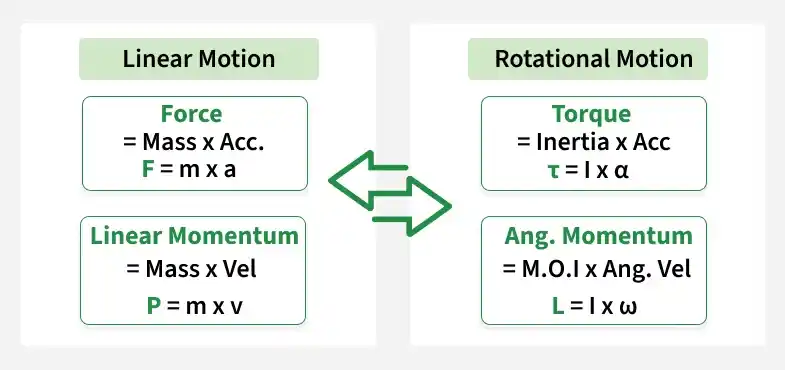
Torque
Torque is a measure of the tendency of a force to rotate an object about an axis or pivot point. It depends on three factors:
- Magnitude of the applied force
- Perpendicular distance from the axis of rotation to the line of action of the force
- Angle between the force and the position vector
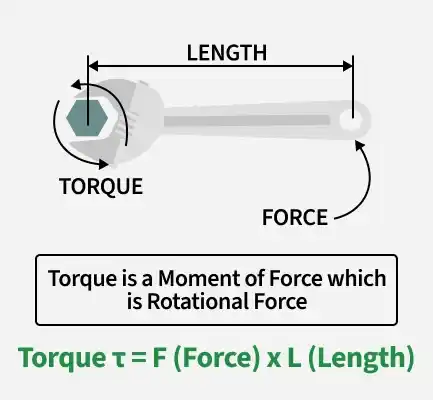
Mathematically, torque is defined as the vector cross product of the position vector and the applied force.
\boxed {\overrightarrow{\tau} = \overrightarrow{r} \times \overrightarrow{F}}
where
- 𝜏 = torque
- r = position vector from the axis of rotation to the point where the force is applied
- F = applied force
The magnitude of torque is
where θ is the angle between r and F
The SI unit of torque is the newton–meter (N·m).
The direction of torque is determined using the right-hand rule.
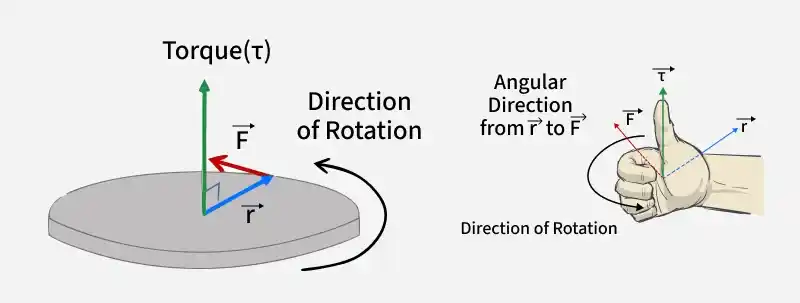
Lever Arm Concept
Torque can also be written using the perpendicular distance from the axis of rotation to the line of action of the force, known as the lever arm.
where l is the perpendicular distance.
This explains why applying force farther from the pivot produces greater rotation.
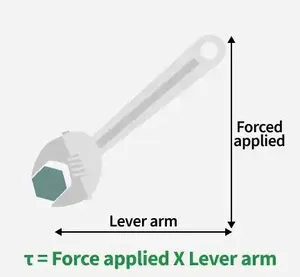
Examples
- Opening a door using the handle instead of pushing near the hinge
- Using a long wrench to loosen a tight bolt
- Pedaling a bicycle crank
Angular Momentum
Angular momentum is the rotational analogue of linear momentum. It describes the quantity of rotational motion possessed by a particle or rigid body.
For a particle, angular momentum about a point is defined as
where
- L = angular momentum
- r = position vector
- p = m.v = linear momentum
For circular motion,
If velocity is perpendicular to the radius (uniform circular motion),
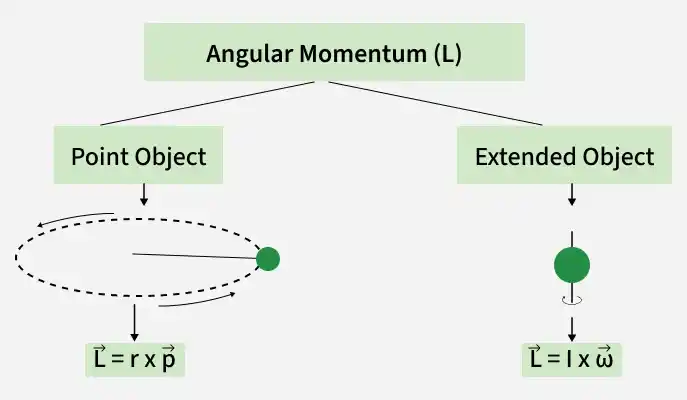
Angular Momentum of a Rigid Body
For a rigid body rotating about a fixed axis,
where
- I = moment of inertia
- 𝛚 = angular velocity
The SI unit of angular momentum is kg·m²/s.
Relationship Between Torque and Angular Momentum
Torque equals the rate of change in angular momentum.
This is the rotational form of Newton's second law.
If moment of inertia is constant,
If a moment of inertia changes:
Conservation of Angular Momentum
If the net external torque on a system is zero, the total angular momentum remains constant.
Examples
1. Spinning Skater: When a skater pulls their arms inward, the moment of inertia decreases. To conserve angular momentum, angular velocity increases.
2. Planetary Motion: In orbital motion, gravitational force acts along the radius vector, producing zero torque. Therefore, angular momentum remains constant. This principle leads to Kepler's Second Law—planets sweep equal areas in equal times.
Applications
- Rotating machinery and engines
- Gyroscopes and stabilization systems
- Satellite motion and orbital mechanics
- Rolling motion of rigid bodies
Solved Examples
Example 1: A force of 10 N is applied perpendicular to a rod of length 0.5 m. Find the torque.
Solution: 𝝉= rF sinθ
- r = 0.5 m
- F = 10N
- 𝜃 = 90°
𝜏 = 0.5 x 10 x 1
𝜏 = 5 N.m
Example 2: A particle of mass 2 kg moves in a circle of radius 3 m with speed 4 m/s. Find angular momentum.
Solution L = mvr
L = 2 x 4 x 3
L = 24 kg m2/s
Example 3: A disc with moment of inertia 4 kg ·m² rotates with angular velocity 5 rad/s. Find its angular momentum.
Solution: L = I.𝜔
L = 4 x 5
L = 20 kg,m2/s
Example 4: A torque of 6 N·m acts on a wheel with a moment of inertia of 3 kg. ·m². Find angular acceleration.
Solution: 𝜏 = I 𝛼
6 = 3 𝛼
𝛼 = 2 rad/s2
Example 5: A skater reduces their moment of inertia from 6 kg·m² to 2 kg. ·m². If initial angular velocity is 2 rad/s, find final angular velocity.
Solution: Using conservation of angular momentum:
I1 ω1 = I2 ω2
6 x 2 = 2 x ω2
ω2 = 6 rad/s
Unsolved Problems
Problem 1: A force of 15 N acts at a distance of 0.4 m from a pivot at an angle of 60°. Calculate the torque.
Problem 2: A particle of mass 3 kg moves in a circle of radius 2 m with speed 5 m/s. Find its angular momentum.
Problem 3: A rotating wheel has a moment of inertia of 5 kg. ·m² and angular velocity 8 rad/s. Calculate its angular momentum.
Problem 4: A torque of 10 N·m acts on a body with a moment of inertia of 2 kg. ·m². Find the angular acceleration.
Problem 5: A rotating platform has a moment of inertia of 10 kg. ·m² and angular velocity 3 rad/s. A person standing on it pulls their arms inward, reducing the moment of inertia to 5 kg. ·m². Find the new angular velocity.