
Thermal conductivity is the property of a material that measures its ability to conduct heat.
- Defined as the amount of heat flowing per unit time through a unit area of a material when the temperature difference per unit length is unity.
- Indicates how easily heat is transferred through a substance from a higher temperature region to a lower temperature region.
- Denoted by k (also written as λ or κ).
- The SI unit of thermal conductivity is W m⁻¹K⁻¹.
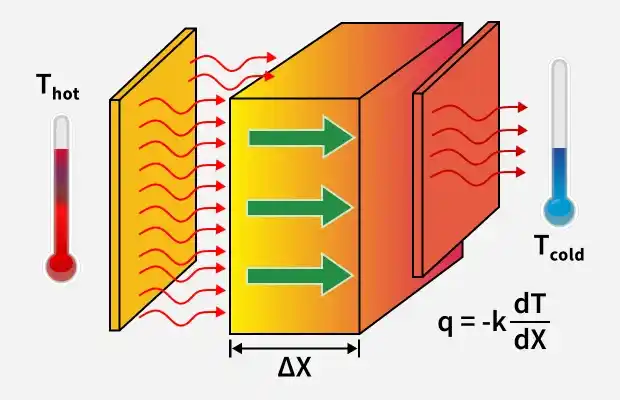
Fourier’s Law of Heat Conduction
\frac{Q}{t} = kA \frac{\Delta T}{L} where,
- Q/t = rate of heat transfer
- k = thermal conductivity
- A = area of cross-section
- ΔT= temperature difference
- L = thickness of material
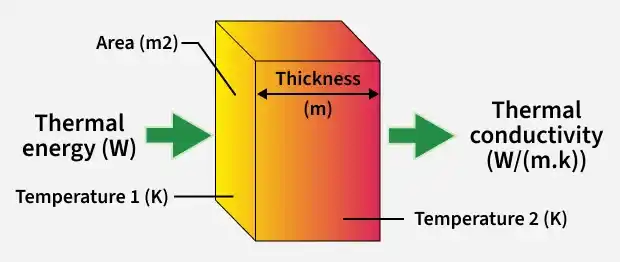
Thermal Conductivity Measurement
Thermal conductivity is measured by determining the rate of heat flow through a material under a known temperature difference. A temperature gradient is applied, and heat flow is recorded to calculate its value.
Common methods include the Guarded Hot Plate method and the Heat Flow Meter method, which require proper calibration for accurate results. This measurement is important in selecting materials for construction, electronics, and thermal management systems.
Steady-State Techniques of Thermal Conductivity
- In steady-state conditions, the temperature at every point of the material remains constant with time.
- A constant temperature difference is maintained across the material.
- Heat flows steadily from the higher temperature region to the lower temperature region.
- After thermal equilibrium is reached, the temperature distribution does not change with time.
- Methods like the Guarded Hot Plate method are used to measure thermal conductivity under steady conditions.
Transient Techniques of Thermal Conductivity
Transient techniques are methods used to measure thermal conductivity when the system is not in steady state. In these methods, the temperature of the material changes continuously with time after a sudden heat input is given. The heat flow is not constant, and the temperature response is used to study how heat spreads through the material.
- In these methods, temperature changes with time.
- A sudden heat pulse or temperature change is applied.
- Heat propagation is observed through time-dependent temperature variation.
- Methods like Laser Flash Analysis are commonly used.
Effect of Temperature on Thermal Conductivity in Metals
- In metals, thermal conductivity generally decreases with an increase in temperature due to increased lattice vibrations.
- Higher temperature increases scattering of free electrons, which reduces heat flow.
- Free electrons are the main carriers of heat in metals, so their motion is affected at higher temperatures.
- Thus, the overall efficiency of heat transfer in metals reduces as temperature increases.
Effect of Temperature on Thermal Conductivity in Non-Metals
- In nonmetals, thermal conductivity generally increases with an increase in temperature due to greater molecular vibrations.
- Heat is mainly conducted through lattice vibrations (phonons), which become more active at higher temperatures.
- In some materials, temperature changes can significantly affect the structure, especially during phase changes (solid, liquid, gas), altering heat transfer.
- Impurities and defects in the structure can affect how heat is conducted, and this effect may vary with temperature.
- Overall, thermal conductivity in non-metals depends strongly on molecular structure and temperature conditions.
Factors Affecting Thermal Conductivity
Thermal conductivity of a material depends on its internal structure and external conditions. It varies because different materials have different abilities to transfer heat through particles like electrons and lattice vibrations.
- Thermal conductivity depends on the nature and structure of the material (metal, non-metal, crystal, etc.).
- It changes with temperature due to variation in lattice vibrations and scattering of heat carriers.
- Impurities and defects reduce thermal conductivity by disturbing heat flow.
- In crystalline materials, it may be direction-dependent (anisotropic nature).
- Porous materials generally have low thermal conductivity because air trapped inside acts as an insulator.
Solved Problems
Question 1: A slab has thermal conductivity k = 200 W/(m⋅K), area A = 2 m, thickness L = 0.5 m, and temperature difference ΔT = 20 K. Find the rate of heat flow.
Solution: Formula:
\frac{Q}{t} = kA \frac{\Delta T}{L}
\frac{Q}{t} = 200 \times 2 \times \frac{20}{0.5}
\frac{Q}{t} = 16000 \, W
Question 2: A material has k = 50 W/(m⋅K), A = 1 m, L = 0.2m, ΔT = 10 K. Find heat flow rate.
Solution: Formula:
\frac{Q}{t} = kA \frac{\Delta T}{L}
\frac{Q}{t} = 50 \times 1 \times \frac{10}{0.2}
\frac{Q}{t} = 2500 \, W
Question 3: Find thermal conductivity if heat flow rate is 100 W, area = 1 m², thickness = 0.5 m, and temperature difference = 20 K.
Solution: Formula:
k = \frac{Q L}{A t \Delta T}
k = \frac{100 \times 0.5}{1 \times 20}
k = 2.5 \, W/(m \cdot K)
Question 4: A slab has k = 10 W/(m⋅K), A = 3 m2, L = 0.3 m, and ΔT = 30 K. Find heat flow rate.
Solution: Formula:
\frac{Q}{t} = kA \frac{\Delta T}{L}
\frac{Q}{t} = 10 \times 3 \times \frac{30}{0.3}
\frac{Q}{t} = 3000 \, W
Unsolved Problems
Question 1: A slab has thermal conductivity k = 150 W/m⋅K, area A = 3 m, thickness L = 0.6m, and temperature difference ΔT = 30 K. Find the rate of heat flow.
Question 2: A material of area 2 m2 and thickness 0.4m conducts heat at a rate of 4000 W when the temperature difference is 20 K. Find its thermal conductivity.
Question 3: A wall has thermal conductivity k = 0.8 W/m⋅K. If heat flow rate is 160W, area is 4m2, and thickness is 0.5m, find the temperature difference across the wall.
Question 4: A slab of thickness 0.25m and area 1.5 m has thermal conductivity 50 W/m⋅K. If the temperature difference is 40K, find the heat flow rate.