
Mechanics is a fundamental branch of Physics that explores how objects move when forces or displacements are applied, as well as how these objects interact with and impact their surroundings. It can be divided into two main areas: statics, which studies objects at rest, and dynamics, which focuses on moving bodies. When a car accelerates on a highway, its motion is influenced by forces such as friction, air resistance, and the engine's power, all of which also affect the road surface and the environment.
The steps involved in solving a mechanical problem are as follows:
1. Draw a Free-Body Diagram
Sketch the system, isolating the relevant part, and show all external forces acting on it.
2. Pick a Coordinate System
Choose a coordinate system that aligns with the expected direction of motion to simplify the problem.
3. List All Forces Acting on the Body
Identify all known forces, including their magnitude and direction.
4. Break Down the Forces
Resolve the forces into components according to the selected coordinate system.
5. Use Newton’s Laws
Apply Newton’s Laws to solve for unknown forces and determine the system's behaviour.
6. Repeat the Steps for Other Systems
If multiple systems are involved, apply the same method to each one consistently.
Laws Of Mechanics
Newton’s Laws of Motion play a important role in solving mechanical problems, especially when multiple forces interact. It’s uncommon for just a single force to act on an object in mechanical systems; instead, these systems usually involve several bodies exerting forces on one another while being influenced by gravity.
When tackling such problems, it is important to apply Newton’s Laws to any selected part of the system. This specific part, known as the "system," should be isolated, while everything else that affects it such as external forces and interactions is considered the “environment.”
By doing this, we can focus on how the forces within the system interact and how the environment influences the system's behavior, allowing us to solve the problem step by step.
Newton's First Law of Motion
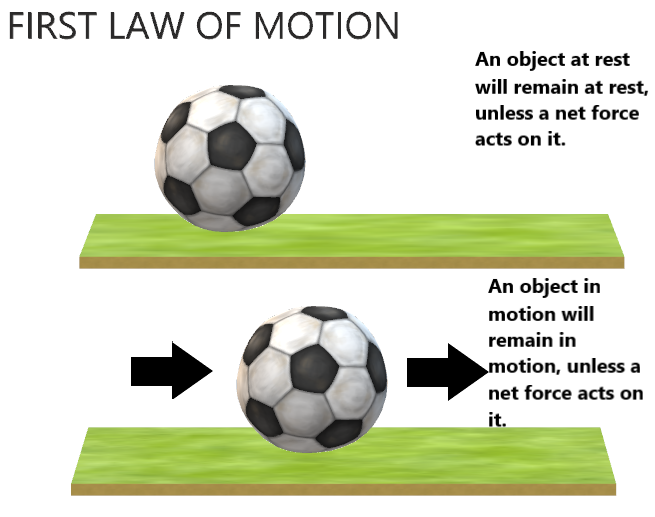
Newton's First Law of Motion, or the Law of Inertia, states that an object will remain at rest or move with constant velocity unless acted upon by a net external force. This law is also known as law of inertia. If the net external force on a body is zero, its acceleration is zero. Acceleration can be non-zero only if there is a net external force on the body.
Formula,
Σ F = 0
⇒ dv/dt = 0
where, "F" is the force (summation of "F" means net force being applied) and "v" is the velocity of the object.
Newton’s First Law of Motion’s Applications
- A rolling football eventually stops due to the friction force on the ground. ( Change in State: Motion to rest , Force Applied: Friction).
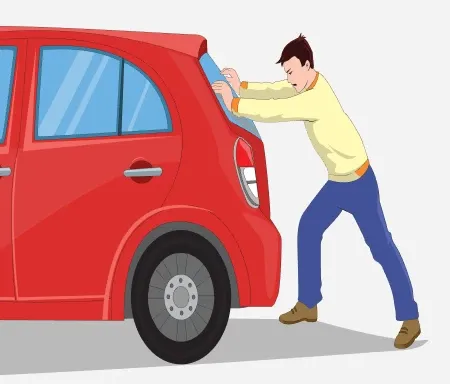
- A car parked on a level surface will remain stationary until an external force, such as a push, is applied, In this picture a person applied a force on car but the car didn’t move.
Newton's Second Law of Motion
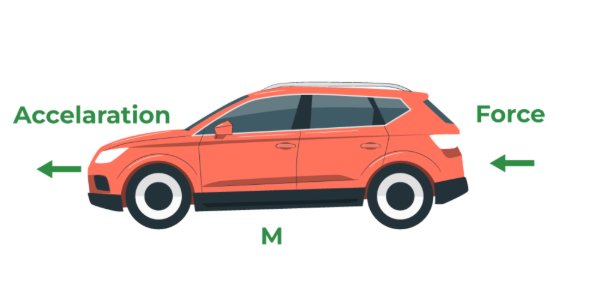
Newton's Second Law of Motion states that the force acting on an object is equal to its mass multiplied by its acceleration. This law is also known as law of momentum. The rate of change of momentum of a body is directly proportional to the applied force and takes place in the direction in which the force acts.
Formula,
F = dp/dt
where, "dp" is the change in the momentum wrt change in time "dt".
Newton’s Second Law of Motion’s Applications:
- A person is pushing a shopping cart, the harder he push (more force), the faster it rolls (accelerates).

- A car's acceleration depends on the engine's force and the car's mass. A sports car (less mass) accelerates faster than a truck (more mass) when the same amount of force is applied.
Newton's Third Law of Motion
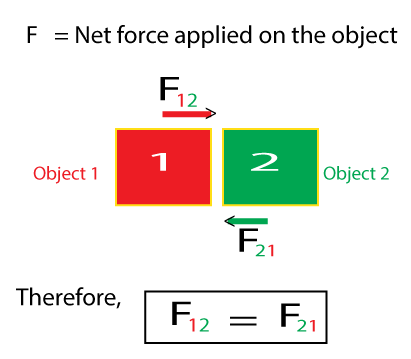
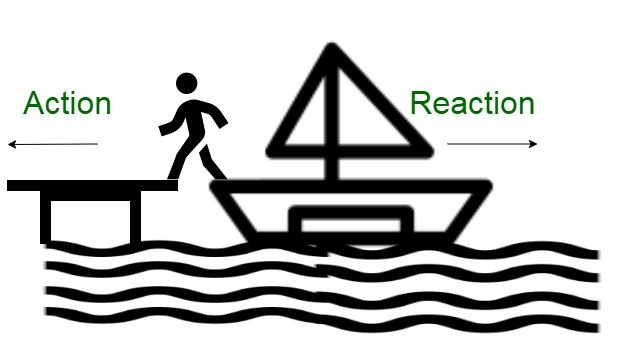
Newton's Third Law of Motion states that for every action, there is an equal and opposite reaction.This law is also known as law of action and reaction. Whenever one object exerts a force on another object, the second object exerts an equal and opposite on the first.
Formula,
FA = -FB
F12 = F21
Newton’s Third Law of Motion’s Applications:
- Recoil of the gun when a bullet is fired is an example of Newton's Third Law of Motion.

- When you push off the boat to jump onto the dock, the force you apply to the boat causes a reaction where the boat pushes back on you with an equal and opposite force. This mutual interaction causes the boat to move backward as you move forward.
Inertia
A passenger in a car experiences inertia when the car suddenly stops. The car comes to a halt due to the brakes, but the passenger's body continues moving forward at the same speed until the seatbelt or another force acts on them to stop them.
Inertia is the inherent property of an object that resists any change in its state of rest or uniform motion along a straight path unless an external force compels it to change. The mass of an object is directly related to its inertia means a larger mass means more inertia, making it harder to accelerate or decelerate the object. Therefore, objects with greater mass resist changes in motion more than objects with smaller mass.
Friction
The property which opposes the relative motion of the body over the surface of another body is called friction.
Formula,
F = μ N
where, "μ" is the coefficient of friction and "N" is the normal force.
Example:
- Rubbing hands together generates heat due to friction between the skin surfaces.
- Climbing a ladder is made possible by the friction between your shoes and the ladder rungs.
Solved Examples
Question 1 : A 2000 kg of thespaceship is moving in space with a constant velocity of 1200 m/s. What is a net force acting on the spaceship (there is no gravitational force acting on the spaceship).
Answer:
Newton's first law of motion states that object remains in a motion until unless any external force is not acting on a object.In a space there is vacuum and there is no external air resistance.Hence, spaceship will travel at constant velocity of 1200 m/s with zero acceleration.
Since, m= mass of spaceship = 2000 kg
a= acceleration of spaceship = 0
∑F = m×a
= 2000 × 0
= 0 N
Hence, net force is acting on a spaceship is 0 N.
Question 2 : If a car of mass 200 kg is moving with an acceleration of 5 m/s2,then what will be the net force of a car?
Answer:
Given that,
Mass of a car = Mc = 200 kg
Acceleration of a car = ac =5 m/s2
Using formula F = Mc × a
= 200 × 5
= 1000 N
Therefore, the net Force is 1000 N.
Question 3 : A batter hits back a ball straight in the direction of the bowler with a velocity of 20 m/s and the initial velocity of the ball was 12 m/s.If the mass of the ball is 0.10kg. Determine the change in momentum on the ball.
Answer :
Given that,
Initial velocity of the ball = 12 m/s
Final velocity of the ball = 20 m/s
Mass of the ball = 0.10kg
Change in momentum = final momentum - initial momentum
= m×v2 - m×v1
= 0.10×20 - (-0.10×12) (ball again is in the direction from the batsman to the bowler)
= -3.2 N.s
Therefore, the change in momentum is -3.2 N.s.
Question 4: During training,a policeman fired a bullet from his gun on a wooden block,now a bullet of mass 10 gm is moving at 400 m/s penetrates 4 cm into awooden block before coming to rest.Assuming that theforce exerted by the wooden block is uniform,find the magnitude of force?
Solution:
Given that,
Mass of the bullet = Mb = 10 gm = 0.010 kg
Penetration of bullet before coming to rest = s = 4 cm = 0.04 m.
Initial velocity of bullet = Vi=400 m/s
Final velocity of bullet = Vf = 0 m/s
Here, wooden block will exert force opposite in the direction of velocity,therefore this force causes deceleration. Hence a be the deceleration in this case (-a)
By using kinematic equation,
(Vf)2 = (Vi)2 + 2as ------(1)
0 = (400)2 - 2 × a × 0.04
a = ( (400)2 - 0 ) / 2 × 0.04
= 160000 / 0.08
= 2000000
The force on the bullet = Mb × a
= 0.01 × 2000000
= 20000 N
Question 5: A box of mass 100 kg is placed on a floor exerting some force on the floor.Determine what force does the floor exerting on the box? ( Here g= 9.81 m/s2 ).
Answer:
According to Newton's third law motion,every action there is equal and opposite reaction.Hence the force exerted by the floor on the box will be the weight of box.
Given that,
Mass of box = M = 100 kg.
weight of the box = M × g
= 100 × 9.81
= 981 N
The force exerted by the floor on the box = -981 N
This Negative sign indicates that force applied by floor is in opposite direction of force applied by the box.
Therefore, the Force applied by the floor is equal to 981 N.
Conclusion
A structured approach is essential for solving mechanics problems. Begin by sketching a free-body diagram of the system, followed by selecting an appropriate coordinate system. Identify all the forces acting on the system and resolve them accordingly. Lastly, apply Newton's Laws of Motion to analyze the system's behavior. This method ensures clarity and helps in breaking down complex problems into manageable steps for accurate solutions.