
The refractive index is a measure of how much light slows down when it passes from vacuum into a material medium. It also indicates how much the light ray bends when entering the medium. In simple terms, it tells us how strongly a material affects the path and speed of light.
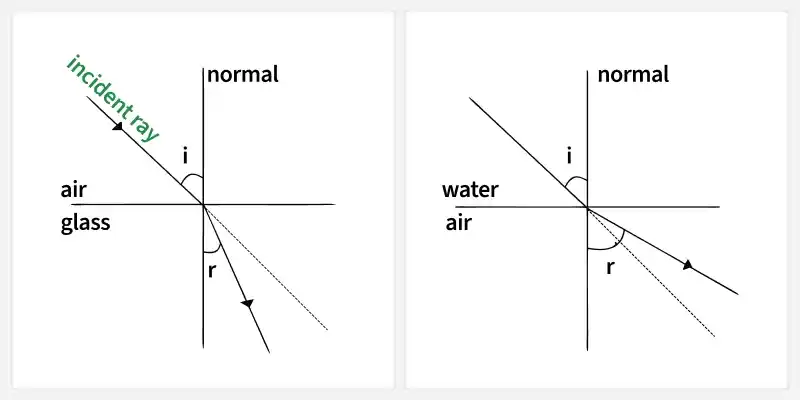
The refractive index of a medium is defined as the ratio of the speed of light in vacuum to the speed of light in that medium.
\boxed {n = \frac{c}{v}}
- n = refractive index
- c = speed of light in vacuum (3 x 10⁸ m/s)
- v = speed of light in the medium
Characteristics of Refractive Index
- When light travels from a denser to a rarer medium, it bends away from the normal.
- It is a dimensionless quantity.
- A higher refractive index means lower speed of light in that medium.
- It determines the bending (refraction) of light.
- It gives an idea about the optical density of a medium.
Types of Refractive Index
1. Absolute Refractive Index
The absolute refractive index of a medium is defined as the ratio of the speed of light in vacuum to the speed of light in that medium. It is represented by n and is given by:
n = \frac{c}{v} where
c is velocity of the light in vacuum
v is velocity of light in the provided medium
The velocity of light in vacuum is 3 × 10⁸ m/s. Since the speed of light in air is almost the same, it is generally taken as 3 × 10⁸ m/s for practical calculations. The absolute refractive index gives an idea about the optical density of a material.
The table gives an idea about the absolute refractive indices of different mediums.
Material | Refractive Index |
|---|---|
| Air | 1.0003 |
| Water | 1.33 |
| Diamond | 2.417 |
| Ice | 1.31 |
| Ethyl Alcohol | 1.36 |
A medium with a higher refractive index is optically denser, while one with a lower refractive index is optically rarer. However, optical density is different from mass density. Example: kerosene is less dense than water in terms of mass, but it is optically denser because its refractive index (1.44) is higher than that of water (1.33).
2. Relative Refractive Index
The relative refractive index refers to the refractive index of one material medium with respect to another one. The given velocities of light in different media can give the relative refractive index by the following also where the first medium is not a vacuum:
\boxed {n_{21} = \frac {v_1}{v_2}} where
n21 is refractive index of the speed of light in material medium 2 with respect to the velocity of light in medium 1
Similarly,
\boxed {n_{12} = \frac {v_2}{v_1}} where
n12 is refractive index of the speed of light in material medium 1 with respect to the velocity of light in medium 2
On travelling from a rarer to a denser medium, a light ray bends towards normal and vice versa, and on travelling from denser to rarer it bends away from normal. As can be observed and seen that the refractive index of ice is lower than that of kerosene so the light ray after travelling from ice to kerosene has bent towards the normal and so their ratio can give us the relative refractive index.
Importance of High Refractive Index in Optical Materials
A high refractive index allows light rays to bend more within a material, enabling lenses to achieve the required optical power with less curvature. As a result, the thickness of the lens decreases, making it thinner and lighter. This is especially useful in optical polymers, as it improves comfort, appearance, and ease of use without affecting performance.
Refractive Index Gradient
Refractive Index Gradient is the rate of change of the refractive index with respect to the distance travelled in the optical material. The refractive index gradient is expressed as the reciprocal of a unit of distance.
Refractive Index Gradient is the rate of change of refractive index at any point with respect to distance. Refractive Index Gradient is a vector point function.
Variation of Refractive Index with Wavelength
As we know, the speed of light is the product of frequency and wavelength. The frequency of the light wave is always constant irrespective of the medium it travels, but we know that the velocity of the light changes as it changes the medium, to compensate for the change in velocity wavelength of the light wave changes based on refraction. Hence, we can say that the refractive index of a material varies with the wavelength.
Applications of Refractive Index
- Design of lenses and optical instruments
- Optical fibers for communication
- Determining purity and concentration of substances
- Used in microscopes and telescopes
- Helps in understanding refraction and total internal reflection
Solved Examples
Example 1: What is the value of the sin of the angle of incidence if the angle of refraction is given to be 35°? The constant is assumed to be 1.34.
Solution: As we know,
sin i / sin r = constant
Given constant has value = 1.34 and sin r = sin 35° = 0.57
Putting the respective values of the angles from log table we get
sin i / sin 35° = 1.34
sin i = 1.34 × 0.57
sin i = 0.763
Hence, sin of angle of incidence or sin i = 0.763.
Example 2: What is the constant value if the angle of incidence is 45° and the angle of refraction is given to be 30°?
Solution: As we know,
sin i / sin r = constant
Given, sin i = sin 45° and sin r = sin 30°
Putting the respective values of the given angles from log table we get
sin 45° / sin 30° = (1/√2) / (1/√3)
= 1.44Hence, the value of the constant is found to be 1.44.
Example 3: Calculate the speed of light in water and also in ice. The absolute refractive index of ice is 1.31 and water is 1.53. In which medium is the speed highest?
Solution: As we know,
n = c/v
Refractive index of water n= 1.53, c = 3 × 10⁸ m/s
n = 3 × 10⁸ / vg
vg = 3 × 10⁸ / n
vg = 3 × 10⁸ / 1.53
vg = 1.96 × 10⁸ m/s
Hence, the velocity or speed of light in water is vw = 1.96 × 10⁸ m/s.
Second case,
Refractive index of ice n = 1.31, c = 3 × 10⁸ m/s
n = 3 × 10⁸ / vg
vi = 3 × 10⁸ / n
vi = 3 × 10⁸ / 1.31
vi = 1.96 × 10⁸ m/s
Hence, the velocity or speed of light in ice is vi = 2.29 × 10⁸ m/s.
Therefore, the velocity of light is greater in case of ice than in water.
Example 4: Calculate the speed of light in benzene. The absolute refractive index of benzene is 1.50.
Solution: As we know we can calculate the refractive index by the following formula,
n = c/v
Refractive index of benzene n= 1.5, c = 3 × 10⁸ m/s
n = 3 × 10⁸ / vb
vb = 3 × 10⁸ / n
vb = 3 × 10⁸ / 1.5
vb = 2 × 10⁸ m/s
Hence, the velocity or speed of light in kerosene is vb = 2 × 10⁸ m/s
Example 5: The velocity of light in kerosene is 2.08 × 10⁸ m/s and in water is 1.96 × 10⁸ m/s. By referring to the given values calculate or find the refractive index of the kerosene with respect to the water medium.
Solution: As we know,
n21 = v1 / v2
nkw = vw / vk
vk = 2.08 × 10⁸ m/s
vw = 1.96 × 10⁸ m/s
nkw = 2.08 × 10⁸ m/s / 1.96 × 10⁸ m/s
nkw = 0.94
Hence, the refractive index ratio of kerosene in respect to second medium water is 0.94.
Unsolved Problems
Question 1: A ray of light passes from air into a medium and gets refracted such that the angle of incidence is (60o) and the angle of refraction is (30o). Calculate the refractive index of the medium and the speed of light in it.
Question 2: The speed of light in two media is (2 × 10⁸ , m/s) and (1.5 × 10⁸ m/s). Find the refractive index of the second medium with respect to the first and state which medium is optically denser.
Question 3: A light ray travels from a medium of refractive index 1.6 into another medium where the angle of refraction is (45o) when the angle of incidence is (30o). Determine the refractive index of the second medium.
Question 4: The refractive index of a medium is 1.5. Calculate the speed of light in that medium.
Question 5: If the angle of incidence is (45o) and the angle of refraction is (30o), calculate the refractive index of the medium.