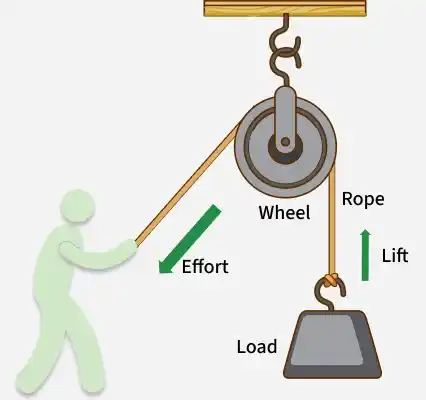
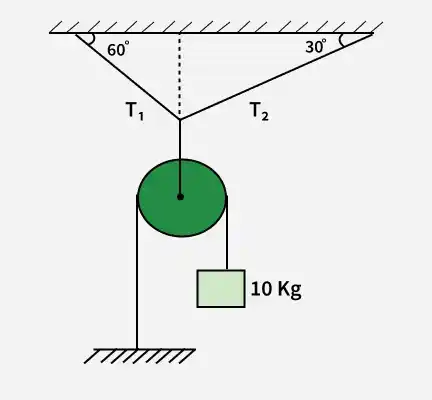
A pulley is a simple machine that is made up of a wheel and a rope or cable that helps us to lift heavy objects more easily. The wheel rotates freely around the axle, and it is generally made up of wood, metal, or even plastic for lifting lighter loads.
The main function of a pulley is to change the direction of force. Instead of lifting a heavy object directly upward, you can pull the rope downward to raise the load. This makes lifting easier and convenient; that's why pulleys are used in wells, cranes, elevators, and flagpoles.
Mechanical Advantage:
Mechanical advantage tells us how much easier a pulley makes in lifting a load. It is the ratio of the weight being lifted (load) to the force you apply (effort). M = \frac{W}{F}
In other words, we can say it tells us how many times the pulley reduces our effort. The greater the mechanical advantage, the less force you need to lift the same weight.
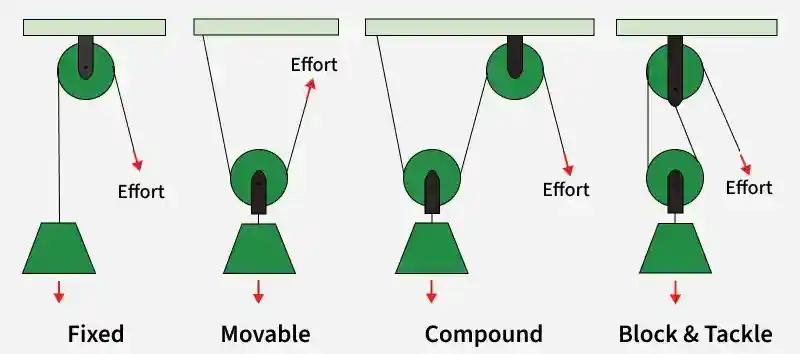
Types of Pulley
1. Fixed Pulley
A fixed pulley is attached to a support and does not move along with the load. It mainly changes the direction of the force applied.
Mechanical Advantage (MA) = 1
It does not actually reduce the effort, but makes lifting more convenient (e.g., drawing water from a well).
2. Movable Pulley
A movable pulley is attached to the load and moves along with it. It reduces the effort required to lift the load.
Mechanical Advantage (MA) = 2 (ideal case situation)
The effort required is half of the load (we are ignoring friction in this case).
3. Compound Pulley
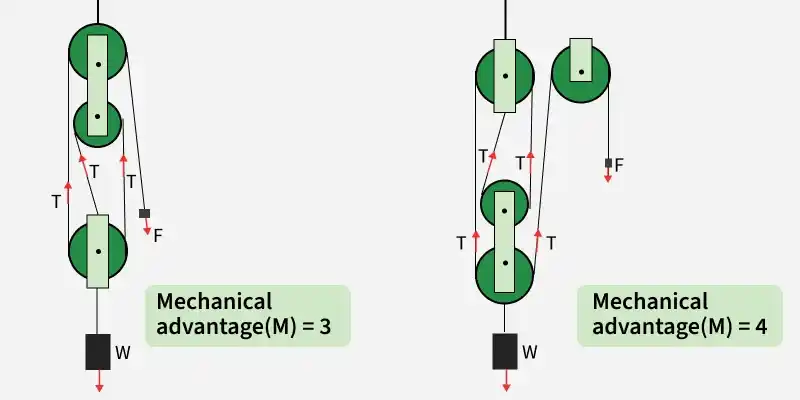
A compound pulley is a combination of fixed and movable pulleys. It changes both direction and reduces effort also.
Mechanical Advantage = Number of supporting rope segments (ideal case situation).
4. Block and Tackle
Block and tackle is a special type of compound pulley system with multiple pulleys arranged in two blocks.
It is used to lift very heavy loads, like in cranes and ships.
Mechanical Advantage = Number of rope segments supporting the load (ideal case situation).
Effect of Number of Pulleys on Mechanical Advantage
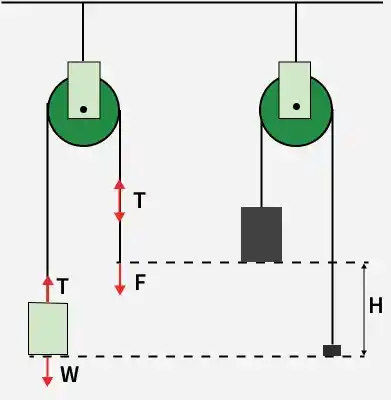
To lift a 1 kg weight in this rope pulley setup, we have to apply a force equal to the weight itself: F=W
The rope tension is the same as the applied force, so there’s no reduction in effort.
So, the mechanical advantage is 1. To lift the weight by 1 ft, you pull 1 ft of rope.
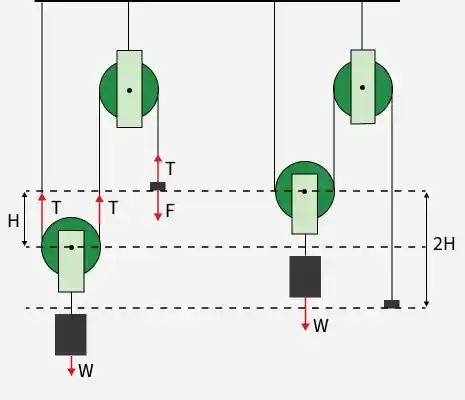
To lift a 1 kg weight using a simple two-pulley system, the rope tension equals the force you apply (F). But the weight is supported by two segments of the rope, so: 2T=W
This means you only need to apply half the force: F = \frac{W}{2}
So the mechanical advantage is 2. To lift the weight 1 ft, you must pull 2 ft of rope.
More Pulley arrangements
String Constraint Method
In pulley problems, the total length of the string attached to the pulley remains constant (if the string is ideal and inextensible). This condition gives us a mathematical relation between the displacement, velocity, and acceleration of different blocks attached to the system.
Since string length remains constant: L = x_1 + x_2 + \text{constant}
Differentiating: v_1 + v_2 = 0
Again differentiating: a_1 + a_2 = 0
For movable pulley: a_{block} = 2a_{pulley}
Ideal Pulley vs Real Pulley
a. Ideal Pulley System
String & Pulley are both massless
No friction is present in the axle
The string does not slip on the pulley
In this case:
Tension is the same throughout the string in the system.
Mechanical Advantage is equal to the number of supporting rope segments.
b. Real (Massive) Pulley
If the pulley has mass M and radius R, then tensions on two sides are not equal.
We must apply rotational dynamics.
\tau = I\alpha
(T_1 - T_2)R = I\alpha
Since the string does not slip: a = \alpha R
For a solid disc pulley: I = \frac{1}{2}MR^2
Therefore,
(T_1 - T_2)R = \frac{1}{2}MR^2 \cdot \frac{a}{R}
T_1 - T_2 = \frac{1}{2}Ma
Solved Questions
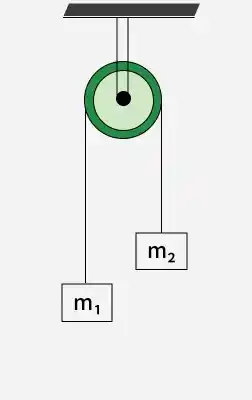
Question 1:- Find the Tension (T) in the string and also the acceleration of the block.
Solution 1:
m1 > m2
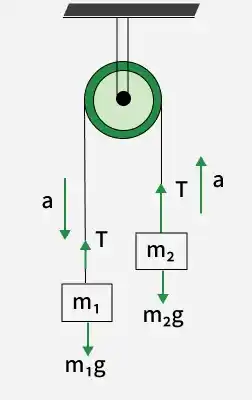
now for mass m1,
m1 g – T = m1a .........(i)
for mass m2
T – m2 g = m2 a .........(ii)
Adding (i) and (ii), we get
\mathbf{a}=\frac{(m_{1}-m_{2})}{(m_{1}+m_{2})}g
\mathbf{T}=\frac{2m_{1}m_{2}}{(m_{1}+m_{2})}g
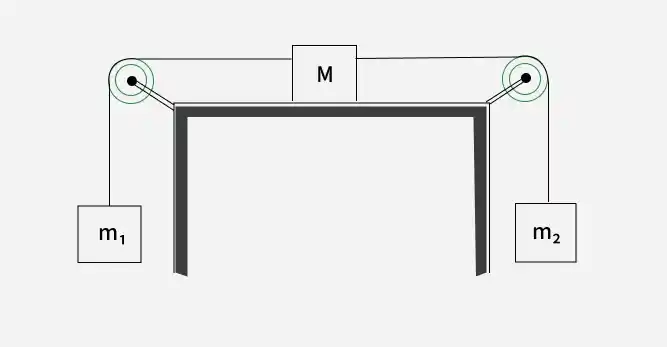
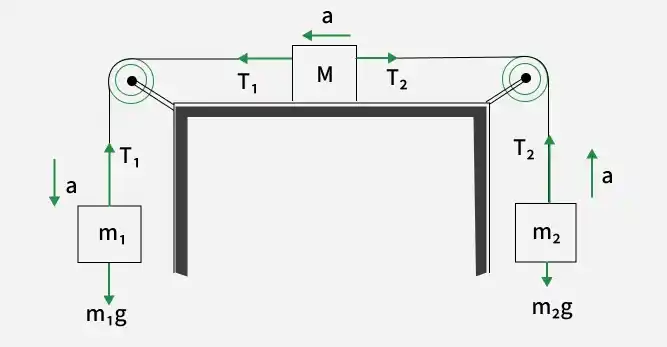
Question 2:- Find the Tension (T) in the string and also the acceleration of the block.
Solution 2:
(m1 > m2)
m1g – T1 = m1a .........(i)
T2 – m2g = m2a .........(ii)
T1 – T2 = Ma .........(iii)
by (i), (ii) and (iii)
a=\frac{(m_{1}-m_{2})}{(m_{1}+m_{2}+M)}g
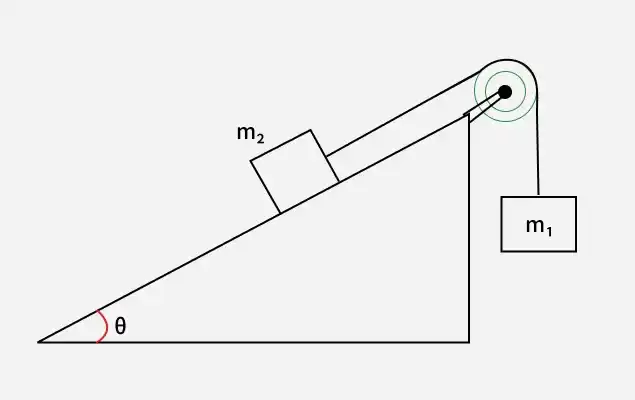
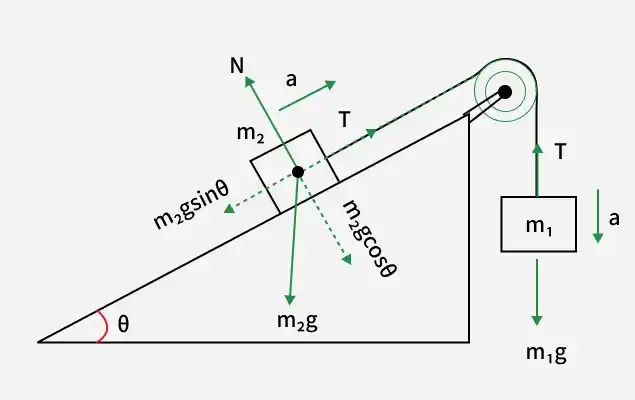
Question 3:- Find the Tension (T) in the string and also the acceleration of the block.