
When a charged particle moves in a magnetic field, it experiences a force that is always perpendicular to its velocity. Because of this perpendicular nature, the magnetic force does no work on the particle. As a result, the kinetic energy and speed of the particle remain constant.
If a charged particle with charge q moves with velocity v in a magnetic field B, the magnetic force acting on it is given by:
\text{F = qv B sinθ} where θ is the angle between the velocity vector (v) and the magnetic field (B).
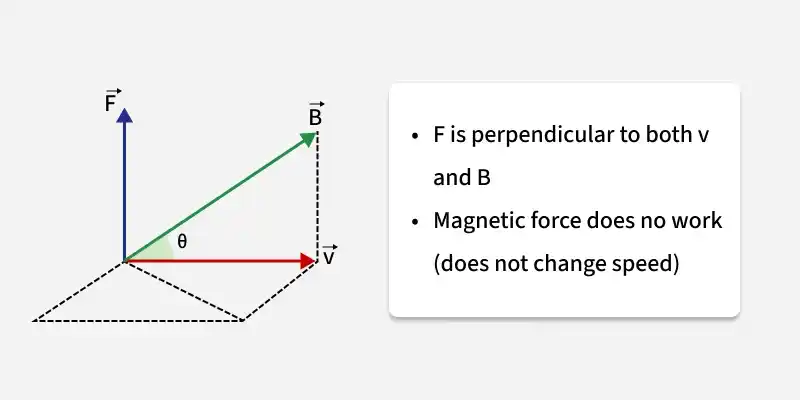
Motion Based on Initial Conditions
Case 1:
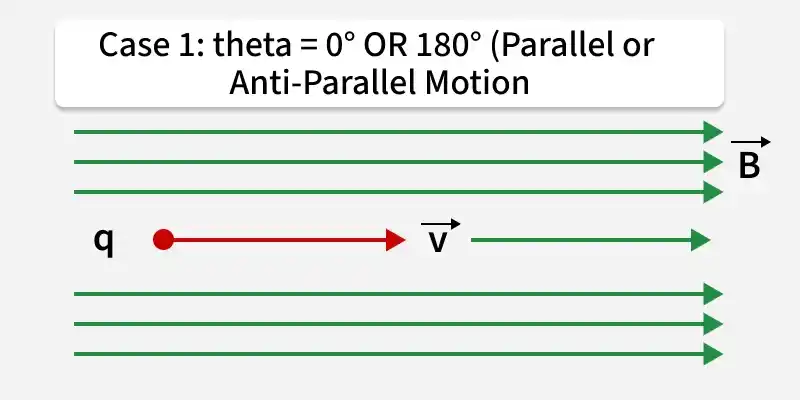
When the charged particle moves parallel (θ = 0°) or anti-parallel (θ = 180°) to the magnetic field, the angle between velocity and magnetic field becomes zero or 180°. Since sin0° = 0 and sin180° = 0, the magnetic force acting on the particle becomes zero:
F = qvB \sin 0° = 0
As no magnetic force acts on the particle, there is no change in its motion. Therefore, the particle continues to move in a straight line at constant velocity parallel to the magnetic field.
Case II:
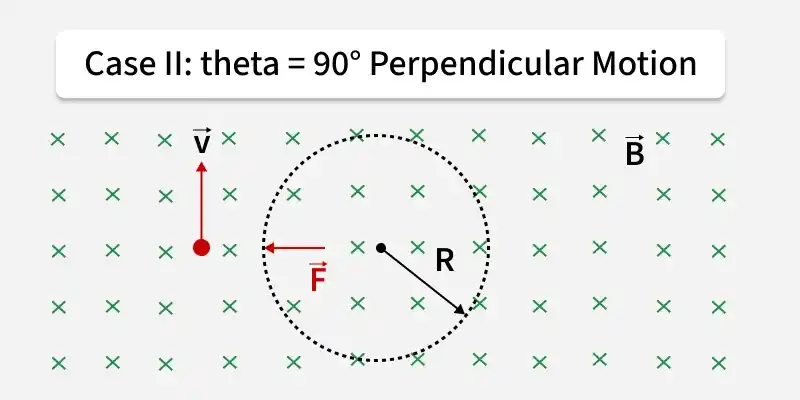
When a charged particle enters a magnetic field such that its velocity is perpendicular to the magnetic field (θ = 90°), it experiences a maximum magnetic force. This force always acts perpendicular to the velocity, continuously changing its direction but not its speed. The particle moves in a circular path with constant speed. In this case, the magnetic force acts as the centripetal force required for circular motion.
Mathematical Expression
The magnetic force is given by:
\text{F = qvB}
This force provides the centripetal force:
On solving, we get the radius of the circular path:
Angular Velocity:
Time Period :The time taken to complete one revolution is:
Frequency
Case III:
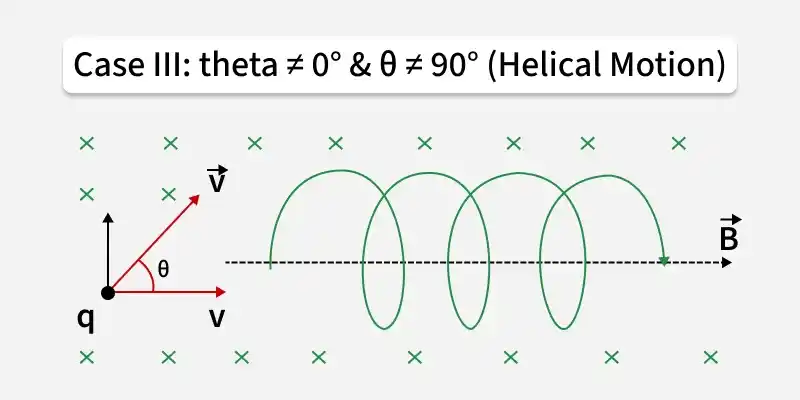
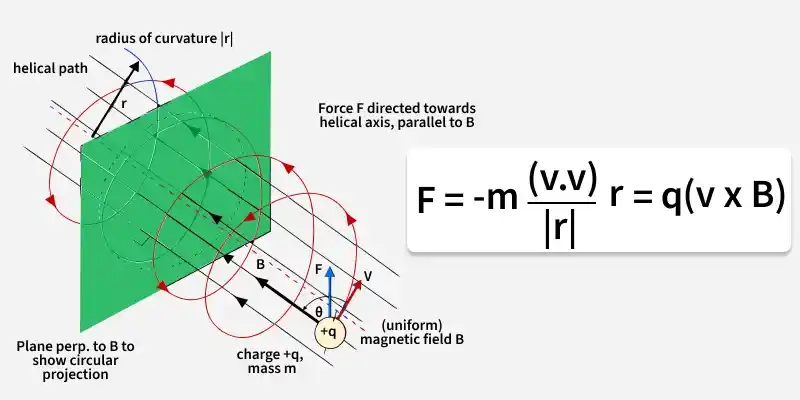
When a charged particle enters a magnetic field at an angle other than 0° or 90°, its velocity can be resolved into two components:
- V|| → along the direction of the magnetic field
- V⊥ → perpendicular to the magnetic field
The parallel component V|| causes the particle to move in a straight line along the magnetic field, while the perpendicular component V⊥ produces a circular motion due to the magnetic force. The combined motion is a helical (spiral) path.
Radius of the Helical Path
The circular motion is due to the perpendicular component V⊥ = v sinθ:
Frequency of Revolution
Time Period
Pitch of Helix
Pitch is defined as the distance travelled by the particle along the magnetic field in one complete revolution.
Since V|| = vcosθ, we get:
Sample Problems
Question 1: A charged particle of charge 2 × 10⁻⁶ C moves with a velocity of 3 × 10⁵ m/s perpendicular to a magnetic field of 0.5 T. Find the magnetic force.
Solution: F = qvB
F = (2 × 10⁻⁶) (3 × 10⁵) (0.5)
F = 0.3 N
Question 2: An electron enters a magnetic field of 0.02 T with velocity 4×10⁶ m/s. Find the radius. (m = 9.1 × 10⁻³¹, q = 1.6 × 10⁻¹⁹)
Solution:
R = \frac{mv}{qB}
R = \frac{9.1 \times 10^{-31} \times 4 \times 10^6}{1.6 \times 10^{-19} \times 0.02}
R = \frac{36.4 \times 10^{-25}}{3.2 \times 10^{-21}}
R = 1.14 \times 10^{-3} \, m
Question 3: Find the time period of revolution of a proton in a magnetic field of 0.1 T. (m = 1.67 × 10⁻²⁷, q = 1.6 × 10⁻¹⁹)
Solution:
T = \frac{2\pi m}{qB}
T = \frac{2\pi \times 1.67 \times 10^{-27}}{1.6 \times 10^{-19} \times 0.1}
T = \frac{10.48 \times 10^{-27}}{1.6 \times 10^{-20}}
T = 6.55 \times 10^{-7} \, s
Question 4: A particle enters a magnetic field of 0.5 T with velocity 2×10⁶ m/s at an angle of 60 °. Find the radius of the helical path. (m = 1.67 × 10⁻²⁷, q = 1.6 ×10⁻¹⁹)
Solution:
v_{\perp} = v \sin\theta = 2 \times 10^6 \times \frac{\sqrt{3}}{2} = 1.732 \times 10^6
r = \frac{mv_{\perp}}{qB}
r = \frac{1.67 \times 10^{-27} \times 1.732 \times 10^6}{1.6 \times 10^{-19} \times 0.5}
r = \frac{2.89 \times 10^{-21}}{0.8 \times 10^{-19}}
r = 3.61 \times 10^{-2} \, m
Unsolved Problems
Question 1: A charged particle of charge 3 × 10⁻⁶ C moves with a velocity of 2 × 10⁵ m/s perpendicular to a magnetic field of 0.4 T. Find the magnetic force acting on it.
Question 2: An electron enters a magnetic field of 0.03 T with a velocity of 5 × 10⁶ m/s perpendicular to the field. Find the radius of its circular path. (m = 9.1 × 10⁻³¹ kg, q = 1.6 × 10⁻¹⁹ C)
Question 3: Find the time period of a proton moving in a magnetic field of 0.2 T (m = 1.67 × 10⁻²⁷ kg, q = 1.6 × 10⁻¹⁹ C)
Question 4: A charged particle enters a magnetic field of 0.6 T with a velocity of 3 × 10⁶ m/s at an angle of 30 °. Find the radius of the helical path. (m = 1.67 × 10⁻²⁷ kg, q = 1.6 × 10⁻¹⁹ C)