
A spherical mirror is a mirror with a surface in the form of a part of a sphere. The mirror formula is a mathematical relation that connects the object distance u, image distance v, and focal length f of a spherical mirror. It is expressed as
\frac{1}{v} + \frac{1}{u} = \frac{1}{f} This formula is applicable to both concave and convex mirrors, and its correct application requires strict use of the Cartesian sign convention.
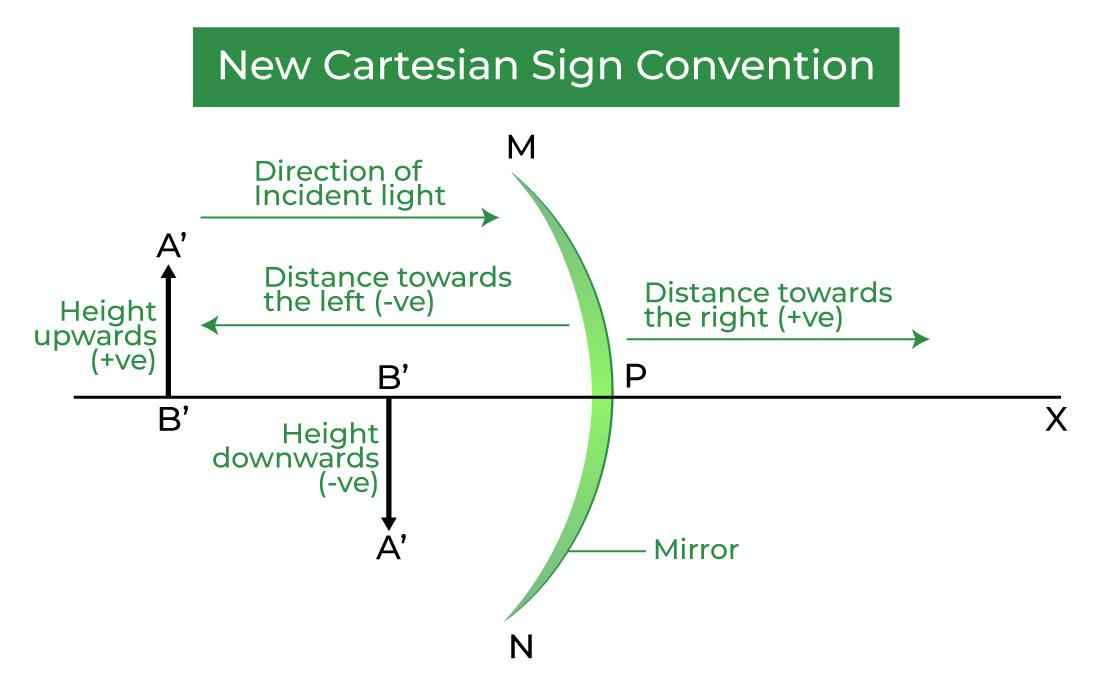
According to this convention, the object distance u is considered negative when the object is placed on the left side of the mirror. The focal length f is negative for concave mirrors and positive for convex mirrors. The image distance v is positive for virtual images and negative for real images. By using this formula, one can determine the position, size, and nature of the image formed by a mirror.
Magnification
Magnification produced by a spherical mirror represents the ratio of the height of the image to the height of the object and indicates how much the image is enlarged or diminished relative to the object. If h is the height of the object and h′ is the height of the image, the magnification m is expressed as.
m = \frac{\text{Height of the image}}{\text{Height of the object}}
\text{m} = \frac{h′}{h}
Magnification is also related to the object distance u and the image distance v, and can be written as
m = -\frac{v}{u}
The height of the object is always taken as positive since the object is usually placed above the principal axis. The height of the image is considered positive for virtual images and negative for real images. A negative magnification indicates that the image is real and inverted, whereas a positive magnification indicates that the image is virtual and erect.
Uses
- A precision magnifier functions like a simple magnifying glass but uses multiple optical elements to correct aberrations, producing a sharper image.
- A tiny water droplet can act as a simple magnifier, enlarging the object behind it.
- Water forms spherical droplets naturally due to surface tension.
- When a droplet is in contact with an object, its shape may be slightly distorted, but it can still form a clear and magnified image.
Solved Problems
Question 1: What is the magnification produced if the image distance is 6 cm and the object is located at 12 cm in case of concave mirror?
Solution: the magnification can be calculated using the following formula;
m=-\frac{v}{u} Given, v= -6cm and u= -12cm the signs are given using sign convention.
\therefore m=-\frac{-6cm}{-12cm}
\therefore m=-\frac{1}{2} m = -0.5
Hence, there is a decrease by a factor of 0.5.
Question 2: What is the image distance in case of convex mirror if the object is placed at 12cm? Determine it if the height of the image if 4 cm and height of the object is 2 cm.
Solution: the magnification can be calculated using the following formulas;
m
=-\frac{v}{u} and also m=\frac{h'}{h} Given, height of image h' = 4cm, height of object{h}= 2cm and u= -12cm the signs are given using sign convention.
\therefore m=\frac{h'}{h}
\therefore m=\frac{4cm}{2cm} m = +2
Hence, there is an increase by a factor of 2.
\therefore m=-\frac{v}{u} Putting m= 2 and u=-12cm we get
\therefore 2=-\frac{v}{-12cm}
\therefore v= (-2)\times (-12cm) v= 24cm
Hence, the image distance is 24cm.
Question 3: What is the magnification if the object height is 6 cm and the image height is 24 cm below the principal axis?
Solution: the magnification can be calculated using the following formula;
m=\frac{h'}{h} Given, height of image h' = -24 cm, height of object{h}= 6cm the signs are given using sign convention.
\therefore m=\frac{h'}{h}
\therefore m=\frac{-24cm}{6cm} m=-4
Hence, the magnification is (-4).
Question 4: What is the magnification if the object height is 6 cm and the image height is 18 cm above the principal axis?
Solution: the magnification can be calculated using the following formula;
m=\frac{h'}{h} Given, height of image h' = 18cm, height of object{h}= 6cm the signs are given using sign convention.
\therefore m=\frac{h'}{h}
\therefore m=\frac{18cm}{6cm} m=+3
Hence, the magnification is 3.
Question 5: What is the image distance in case of concave mirror if the object distance is 8 cm? It is given that the focal length of the mirror is 4 cm.
Solution: from mirror formula,
\frac{1}{v} + \frac{1}{u} = \frac{1}{f} Where u= object distance= -8cm
v= image distance=?
f= focal length of mirror= -4cm
Putting values we get
\frac{1}{v} + \frac{1}{-8} = \frac{1}{-4}
\frac{1}{v} = \frac{1}{-4}-\frac{1}{-8}
\frac{1}{v} = \frac{1}{-4}+\frac{1}{8}
\frac{1}{v} = \frac{-2}{8}+\frac{1}{8}
\frac{1}{v} = \frac{-1}{8} v= -8 cm
Hence, the image is formed 8 cm in front of the mirror.
Unsolved Problems
Question 1: An object is placed 15 cm in front of a concave mirror of focal length 10 cm. Find the position and nature of the image.
Question 2: The object is 8 cm tall and is placed 12 cm in front of a convex mirror. If the image height is 4 cm, find the image distance.
Question 3: A concave mirror produces an image three times the size of the object. If the object is placed 10 cm in front of the mirror, calculate the focal length of the mirror.
Question 4: A convex mirror forms an image 6 cm behind the mirror of an object placed 18 cm in front of it. Calculate the focal length of the mirror.
Question 5: An object 5 cm tall is placed 20 cm from a concave mirror. The image formed is 10 cm tall and real. Find the image distance and focal length of the mirror.