
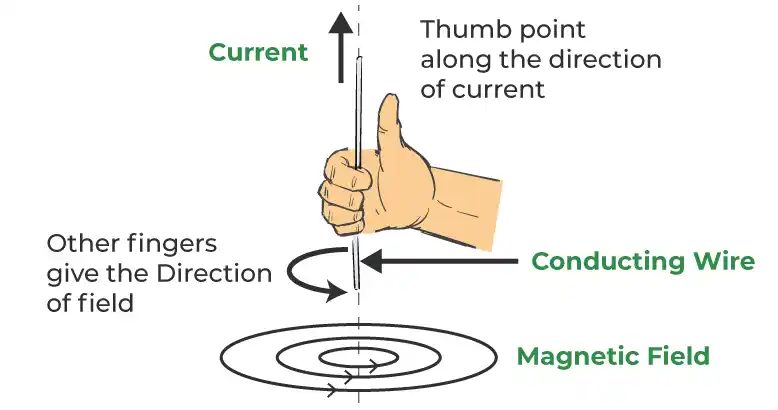
When an electric current flows through a conductor (like a wire), it produces a magnetic field around it. These magnetic field lines form concentric circles centered on the conductor at every point.
The direction of the magnetic field with respect to the current can be determined using the Right-Hand Thumb Rule (Maxwell’s Corkscrew Rule).
- If the conductor is held in the right hand such that the thumb points in the direction of the current, the curled fingers indicate the direction of the magnetic field.
- The strength of the magnetic field is greater near the conductor and decreases as the distance from the conductor increases.
Magnetic field due to a circular loop
When an electric current flows through a circular loop, it produces a magnetic field around it. The magnetic field lines near the wire are circular, but as they approach the center of the loop, they become nearly straight and parallel, forming a strong and almost uniform magnetic field at the center.
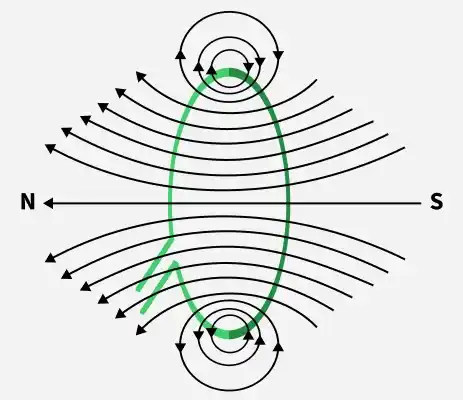
The direction of the magnetic field is given by the Right-Hand Thumb Rule, and its strength is directly proportional to the current and the number of turns of the coil, as the magnetic fields due to each turn add up in the same direction.
Magnetic field due to a current in a Solenoid
A solenoid is a coil of many closely wound circular turns of insulated wire in the shape of a cylinder. When an electric current flows through a solenoid, it produces a magnetic field similar to that of a bar magnet, with one end acting as a north pole and the other as a south pole.
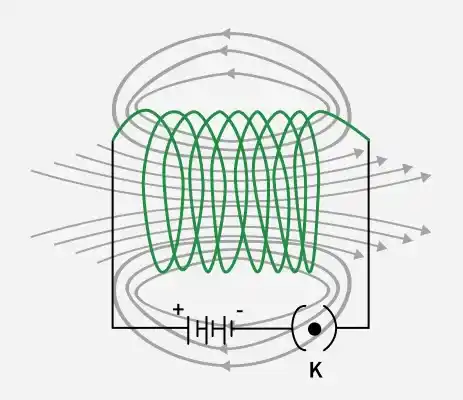
Inside the solenoid, the magnetic field lines are straight, parallel, and closely spaced, indicating a strong and uniform magnetic field. This strong magnetic field can be used to magnetize magnetic materials such as soft iron placed inside the solenoid.
Read More: Magnetic Field Due to Solenoid and Toroid
Characteristics
- Magnetic field lines around a current-carrying conductor form concentric circles.
- As we move away from the wire, the circles become larger.
- Near the centre of a circular loop, the field lines appear as parallel straight lines.
- The magnetic field is nearly uniform at the centre of the loop.
- The strength of the magnetic field is directly proportional to current and inversely proportional to the radius of the loop.