
Electric charges interact with one another through forces that can either attract or repel. When more than two charges are present, the system becomes more complex because each charge experiences the influence of all others. When our synthetic clothing or sweater is removed from our bodies, especially in dry weather, a spark or crackling sound appears. Lightning, in the sky during thunderstorms, is another case of electric discharge. It is an electric shock always felt while opening a car door or grabbing the iron bar of a bus after sliding out of our seats. In all these cases, the sensation or spark is due to the sudden discharge of electric charges that have accumulated because of friction.
Force on a Charge Due to Two Other Charges
Consider a system in a vacuum with n motionless charges that are stationary: q1, q2, and q3. It has been proven experimentally that the vector sum of all the forces on a charge due to several other charges, taken one at a time, is the vector sum of all the forces on that charge owing to the other charges. Due to the presence of other charges, the separate forces remain unaffected. This is known as the superposition principle.
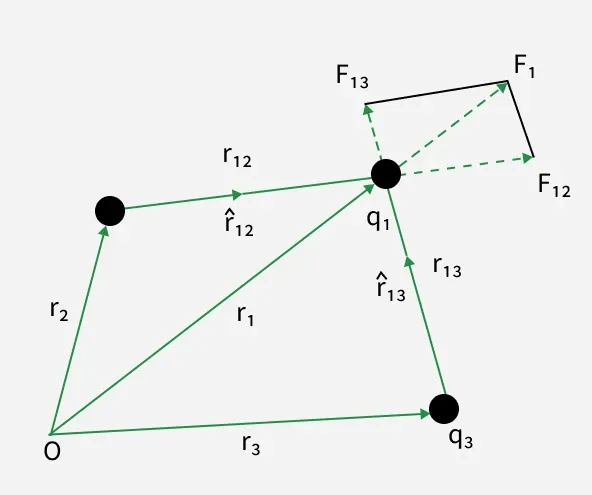
The force on one charge, say q1, due to two other charges, q2 and q3, may be determined by conducting a vector addition of the forces due to each of these charges. As a result, if F12 denotes the force exerted on q1 as a result of q2,
Similarly, F13 denotes the force exerted on q1 as a result of q3, which again is the Coulomb force on q1 due to q3, even though another charge, q2, is present. Thus, the total force F1 on q1 due to the two charges q2 and q3 can be expressed as,
Force on a Charge in a System of n Charges
The above force calculation can be applied to a system with more than three charges. The principle of superposition states that in a system of charges q1, q2,..., qn, the force on q1 owing to q2 is the same as Coulomb's law, i.e., it is unaffected by the presence of other charges q3, q4,..., qn.
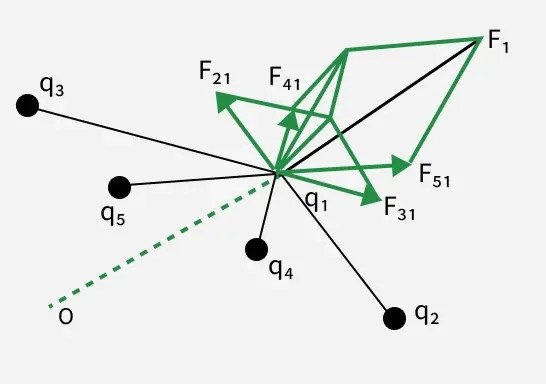
The vector sum of the forces F12, F13,..., F1n on the charge q1 owing to all other charges gives the overall force F1 can be written as
The vector sum is calculated by using the parallelogram law of vector addition. Coulomb's law and the superposition principle are the foundations of electrostatics.
Related Articles:
Sample Problems
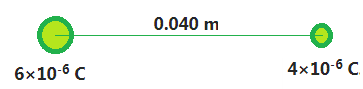
Problem 1: A positive charge of 6×10⁻⁶ C is 0.040 m from the second positive charge of 4×10⁻⁶ C. Calculate the force between the charges.
Solution:
Given,
A positive charge q1 is 6×10⁻⁶ C.
The second positive charge q2 is 4×10⁻⁶ C.
The distance between the charges r is 0.040 m.
F_e=k\frac{q_1q_2}{r^2} Substitute the values in the above expression,
F_e=9\times10^9\times\frac{6\times10^{-6}\times4\times10^{-6}}{0.04^2}\\F_e=9\times10^9\times\frac{24\times10^{-12}}{0.04^2} \\F_e=134.85\text{ N}
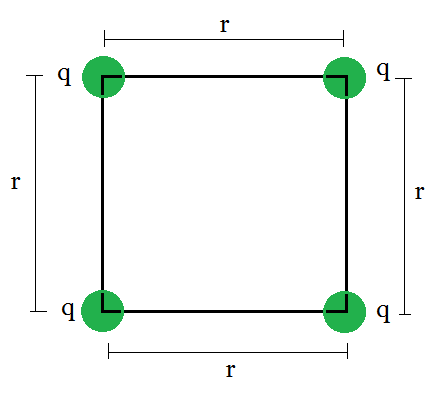
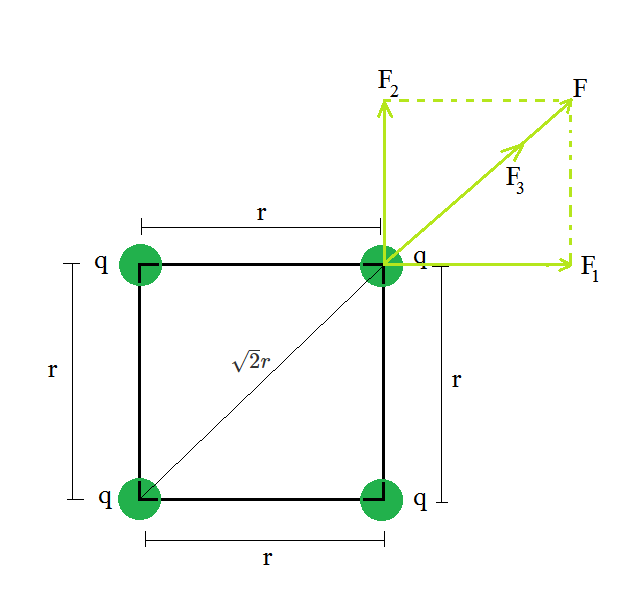
Problem 2: Four equal charges q are kept on the corners of a square of side 'r'. Find the net force on one of the charges.
Solution:
Given,
Four equal charges ‘q’ and the distance between them is r.
The individual repulsive forces on the corner charge q, and make a vector diagram and note down the forces, which as:
The force due to the Left top charge on the right top charge is F1 and can be expressed as,
F1 = (kq2)/r2
The force due to the right bottom charge on the right top charge is F2 and can be expressed as,
F2 = (kq2)/r2
The force due to the Left bottom charge on the right top charge is F3 and can be expressed as,
F_3=\frac{kq^2}{(\sqrt{2}r)^2} The resultant force on the right top charge can be written as,
F=\sqrt{F_1+F_2+2F_1F_2\cos\theta}+F_3 Here, cos 90o is equal to 0.
Substitute the value in the above expression.
F=\sqrt{\frac{kq^2}{r^2}+\frac{kq^2}{r^2}+2\times\frac{kq^2}{r^2}\times\frac{kq^2}{r^2}\times\cos90^\circ}+\frac{kq^2}{(\sqrt{2}r)^2}\\ F=\sqrt{\frac{2kq^2}{r^2}}+\frac{kq^2}{2r^2}\\ F=\sqrt{2k}\left(\frac{q}{r}\right)+\frac{kq^2}{2r^2}
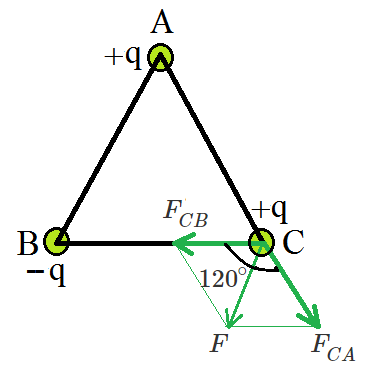
Problem 3: Charges of magnitude 100 microcoulomb each are located in vacuum at the corners A, B, and C of an equilateral triangle measuring 4 meters on each side. If the charges at A and C are positive and the charge B is negative, what is the magnitude and direction of the total force on the charge at C?
Solution:
The Force FCA is applied toward AC, and the expression for the FCA is expressed as
F_{CA}=\frac{qq}{4\pi{\epsilon}_\circ} Substitute the values in the above expression,
F_{CA}=\frac{100\times10^{-6}\times100\times10^{-6}}{4\pi\times8.854\times10^{-12}}\\ F_{CA}=5.625\text{ N} The Force FCB is applied toward CB, and the expression for the FCB is expressed as
F_{CB}=\frac{qq}{4\pi{\epsilon}_\circ} Substitute the values in the above expression,
F_{CB}=\frac{100\times10^{-6}\times100\times10^{-6}}{4\pi\times8.854\times10^{-12}}\\ F_{CB}=5.625\text{ N} Therefore, the two forces are equal in magnitude but in different directions. The angle between them is 120º. The resultant force F is given by,
F=\sqrt{F_{CA}^2+F_{CB}^2+2F_{CA}F_{CB}\cos\theta}\\ F=\sqrt{5.625^2+5.625^2+2\times5.625\times5.625\times\cos120^\circ}\\ F=5.625\text{ N}
Problem 4: Compare the nature of electrostatic and gravitational forces.
Solution:
Between two huge masses, a gravitational force acts. However, an electrostatic force is activated when two charged bodies come into contact.
Similarities:
- These two forces are central.
- Follow the law of inverse squares.
- They're both long-range forces.
- Both forces are naturally conservative.
Dissimilarities:
- In nature, electrostatic force can be both attractive and repellent. In nature, gravitational force can only be attractive.
- The material medium between two charges affects the electric force between them. The material medium between huge bodies has little effect on the gravitational force.
- Electric forces are extremely powerful approximately 10 38 times stronger) than gravitational forces.
Problem 5: Why does Coulomb's force act between two charges only in the line joining their centres?
Solution:
Because of the fundamental features of electrical charge, this is the case. Charges that are similar repel each other. Charges that are opposed attract each other.
The force of attraction or repulsion between two charges will be directed in a direction so that the force does the least amount of work. As a result of this requirement, the action is directed along the straight line connecting the two charges, which is the shortest distance between them.