
When a current-carrying conductor is placed in a magnetic field, it experiences a force due to the interaction between the magnetic field and the moving charges inside the conductor. This force always acts perpendicular to both the direction of current and the magnetic field.
The magnitude of this force depends on the strength of the magnetic field, the amount of current flowing through the conductor, the length of the conductor, and the angle between the current and the magnetic field.
The magnitude of the force acting on a current-carrying conductor placed in a magnetic field is given by:
\text{F = BIL sinθ}
- F = force on the conductor (N)
- B = magnetic field (T)
- I = current (A)
- L = length of conductor (m)
- θ = angle between current and magnetic field
Vector Form
The vector indicates that the force is always perpendicular to both the current and the magnetic field, following the right-hand rule of the vector cross product. The vector form of the force is given by:
{\vec F= I(\vec L \times \vec B)}
Special Cases of Force on a Current-Carrying Conductor
There are a few special cases of force on the current-carrying conductors depending on the position of the conductor in the magnetic field. These cases are explained as follows:
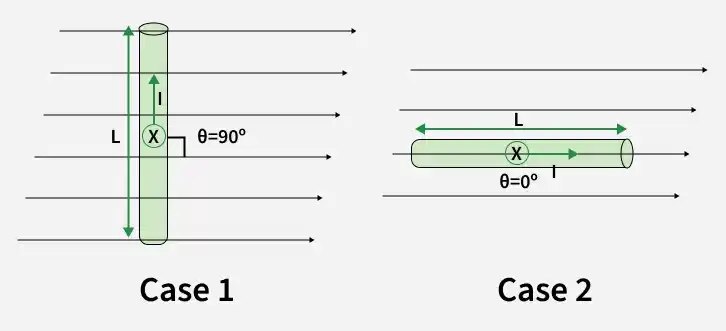
Case I: When a conductor is placed parallel to the Magnetic Field
When sin θ = 0 (minimum) i.e., θ = 0° or 180°, then force on the current element in a magnetic field is zero(minimum).
Fmin = 0
A current element in a magnetic field does not experience any force if the current in it is collinear with the field, thus it is the least magnitude of the force experienced by the conductor in the given magnetic field.
Case II: When a conductor is placed perpendicular to the Magnetic Field
When sin θ = 1 (maximum) i.e., θ = 90°, then force on the current element in a magnetic field is maximum (=ILB).
Fmax = ILB
The direction of force is always perpendicular to the plane containing
Direction of Force on a Current-Carrying Conductor
The direction of the force on a current-carrying conductor can be determined using the left and right-hand rules or thumb rules, which are explained as follows:
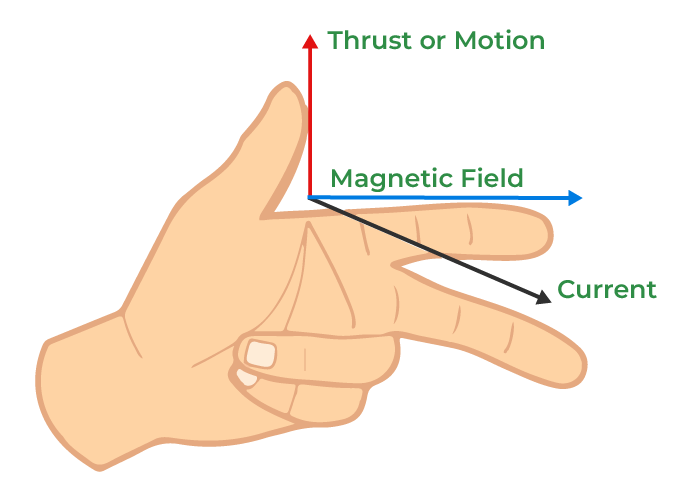
Fleming's Left-Hand Rule
Fleming’s Left-Hand Rule is used to determine the direction of force acting on a current-carrying conductor placed in a magnetic field. If the thumb, forefinger, and middle finger of the left hand are stretched mutually perpendicular to each other, then the forefinger represents the direction of the magnetic field, the middle finger represents the direction of current, and the thumb gives the direction of the force or motion of the conductor.
Also, Read
Solved Problems
Question 1: A current of 1A flows in a wire of length 0.1cm in a magnetic field of 0.5T. Calculate the force acting on the wire when the wire makes an angle of (i) 90° (ii) 0° with respect to the magnetic field.
Solution:
F = I L B \sin\theta
\text{(i) For } \theta = 90^\circ:
F = 1 \times 0.001 \times 0.5 \times \sin 90^\circ
F = 0.0005 \,\text{N}
\text{(ii) For } \theta = 0^\circ:
F = 1 \times 0.001 \times 0.5 \times \sin 0^\circ
F = 0 \,\text{N}
Question2: A current-carrying conductor of length 0.5cm with current 2A is placed at an angle of 30° in the magnetic field of 0.3T. Calculate the force acting on it.
Solution: Given
Length L = 0.5 cm = 0.005 m
Current I = 2 A
Magnetic field B = 0.3 T
Angle θ = 30o
F = I L B \sin\theta
F = 2 \times 0.005 \times 0.3 \times \sin 30^\circ
F = 2 \times 0.005 \times 0.3 \times 0.5
F = 0.0015\,\text{N}
Question 3: Find the length of the current-carrying conductor with 3A current which is placed at 90° in the magnetic field of 0.5T with 0.3 N force acting on it.
Solution: Given
Current I = 3 A
Magnetic field B = 0.5 T
Force F = 0.3 N
Angle θ = 90o ⇒ sin90o = 1
F = I L B \sin\theta
0.3 = 3 \times L \times 0.5 \times \sin 90^\circ
0.3 = 1.5 \, L
L = \frac{0.3}{1.5} = 0.2\,\text{m}
Question 4: At what angle the current-carrying conductor of length 0.6cm with a current 2A is placed in the magnetic field of 0.2T with 0.24N force acting on it?
Solution: Given:
Length L = 0.6 cm = 0.006 m
Current I = 2 A
Magnetic field B = 0.2 T
Force F = 0.0024 N
F = I L B \sin\theta
0.0024 = 2 \times 0.006 \times 0.2 \times \sin\theta
0.0024 = 0.0024 \, \sin\theta
\sin\theta = \frac{0.0024}{0.0024} = 1
\theta = 90^\circ
Unsolved Problems
Question 1: A wire of length 0.8 m carrying a current of 5 A is placed at an angle of 60° to a uniform magnetic field of 0.3 T. Calculate the force acting on the wire.
Question 2: A conductor of length 1 m carrying a current of 3 A is placed perpendicular to a uniform magnetic field. If the force on the conductor is 0.9 N, find the magnitude of the magnetic field.
Question 3: A current of 4 A flows through a conductor of length 0.5 m placed at 45° to a magnetic field of 0.6 T. Calculate the force experienced by the conductor.
Question 4: A conductor of length 0.2 m carries a current of 2 A and experiences a force of 0.12 N in a uniform magnetic field of 0.5 T. Find the angle between the conductor and the magnetic field.