
Friction is an opposing force that restricts the motion of one body over the surface of another body in contact with it. It is absolutely necessary for the motion of any object over another. It is like a necessary evil that harms and helps. Its dual function can be explained by the example of walking: we are able to walk because there is friction, and we are walking at a certain low speed because of the opposing force provided by friction.
Also, like in the case when a sledge is pushed forward on snow, the force applied moves the sledge in the forward direction. Friction between the sledge and the snow surface acts in the opposite direction, gradually bringing the sledge to a stop. If the force acts in the right-to-left direction, friction will act in the left-to-right direction, opposing the motion.
There are some forces that only come into action when they are in contact with each other. It is known as the contact forces. It is offered by solids, liquids, and also by gases, but it is maximum in the case of solids and least in the case of gases. The effects of friction include the gradual wearing away of things; this can be seen in examples like the uneven soles of our shoes, balding bicycle tires, and the deliberate action of rubbing sandpaper on a surface.
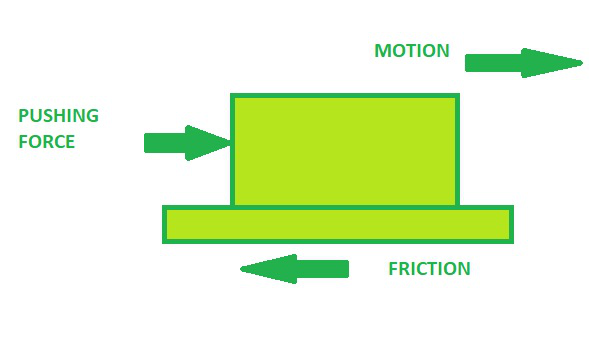
- Friction can only be reduced; it cannot be completely eliminated.
- We can reduce friction by applying lubricants to the surfaces in contact.
- Reducing friction helps in the smoother and better movement of objects over each other.
- If a surface is very rough, it needs to be made smoother for better movement by using effective lubricants such as oil or grease.
- In machinery parts, greasing is commonly used to reduce friction between moving parts during operation.
- If friction were reduced to zero, movement would not occur properly — objects would simply slip over each other without controlled motion.
- A minimum amount of friction is necessary for any kind of motion between two objects or surfaces.
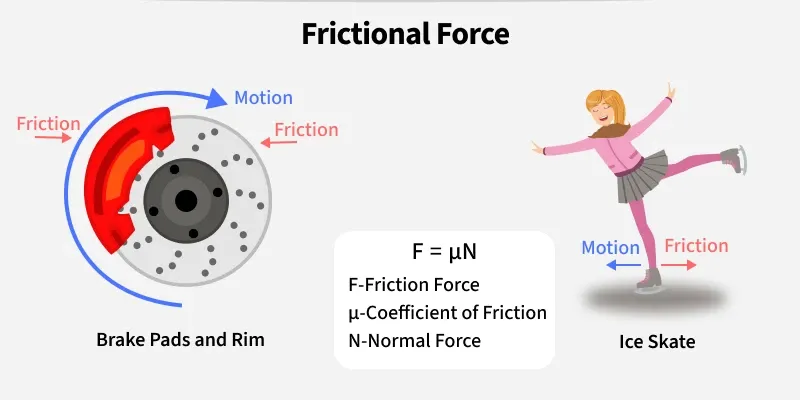
- For example, we cannot walk easily on ice because its surface is very smooth and has very low friction, causing us to slip.
- For activities like ice skating, special ice skating shoes or boots are used, which have roughened or specially designed ends to provide the required amount of friction for movement.
What causes Friction?
Friction is a force that resists or opposes the relative motion between two objects or materials. Various reasons are responsible for this opposing force to come into action. Among various other causes, the main cause of this resistive force or frictional force is molecular adhesion, surface roughness which depends on the nature of surface and body in contact, and deformations in the surface or in the moving object.

Molecular Adhesion:
Adhesion is the molecular attraction between two materials when they are in close contact. For instance, the force of adhesion between the surface of glass and water is why water wets the glass when poured into it. This molecular attraction leads to friction when two surfaces interact.
Surface Roughness:
Even though surfaces may appear smooth to the naked eye, when examined under a microscope, they are often rough at a microscopic level. This roughness results in friction when two surfaces come into contact. The rougher the surfaces, the greater the friction. For example, it’s harder to walk on a gravel road (rough surface) compared to a smooth, leveled road. The more pronounced the roughness, the greater the friction.
Deformations of Surfaces:
Friction is also caused by the deformations (bending or compressing) that occur in the materials when they come into contact. When surfaces deform during motion, they create resistance, contributing to friction. Lubricants are often used in such situations to reduce friction by minimizing surface deformations.
Spring balances provide a method of mass measurement that is both simple and convenient as well as cheap. The mass is hung on the end of spring, and the deflection of the spring due to the downwards gravitational force on the mass is measured against a scale. We can use this for performing and experimentally determining the different frictional forces in the case of different objects.
The observations are used to determine the following:
- The force acting on an object hung at the end of the balance.
- The force of friction exerted by the body.
- The magnitude of the pressure by the body.
- Relative motion between the object and the balance.
One of the ways to determine the coefficient of friction between two surfaces is to pull on an object, using a spring scale that is used to measure the weight of the object. If we lay an object on another surface and then pull it, we can determine the amount of force required to move the object into any surface.
Types of Friction
There are four types of friction and they are categorise as :
- Static Friction
- Sliding Friction
- Rolling Friction
- Fluid Friction
Read More, Types of Friction
Factors affecting Friction
1. Roughness/smoothness of the sliding object
The friction generated depends upon the roughness and smoothness of the sliding object. The rougher is the object the more friction will be generated and hence its movement will become restricted. The smoother is the object the more smoothly it can move.
As we can see in the image the smooth ball having a smoother surface can travel a longer distance than the rough ball.
We cannot hold a glass with oily hands. Our hands are greasy and smooth, and we know that a smooth surface offers lesser interaction with the glass. And hence, it tends to slip. Another example of this is that while trekking on hilly and watery terrains, we wear groovy sports shoes so that rough shoes establish better locking with the hilly terrains, increasing friction, providing more grip, and decreasing get chances of a slip.
2. Roughness/smoothness of the surface
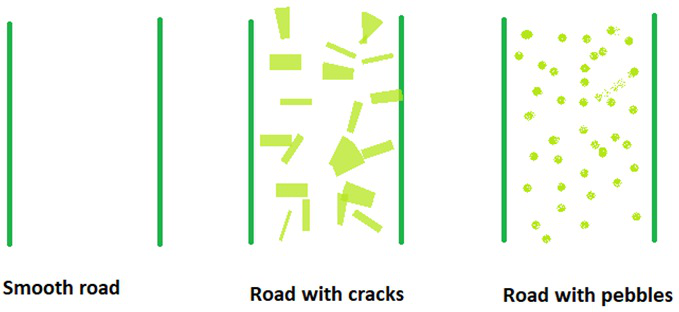
The friction is dependent upon the nature of the surface in contact. If the surface is rough the friction generated for the opposing motion of the object is greater as compared to the smoother surface.
For example, it is difficult to walk on a road full of small pebbles or a cracked rough with so many cracks in between them than on a smoother well-leveled road.
The opposing force generated during walking on the rougher road in the first case is more than in the second case.
3. Shape/design of the object
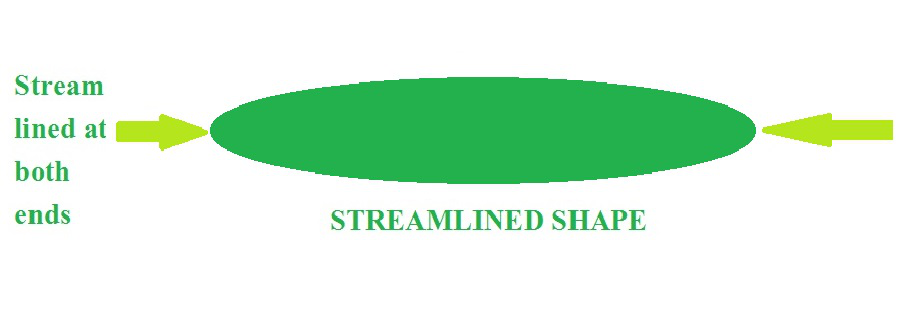
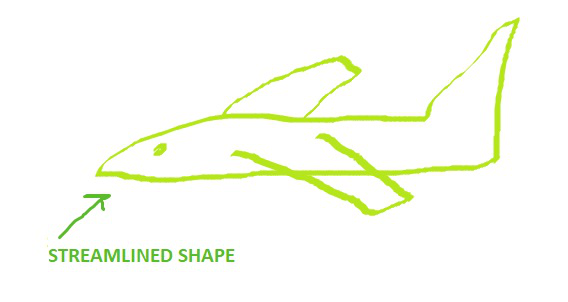
The shape and design of the object determine the surface area in contact with the surface on which it is moving. For example- if the shape of the body is streamlined so while traveling in water or air it will experience a lesser frictional force opposing its motion than any other shape.
It is the area of contact which matters, not the overall area of the surface something is moving on. If a ball of diameter 8 cm is rolling in a small room or a stadium, it makes no difference as long as the floor material and the speed of rolling are the same. Also, if a body has the shortest point of contact then the frictional force generated is also very less as compared to sliding the object it is preferred to roll the object for lesser friction.
So if two objects are in motion (considering they are made of the same material and shape are moving at the same speed) then the larger body will suffer greater friction due to its larger area of contact which will generate a relatively higher frictional force or opposing force relative to its motion.
4. Normal force acting upon the sliding bodies
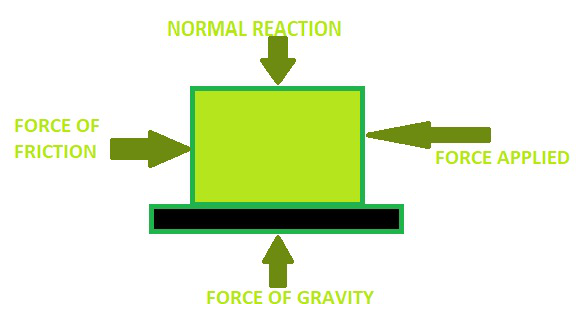
Force of friction or the opposing force restricting the motion of the body also depends on the Normal Force acting upon the sliding bodies. We usually think of the normal force as opposed to weight by following the Newtonian action-reaction pair. So higher the mass or weight of the object higher will the reaction or normal force generated. As the strength and magnitude of the normal force generated perpendicularly increases which is the force between the “sliding” surfaces, the strength or magnitude of the frictional force or opposing force also increases.
Frictional force or opposing force is a force that opposes two objects sliding against each other, and it acts as a contact force like the normal force. While the normal force acts perpendicular to the flat surface, friction acts in a direction that is along the flat surface of an object.
5. Coefficient of friction
The force of friction depends upon the coefficient of friction of the surface. The greater is the coefficient of friction of the surface the more is the force required to move it over that surface. The coefficient of friction, µ, is the amount of friction existing between two surfaces. A low value of the coefficient of friction indicates that the force required to slide the object is less than the force required when the coefficient of friction is high. The force of friction has the following formula:
F = µ× N
Where F= force of friction
µ = Coefficient of friction
N = normal reaction force
Examples of Friction Force
- Writing with a pencil: Friction between the pencil tip and paper allows the graphite to leave marks.
- Brakes of a bicycle: Friction between the brake pads and wheel rim slows down or stops the bicycle.
- Lighting a matchstick: Striking a match against the rough matchbox surface uses friction to generate heat and ignite it.
- Walking on a carpet: The roughness of the carpet provides friction that prevents slipping.
- Rock climbing: Specialized shoes increase friction with rocky surfaces to help climbers grip better.
- Playing a violin: Friction between the bow and the strings causes vibrations that produce sound.
- Tug of war: Friction between the participants' feet and the ground helps them pull harder without slipping.
Sample problems
Question 1: Find the force of friction if the coefficient of friction is 0.25 and the normal reaction offered by the surface is 5N.
Solution:
As we know that, F = µ ×N
Given, µ = 0.25
N = 5N
F = µ N
Therefore, F = 0.25 × 5N
Therefore, F = 1.25N
Hence, the frictional force exerted is 1.25 N.
Question 2: What is the coefficient of friction if the frictional force exerted is 125N and the normal reaction force offered is 200N.
Solution:
As we know that
F = µ× N
Given, F = 125N
N= 200N
\therefore \mu =\frac{F}{N}
\therefore \mu =\frac{125N}{200N} µ = 0.625
Hence, the coefficient of friction is 0.625.
Question 3: What is the normal reaction offered by the surface if the frictional force generated was 60N and the coefficient of friction to be 0.6.
Solution:
As we know that
F = µ×N
Given, F = 60N
µ = 0.6
\therefore N=\frac{F}{\mu}
\therefore N=\frac{60N}{0.6}
\therefore N=100N Hence, the normal reaction generated by the surface is 100N.
Question 4: A box weighing 150 N is resting on a flat surface. If the frictional force generated is 75 N and the coefficient of friction is 0.5, what is the normal reaction force offered by the surface?
We know the formula for friction:
F=μ×N
Where:
F=75 N (frictional force)
μ=0.5 (coefficient of friction)
N is the normal reaction force we need to find.
N=μ/F
Substituting the given values:
N=75 N/0.5=150 N
Question 5: A box weighing 10 N rests on a horizontal surface with a coefficient of friction of 0.3. Calculate the frictional force acting on the box.
Solution:
First, calculate the normal force (since the box is on a horizontal surface, it's equal to the weight):
N=10 NNow, use the friction formula:
Ffriction=μ×NWhere:
μ=0.3
N=10 N
So,
Ffriction=0.3×10=3 N
Conclusion
Friction is the invisible force that resists motion between two surfaces in contact, and it’s shaped by several important factors: the type of surfaces, their roughness, the amount of force pressing them together, and whether lubricants are present. Rough surfaces naturally generate more friction than smoother ones. Similarly, increasing the force that pushes two surfaces together leads to stronger frictional resistance. The texture and material of the surfaces can completely change how much friction is experienced. Without friction, everyday activities like walking, writing, or even holding objects would become nearly impossible.