The equations that explain the nature and the behavior of a physical system in terms of its motion as a function of time are called the equations of motion. There are three equations of motion that can be used to calculate the components of motion, like distance, displacement, velocity (initial and final), time (t), and acceleration (a) of an object. The following are the three equations of motion:
First Equation of Motion: v=u+at
Second Equation of Motion: s = ut + \frac{1}{2}at^2
Third Equation of Motion: v^2 = u^2 + 2as
where,
u and v are the initial and final velocities, respectively.
a is the acceleration,
t is the time taken.
s is the displacement of an object.
Derivation of Equations of Motion
On the basis of the purpose of the application of different components in different solutions, there are three different ways to derive these equations:
Derivation of the equations of motion algebraically, using the definition and different formulae of the components of the motion.
Derivation of the equations of motion graphically, using the graphical representation for distance, velocity and acceleration of an object.
Derivation of the equations of motion using integral method.
The derivation of the three equations of motion is discussed graphically as follows:
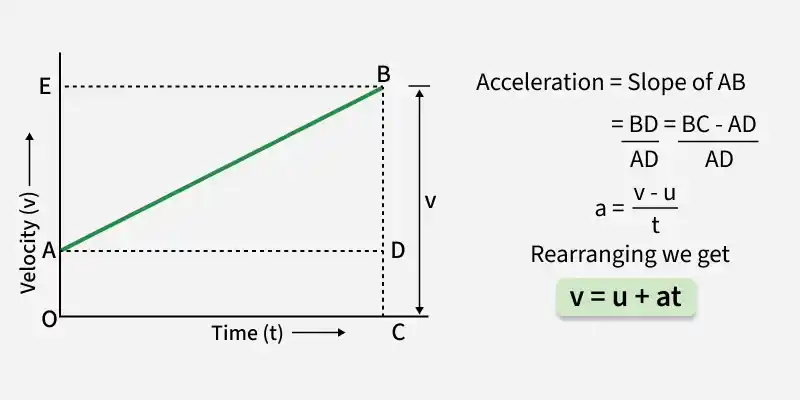
1. Derivation of First Kinematic Formula
We have, Acceleration = Change in Velocity / Time ⇒ a = Δv / Δt
We can now use the definition of velocity change v-v0 to replace Δv ⇒ a = (v-u)/Δt.
v = u + aΔt
This becomes the first kinematic formula if we agree to just use t for Δt.
\boxed {{v}=u +at}
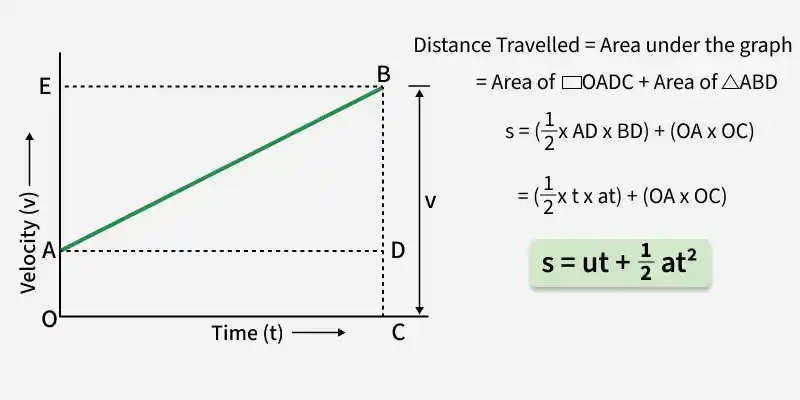
2. Derivation of Second Kinematic Formula
Average Velocity = Δx/t = (v + u)/2
put v = u + at, we get ⇒ s/t = (u+at+u)/2
s/t = u+ at/2
Finally, to obtain the third kinematic formula,
\boxed {s=ut+\frac{1}{2}at^{2}}
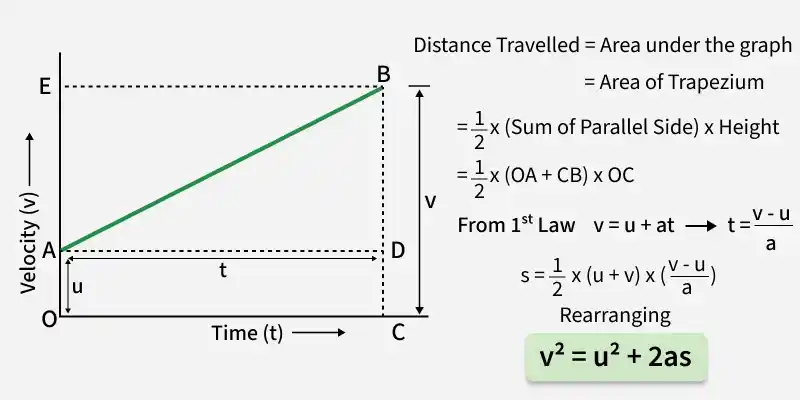
3. Derivation of Third Kinematic Formula
From the second kinematic formula, ⇒ Δx = ((v+u)/2)t
As we know v = u + at ⇒ t = (v - u)/a
Put the value of t in the second kinematic formula, we get
Δx = ((v+u)/2) × ((v-u)/a)
Δx = (v2-u2)/2a
We get the third kinematic formula by solving for v.
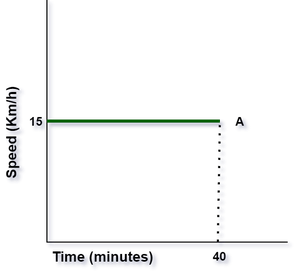
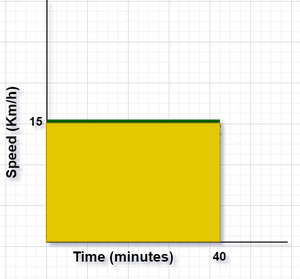
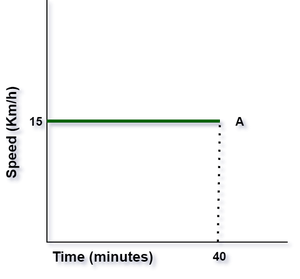
Problem 1: Speed-time graph for a particle is given below, find the distance covered by the particle in 40 minutes.
Speed-Time Plot
Solution: Calculating distance using the area under the speed-time graph.
Area under the given curve.
Distance covered by the particle in 40 min = Area under the given curve.
The shape formed under the curve is of a rectangle therefore, the area under the curve = length × width.
Here, the length of the shape is equivalent to the time taken i.e. 40 min or 40 min × 60 s/1 min = 2400 s.
Similarly, the width of the shape is equivalent to the speed i.e. 15 km/h or 15 km/h × 1 h/3600 s × 1000 m/1 km = 4.17 m/s.
Therefore, the area under the curve or the distance covered in 40 min is given by:
⇒ 2400 s × 4.17 m/s = 10000 m or 10 km.
Hence, the distance covered by the particle in 40 min is equal to 10 km.
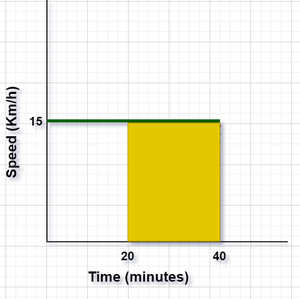
Problem 2: For the Below, graph calculates the distance covered by the particle between the time 20 minutes to 40 minutes.
Speed-Time plot
Solution: Distance covered by the particle from time t = 20 min to 40 min is equal to the Area under the given curve between the given time range.
Highlighted Area of Speed-time Plot
The shape formed under the curve is of a rectangle therefore, the area under the curve = length × width.
Here, the length of the shape is equivalent to the time taken i.e. (40 - 20) min or 20 min × 60 s/1 min = 1200 s.
Similarly, the width of the shape is equivalent to the speed i.e. 15 km/h or 15 km/h × 1 h/3600 s × 1000 m/1 km = 4.17 m/s.
Therefore, the area under the curve or the distance covered from time t = 20 min to 40 min is given by:
⇒ 1200 s × 4.17 m/s = 5004 m or 5.004 km.
Hence, the distance covered by the particle from time t = 20 min to 40 min is equal to 5.004 km.
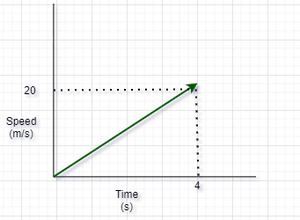
Problem 3: Find the distance covered by a particle during the time interval t = 0 s and t = 4 s for which the speed-time graph is given below:
Speed-time plot
Solution: Distance covered by the particle in t = 0 s and t = 4 s is equal to area under the curve.
The shape formed under the curve is of a triangle therefore, the area under the curve = 1/2 × base × height.
Here, the base of the shape is equivalent to the time taken i.e. 4 s.
Similarly, the height of the shape is equivalent to the speed i.e. 20 m/s.
Therefore, the area under the curve or the distance covered in t = 0 s and t = 4 s is given by:
⇒ 1/2 × 4 s × 20 m/s = 40 m.
Hence, the distance covered by the particle in t = 0 s and t = 4 s is equal 40 m.
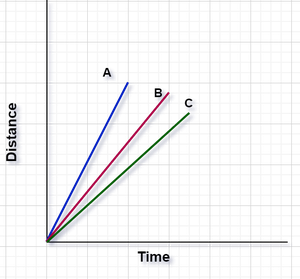
Problem 4: The figure below shows the distance-time graph of three objects A, B, and C. Determine:
(a) which object is moving with a greater speed?
(b) which object is moving with a lesser speed?
Distance-Time Plot
Solution: The given graph is distance time graph and the slope gives us the value of speed i.e. more the slope more is speed.
As it is observed from the given graph, A has maximum slope, so it is moving with greater speed and C has the least slope, so it is moving with the slowest speed.
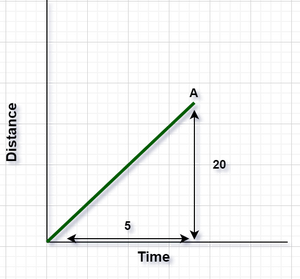
Problem 5: Calculate the speed of the particle with the help of the given distance-time motion graph.
Distance-Time Plot
Solution: Here, the speed of the particle is equal to the slope of the graph.
And the slope of the distance graph is equal to the speed of the particle.
Therefore, the formula to calculate the speed of the particle is:
Speed = Distance / Time
= 20 m / 5 s
= 4 m/s.
Hence, the speed of the particle is equal to 4 m/s.