
Elasticity refers to the ability of a material to return to its original shape, size, or volume after being deformed by an external force such as stress.
When a force is applied to a rigid object, it undergoes changes in its dimensions. As a result, strain, which is the deformation or displacement caused by stress, occurs. However, once the force is removed, the material naturally seeks to return to its initial state.
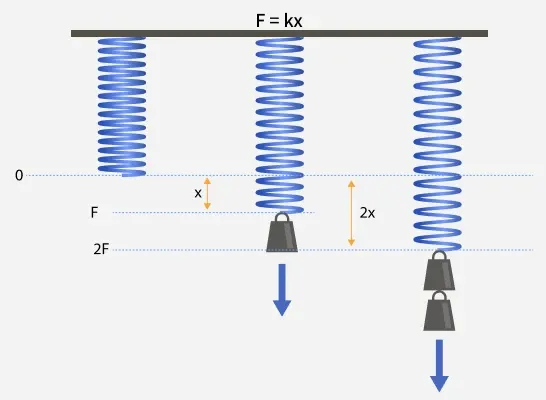
- This property is known as elasticity, and it allows a material to recover its original form after deformation.
- The SI unit of elasticity is the pascal (Pa), which represents the force applied per unit area, and its dimensional formula is [ML-1T-2].
Stress
Stress is the internal resistance of a material to deformation when an external force is applied. It is defined as the force per unit area and measures how much force is acting on a given surface.
When a force F is applied uniformly over a surface area A, stress is defined as the force exerted per unit area.
Stress= \frac{Force}{ Area}
The SI unit of stress is Newton per square meter (N/m²).
Stress can be classified into three types:
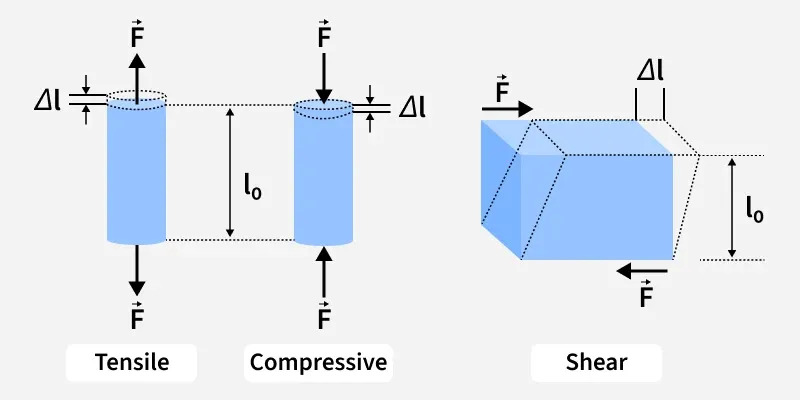
- Tensile Stress: The stress produced when a material is stretched or pulled.
- Compressive Stress: The stress produced when a material is compressed or squashed.
- Shear Stress: The stress produced when a material experiences forces parallel to its surface.
Strain
Strain is the measure of the deformation of a material in response to applied stress. Unlike stress, strain is a dimensionless quantity because it represents the ratio of the change in dimension to the original dimension.
Formula
Strain=\frac {Change \ in \ dimension} {initial \ dimension}
Strain can also be classified into three types:
- Tensile Strain: The relative elongation or stretching of a material.
- Compressive Strain: The relative shortening or compression of a material.
- Shear Strain: The deformation caused by forces acting parallel to the surface, resulting in angular displacement.
The angle of shear quantifies the relative displacement between two parts of the material under stress.
tan Φ= \frac{Δx}{L}
Where;
- Δx is the shear displacement (the relative lateral shift),
- L is the original length of the material,
- Φ is the angle of shear.
Relationship Between Stress and Strain
The relationship between stress and strain is governed by Hooke's Law (for elastic materials), which states that, within the elastic limit, stress is directly proportional to strain:
σ=E⋅ε
Where;
- σ is the stress,
- E is Young's Modulus (a material constant),
- ε is the strain.
This proportionality holds true as long as the material is within its elastic limit, means it will return to its original shape once the applied force is removed.
Stress - Strain Curve
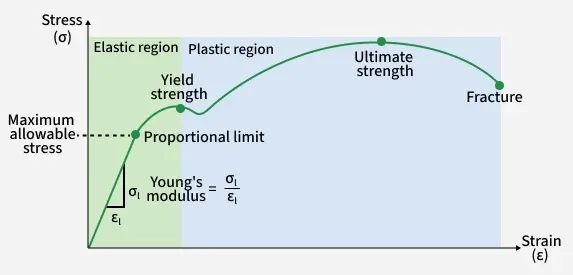
In this Graph
The X-axis represents strain (ε), a unitless measure of material deformation, while the Y-axis represents stress (σ), the force applied per unit area, measured in Pascals (Pa) or Newtons per square meter (N/m²).
Elastic Region (Green): In this region, the material returns to its original shape when stress is removed, with the stress-strain relationship being linear and following Hooke’s Law, allowing Young’s Modulus (E) to be calculated as E = -σ1/ε1, where σ1 is stress and ε1 is strain.
Proportional Limit: This is the point where the material stops following a linear stress-strain relationship, but stress remains reversible, allowing the material to return to its original shape.
Yield Strength: This marks the beginning of permanent deformation, where the material starts to behave plastically and cannot return to its original shape.
Plastic Region (Blue): Deformation becomes permanent, and the material will not return to its original shape once stress is removed, with stress continuing to increase until the material can no longer withstand it.
Ultimate Strength: This is the maximum stress the material can withstand before it begins to fail.
Fracture Point: The point at which the material breaks, and the stress exceeds the material's capacity to resist deformation.
Maximum Allowable Stress: This is the safe limit for material design, ensuring that the stress applied to a material stays below the yield strength to avoid permanent deformation.