
Vectors are mathematical entities used to represent quantities that have both magnitude and direction. They are commonly used in physics, engineering, computer science, and many other fields to describe various physical and abstract phenomena. The real-life applications of vectors are given below:
1. Applications in Physics
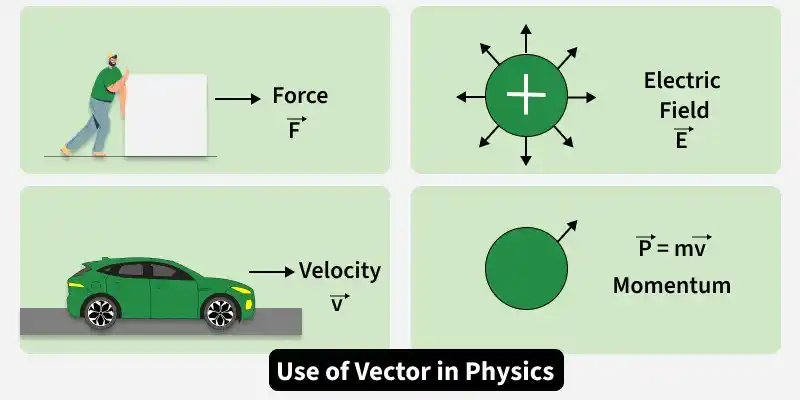
Vectors play an important role in physics. They are used to represent physical quantities such as force, velocity, acceleration, and momentum. For example, in mechanics, forces acting on objects are represented as vectors, allowing engineers and physicists to analyze and predict the motion of the objects. Additionally, vectors are essential in electromagnetism, where they describe electric and magnetic fields and their interactions with charged particles.
2. Engineering and Structural Analysis
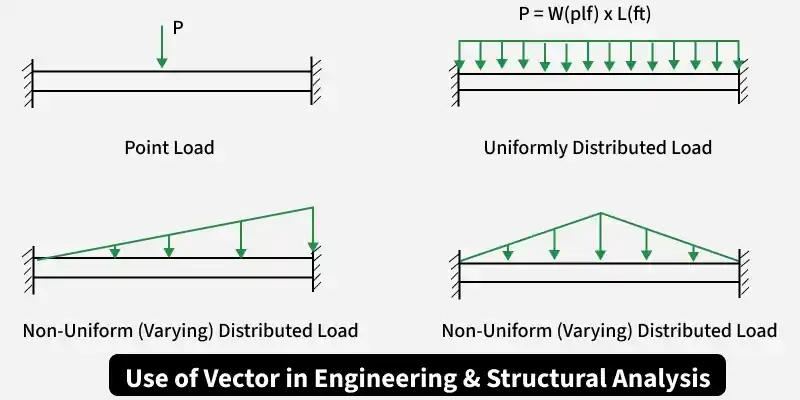
In engineering, vectors are extensively utilized in structural analysis and design. Engineers use vectors to represent various forces acting on structures, such as tension, compression, and shear forces. By analyzing these vectors, engineers can determine the stability and strength of the structures and design efficient and safe engineering solutions. For instance, in civil engineering, vectors are employed to analyze the forces acting on bridges, buildings, and other infrastructure projects.
3. Computer Graphics and Animation
Vectors are essential in computer graphics and animation, where they are used to represent geometric transformations, such as translation, rotation, and scaling. The graphics programmers utilize vectors to define the positions and orientations of the objects in virtual environments, enabling the creation of realistic simulations and visual effects. The vectors also facilitate the rendering of the 2D and 3D graphics, allowing the developers to create immersive gaming experiences and visually appealing user interfaces.
4. Navigation and GPS Systems
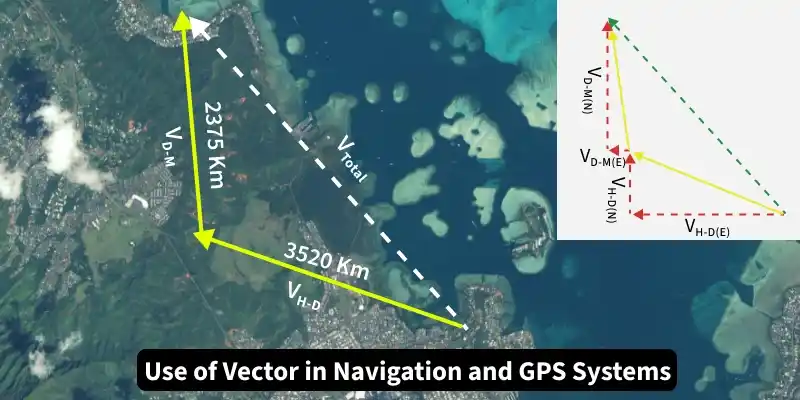
In navigation systems and GPS devices, vectors are used to represent positions, velocities, and directions of movement. By calculating the vector between the current location and the destination, GPS devices can provide the accurate directions for the users to navigate from the one point to the other.
5. Fluid Dynamics
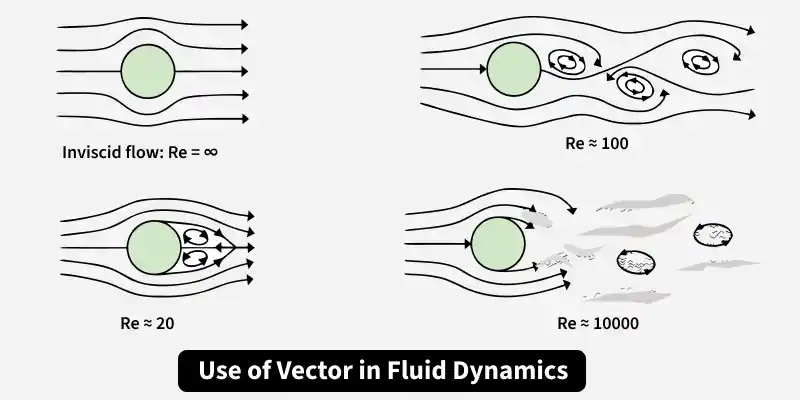
In fluid mechanics and aerodynamics, vectors are used to describe fluid flow, pressure distributions, and forces acting on objects immersed in fluids. They help engineers to analyze and optimize designs of pumps, turbines, aircraft wings, and other fluid-handling devices.
Real-life experiments based on Vector
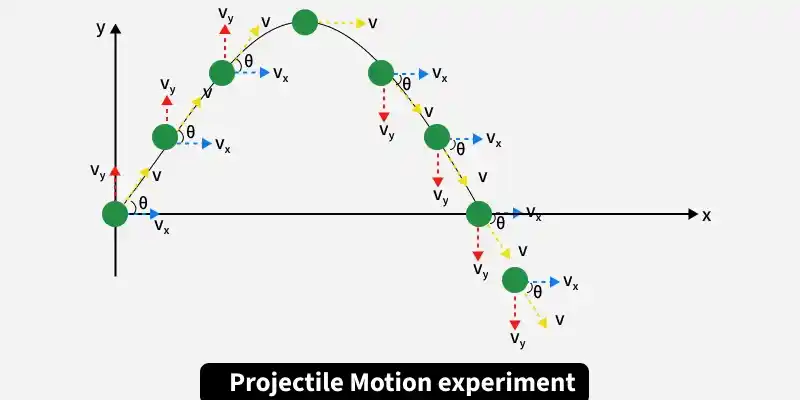
1. Projectile Motion Experiment
In physics, an experiment can be conducted to study projectile motion. By launching a projectile (such as a ball) at different angles and velocities and measuring its trajectory, distance, and time of flight, researchers can analyze the motion in terms of vectors, including initial velocity, acceleration, and displacement.
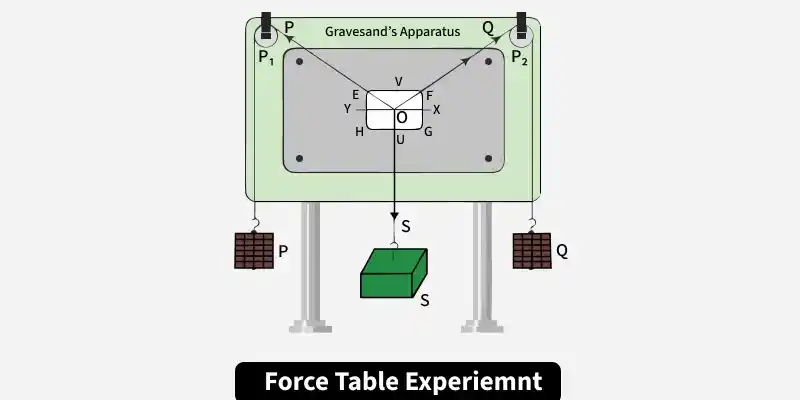
2. Force Table Experiment
A force table experiment is often performed in physics laboratories to study the principles of vector addition and equilibrium of forces. By applying known forces using weights or spring balances at various angles and magnitudes on a force table, students can use vector addition to determine the resultant force and its direction.
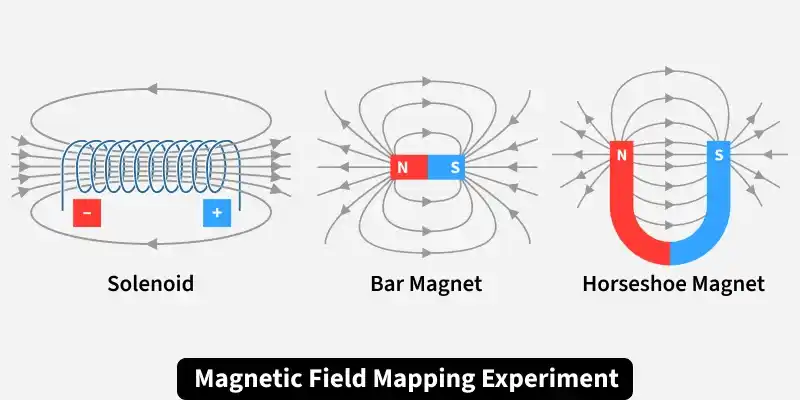
3. Magnetic Field Mapping Experiment
In physics and engineering, experiments can be conducted to map out magnetic fields using vector measurements. By placing a magnetic sensor at different positions around a magnet or electromagnet and recording the magnetic field strength and direction, researchers can create vector maps of the magnetic field lines.
Also, Check