
Optics is a branch of physics that focuses on the study of light and its properties. It explores how light behaves when it interacts with different materials and travels through various mediums. The field covers a wide range of phenomena, including how light bends, bounces, scatters, and is absorbed by objects.
Reflection and Refraction are two key processes in optics. Reflection occurs when light bounces off a surface, while refraction happens when light passes through a substance and bends. Both processes are important for optical devices like mirrors, lenses, and prisms to function.
Applications of Optics in Real Life
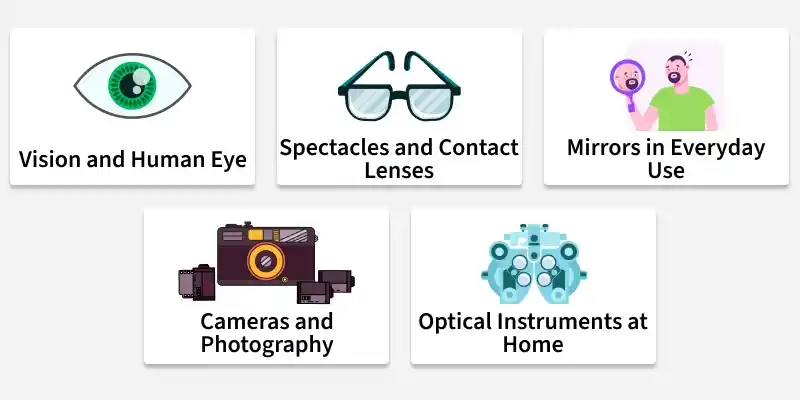
1. Vision and Human Eye
- The human eye works on the principles of refraction and image formation.
- Light enters the eye through the cornea and lens and forms an image on the retina.
- Optics helps us understand how we see colors, shapes, and distances.
2. Spectacles and Contact Lenses
- Used to correct vision defects like myopia, hypermetropia, and astigmatism.
- Convex and concave lenses adjust the path of light to focus images correctly on the retina.
- Contact lenses work on the same optical principles as spectacles.
3. Mirrors in Everyday Use
- Plane mirrors are used for grooming and decoration.
- Convex mirrors are used as rear-view mirrors in vehicles to provide a wider field of view.
- Concave mirrors are used in shaving mirrors and headlights.
4. Cameras and Photography
- Cameras use lenses to focus light and form clear images on sensors or films.
- Smartphone cameras, CCTV cameras, and digital cameras are all based on optics.
- Optical principles help control focus, zoom, brightness, and clarity.
5. Optical Instruments at Home
- Devices like magnifying glasses, binoculars, and microscopes are common applications of optics.
- They help in reading small text, observing distant objects, and studying tiny organisms.
Applications of Optics in Technology
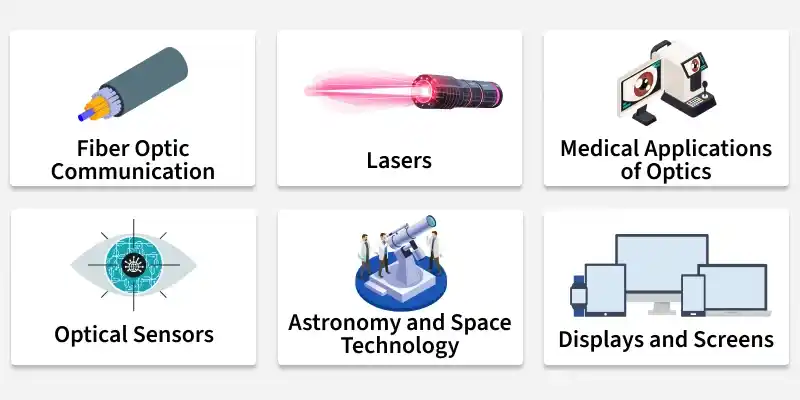
1. Fiber Optic Communication
- Optical fibers transmit information in the form of light signals.
- Used in internet, telephone networks, cable TV, and data transmission.
- Provides high-speed communication with very low signal loss.
2. Lasers
- LASER stands for Light Amplification by Stimulated Emission of Radiation.
- Used in barcode scanners, laser printers, CD/DVD players, and laser pointers.
- Also used in cutting, welding, and medical treatments.
3. Medical Applications of Optics
- Endoscopy uses optical fibers to view internal organs.
- Laser surgery is used in eye treatments (LASIK), cancer therapy, and skin treatments.
- Optical imaging techniques help in diagnosis and treatment.
4. Optical Sensors
- Used to detect light, colour, motion, and temperature.
- Applications include automatic street lights, security systems, and smartphone sensors.
- Play a key role in automation and smart devices.
5. Astronomy and Space Technology
- Telescopes use lenses and mirrors to observe distant stars and galaxies.
- Optical instruments help scientists study planets, black holes, and cosmic radiation.
- Space observatories rely heavily on optics.
6. Displays and Screens
- TV screens, mobile phones, and computer monitors use optical principles to display images.
- Technologies like LED, LCD, and OLED are based on light emission and control.