Atomic orbitals are regions in an atom where the probability of finding an electron is the highest. According to the quantum mechanical model of the atom, electrons do not move in fixed paths around the nucleus. Instead, they occupy certain regions of space called orbitals. These orbitals have specific shapes and sizes that help describe the distribution of electrons around the nucleus.
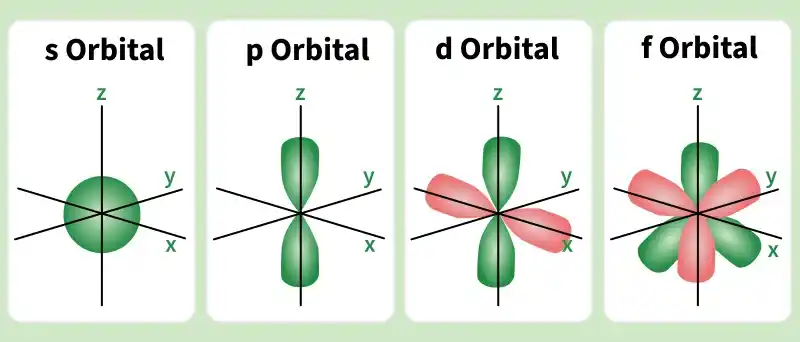
The shape of an atomic orbital mainly depends on the azimuthal quantum number (l), while its size depends on the principal quantum number (n). Different orbitals, such as s, p, d, and f, have different shapes and orientations in space. For example, the s orbital is spherical, the p orbital is dumbbell-shaped, and the d and f orbitals have more complex shapes
Atomic Orbitals
- Atomic orbitals are three-dimensional regions around the nucleus of an atom where the probability of finding an electron is highest.
- According to the Quantum Mechanical Model of the Atom, electrons do not move in fixed circular paths like planets around the sun.
- Instead, they exist in specific regions of space called orbitals.
- Each atomic orbital can hold a maximum of two electrons, and these electrons have opposite spins.
- Orbitals are described using quantum numbers, which determine their energy, shape, size, and orientation in space.
- Atomic orbitals play an important role in understanding the electronic configuration of atoms, chemical bonding, and the arrangement of electrons in different energy levels.
- By studying atomic orbitals, scientists can explain many chemical properties and reactions of elements.
Shapes of Atomic Orbitals
Atomic orbitals are regions around the nucleus where electrons are most likely to be found. Based on their shapes and energy levels, atomic orbitals are mainly classified into four types. These orbitals differ in their shapes, orientations, and the number of electrons they can hold.
1) Shape of s-Orbital
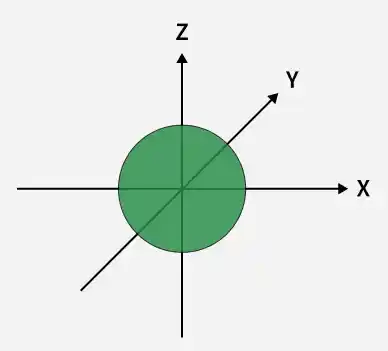
- The s orbital has a spherical shape around the nucleus.
- This means the probability of finding an electron is the same in all directions at a certain distance from the nucleus.
- Because of this symmetry, the s orbital looks like a sphere with the nucleus at its center.
- There is only one s orbital in each energy level, and it can hold a maximum of two electrons. As the principal quantum number increases, the size of the s orbital also increases.
Example:
The 1s orbital of the hydrogen atom is the simplest orbital and has a spherical shape around the nucleus.
2) Shape of p-Orbital
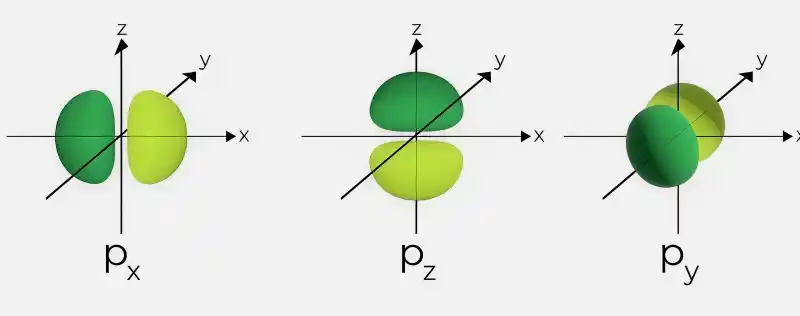
- The p orbital has a dumbbell shape with two lobes on opposite sides of the nucleus.
- These two lobes represent the regions where the probability of finding an electron is highest.
- Between the two lobes there is a nodal plane that passes through the nucleus where the probability of finding an electron is zero.
- There are three p orbitals in each energy level starting from the second shell.
- These are px, py, and pz, and they are oriented along the x, y, and z axes in space. Each p orbital can hold two electrons, so the p subshell can contain a maximum of six electrons.
Example:
In the second energy level of carbon or oxygen atoms, electrons occupy the 2p orbitals, which have the dumbbell shape oriented along different axes.
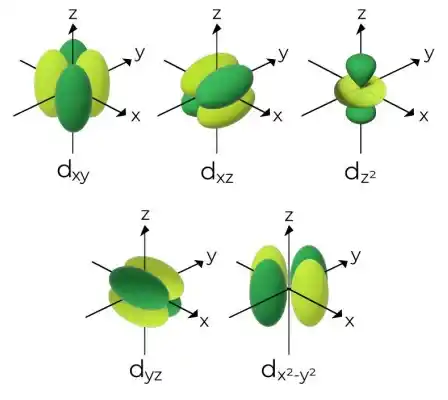
3) Shape of d-Orbital
- The d orbitals have more complex shapes compared to s and p orbitals.
- Most d orbitals have a cloverleaf shape, consisting of four lobes arranged around the nucleus. These lobes lie in different planes in space.
- There are five d orbitals, which are named dxy, dyz, dxz, dx²–y², and dz².
- Among these, four orbitals (dxy, dyz, dxz, dx²–y²) have the cloverleaf shape.
- The dz² orbital is slightly different; it has two lobes along the z-axis and a ring-shaped region around the center.
- Each d orbital can hold two electrons, so the d subshell can contain a maximum of 10 electrons.
- The d orbitals start appearing from the third energy level (3d).
Example:
Elements like iron (Fe) and copper (Cu) have electrons in the 3d orbitals, which influence their chemical and magnetic properties.
4) Shape of f-Orbital
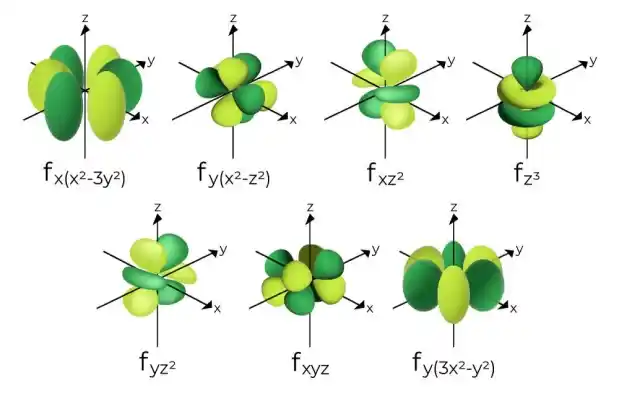
- The f orbitals have very complex shapes with multiple lobes.
- Their shapes are more complicated than s, p, and d orbitals and are difficult to represent simply.
- There are seven f orbitals, and each orbital can hold two electrons, so the f subshell can contain a maximum of 14 electrons.
- The f orbitals start appearing from the fourth energy level (4f).
- These orbitals are mainly found in elements known as the lanthanides and actinides, which are placed at the bottom of the periodic table.
Example:
Elements such as cerium (Ce) and uranium (U) contain electrons in f orbitals, which contribute to their unique chemical properties.