
Redox reactions are chemical reactions in which oxidation and reduction occur simultaneously. These reactions involve the transfer of electrons from one substance to another. The substance that loses electrons undergoes oxidation, while the substance that gains electrons undergoes reduction.
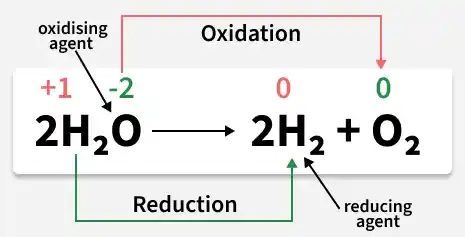
Oxidation and Reduction Reactions
Oxidation is defined as the loss of electrons by a substance, while reduction is the gain of electrons.
- Oxidation can also be described as the addition of oxygen or removal of hydrogen, whereas reduction involves the removal of oxygen or addition of hydrogen.
- In any chemical reaction, oxidation and reduction occur simultaneously, as the electrons lost by one substance are gained by another.
Example:
Zn + Cu 2+ → Zn 2++ Cu
In this reaction:
- Zinc loses electrons and is oxidized:
Zn → Zn2+ + 2e⁻
- Copper ions gain electrons and are reduced:
Cu2+ + 2e⁻ → Cu
Thus, zinc undergoes oxidation and copper undergoes reduction.
Oxidizing and Reducing Agent
- An oxidizing agent is a substance that causes oxidation of another substance by accepting electrons and itself gets reduced.
- A reducing agent is a substance that causes reduction of another substance by donating electrons and itself gets oxidized.
Example:
Zn + Cu2+ → Zn2+ + Cu
- Zn loses electrons and acts as a reducing agent
- Cu2+ gains electrons and acts as an oxidizing agent
Types of Redox Reactions
Redox reactions can be classified into different types based on the nature of the chemical change involved:
1. Combination Reactions
In these reactions, two or more substances combine to form a single product. Magnesium is oxidized and oxygen is reduced.
Example:
2Mg + O2 → 2MgO
2. Decomposition Reactions
In these reactions, a single compound breaks down into two or more simpler substances. Potassium chlorate undergoes both oxidation and reduction.
Example:
2KClO3 → 2KCl + 3O2
3. Displacement Reactions
In these reactions, one element displaces another from its compound. Zinc displaces copper and gets oxidized, while copper ions are reduced.
Example:
Zn + Cu 2+ → Zn 2+ + Cu
Balancing Redox Reaction
There are two ways of balancing the redox reaction. One method is by using the change in oxidation number of oxidizing agent and the reducing agent and the other method is based on dividing the redox reaction into two half reactions-one of reduction and another for oxidation.
1. Oxidation Number Method
In this method, the oxidation numbers of elements are determined. The increase in oxidation number (oxidation) and decrease in oxidation number (reduction) are balanced by adjusting coefficients.
Example:
6Fe2+ + Cr₂O₇2- + 14 H + → 6Fe3+ + 2Cr3+ + 7 H2O
- Fe2+ → Fe3+ (increase in oxidation number → oxidation)
- Cr₂O₇2- → Cr3+ (decrease in oxidation number → reduction)
2. Half-Reaction Method
In this method, the reaction is divided into two separate half-reactions: one for oxidation and one for reduction. Each half-reaction is balanced individually and then combined.
Example:
Zn + Cu2+ → Zn2+ + CuOxidation:
Zn → Zn2+ + 2e⁻Reduction:
Cu2+ + 2e⁻ → CuAdding both gives the balanced equation.