
A buffer solution is a solution that resists change in pH when small amounts of acid or base are added to it. This means that even if we add a little acid (H⁺ ions) or base (OH⁻ ions), the pH of the solution remains almost constant. Buffers are very important in chemistry because many reactions and processes require a stable pH to occur properly.
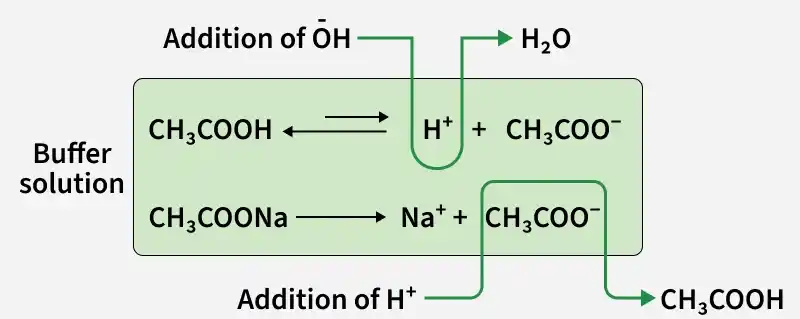
Example:
- Acetic acid (weak acid) + sodium acetate (its salt) forms an acidic buffer
- Ammonia (weak base) + ammonium chloride (its salt) forms a basic buffer
Properties of Buffer Solution
Buffer solutions have special properties that allow them to maintain a nearly constant pH even when small amounts of acid or base are added.
1. Resistance to pH Change
When a small amount of acid (H⁺) is added, the buffer neutralizes it. When a small amount of base (OH⁻) is added, the buffer neutralizes it. The pH changes very slightly instead of changing drastically.
2. Depends on Composition of Buffer
The pH of a buffer depends on: The ratio of salt to acid (or base) and not just their individual amounts. If the ratio remains constant, the pH remains constant. This is why buffers work even after dilution (to some extent).
3. Buffer Capacity
Buffer capacity is the amount of acid or base a buffer can absorb without significant change in pH. It depends on concentration of buffer components.
4. Slight Change on Dilution
When a buffer is diluted: Its pH remains almost the same, but buffer capacity decreases
5. pH depends on ratio (Henderson–Hasselbalch concept)
The pH of a buffer depends on the ratio of concentrations, not absolute values:
pH = pK_a + \log \frac{[\text{salt}]}{[\text{acid}]}
6. Effective pH range
- Buffer is most effective when: [acid] ≈ [salt]
- Effective range: pH = pKa ± 1
Types of Buffer Solutions
Buffer solutions are classified into two main types based on their nature and the components used to maintain the pH.
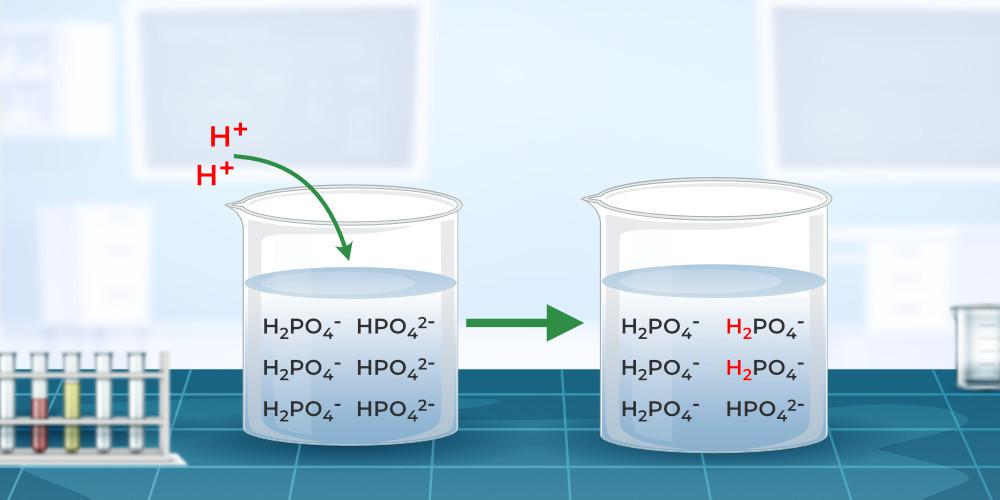
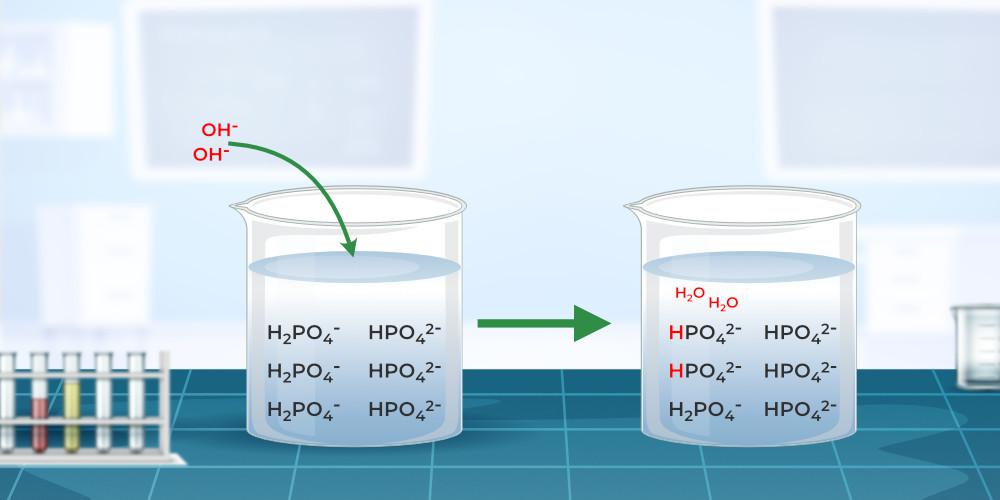
1. Acidic Buffers
An acidic buffer is a buffer solution that maintains a slightly acidic pH (less than 7).It is prepared by mixing: A weak acid and Its salt with a strong base.
- The weak acid controls the H⁺ ions
- The salt provides a common ion (CH₃COO⁻), helping in maintaining equilibrium
- It resists changes when acid or base is added
Example:
Acetic acid (CH₃COOH) + Sodium acetate (CH₃COONa)
2. Alkaline Buffers
A basic buffer is a buffer solution that maintains a slightly basic pH (greater than 7). It is prepared by mixing: A weak base and Its salt with a strong acid.
- The weak base controls OH⁻ ions
- The salt provides a common ion (NH₄⁺), maintaining equilibrium
- It resists changes when acid or base is added
Example:
Ammonium hydroxide (NH₄OH) + Ammonium chloride (NH₄Cl)
Mechanism of Buffer Solution
The mechanism of a buffer solution explains how it resists change in pH when small amounts of acid or base are added. This happens because the buffer contains components that neutralize added H⁺ or OH⁻ ions.
1. Acidic Buffer Mechanism (Weak Acid + Salt)
The solution contains: Weak acid (CH₃COOH) and Common ion (CH₃COO⁻ from salt)
a. When acid (H⁺) is added:
CH3COO - + H+ → CH3COOH
- The added H⁺ is removed by acetate ion
- So, pH does not decrease much
b. When base (OH⁻) is added:
CH3COOH + OH - → CH3COO - + H2O
- The weak acid neutralizes OH⁻
- So, pH does not increase much
2. Basic Buffer Mechanism (Weak Base + Salt)
The solution contains: Weak base (NH₄OH) and Common ion (NH₄⁺ from salt)
a. When acid (H⁺) is added:
NH4OH + H + → NH4+ + H2O
- Weak base neutralizes the acid
- pH does not decrease much
b. When base (OH⁻) is added:
NH4+ + OH - → NH4OH
- Ammonium ion neutralizes OH⁻
- pH does not increase much
Preparation of Buffer Solution
Buffer solutions are prepared by mixing appropriate components so that they can resist changes in pH. The method depends on whether we want an acidic buffer or a basic buffer.
1. Preparation of Acidic Buffer
An acidic buffer is prepared by mixing: A weak acid and Its salt with a strong base
- Take a solution of weak acid
- Add its salt in required proportion
- Adjust the ratio to control pH
Example: Acetic acid (CH₃COOH) + Sodium acetate (CH₃COONa)
2. Preparation of Basic Buffer
A basic buffer is prepared by mixing: A weak base and Its salt with a strong acid
- Take a solution of weak base
- Add its salt in required proportion
- Maintain proper ratio for desired pH
Example: Ammonium hydroxide (NH₄OH) + Ammonium chloride (NH₄Cl)
Henderson-Hasselbalch Equation
The Henderson–Hasselbalch equation gives a mathematical relation between: pH of a solution, pKa (or pKb) and Ratio of salt to acid (or base). It is derived from the equilibrium of a weak acid or weak base and is very useful for calculating the pH of buffer solutions.
For Acidic Buffer:
\text{pH} = \text{p}K_a + \log_{10}\left(\frac{[\text{A}^-]}{[\text{HA}]}\right)
For Basic Buffer:
\text{pOH} = \text{p}K_b + \log_{10}\left(\frac{[\text{BH}^+]}{[\text{B}]}\right)
Where:
- pKa = −logKa
- pKb = −logKb
- Salt = provides conjugate ion
- Acid/Base = weak acid (HA) or weak base (B)
- pH + pOH = 14
Solved Examples
Example 1: What is the pH of a buffered solution of 1.5 M NH3 and 2.5 M NH4Cl when 0.5 M HCl is added to the solution?
Solution:
We know that,
pKb of ammonia is 4.75
pKa = 14 – pKb.
= 14 - 4.75 = 9.25
Now, on adding 0.5 M HCl
0.5 M H+ ions are available in the aqueous solution which reacts with 0.5 M NH3 to form 0.5 M NH4Cl
Now the remaining concentration of ammonia is 1 M and that of NH4Cl is 3 M.
Using the Henderson-Hasselbalch equation,
pKa + log ([salt]/[acid]) = 9.25 + log (3/1)
= 9.25 + 0.477
= 9.73