Hybridization is a concept introduced by Linus Pauling in which atomic orbitals of nearly equal energy mix together to form new equivalent orbitals called hybrid orbitals. These hybrid orbitals have the same energy and identical shape, and help explain the formation of covalent bonds and the geometrical arrangement of atoms in molecules.
Steps to determine the type of Hybridisation
To understand the type of hybridization in an atom or an ion, the following rules must be followed.
- First, determine the total number of valence electrons contained in an atom or ion.
- Then, count the number of lone pairs attached to that atom or ion.
- Now, the number of orbitals required can be calculated by adding the number of duplex or octet and the number of lone pairs of electrons.
- It should be noted that the geometry of orbitals in atoms or ions is different when there is no lone pair of electrons.
Features of Hybridization
The following features explain how hybridization takes place and why it is useful in determining molecular structure :
- Hybridization takes place between atomic orbitals of the same atom, not between different atoms.
- The atomic orbitals that participate in hybridization must have nearly equal energy.
- The number of hybrid orbitals formed is always equal to the number of atomic orbitals that are mixed.
- All hybrid orbitals formed are equivalent in energy and shape.
- Hybrid orbitals are more directional than pure atomic orbitals, which results in stronger covalent bonds.
- Hybridization helps in explaining the shape and bond angles of molecules.
- It mainly occurs in covalent compounds where electron sharing takes place.
Types of Hybridization
Hybridization can occur in different ways depending on the number and type of atomic orbitals that mix together. When different combinations of s, p, and d orbitals participate in the process, different types of hybrid orbitals are formed. These different types of hybridization help explain the various shapes and bond angles observed in molecules.
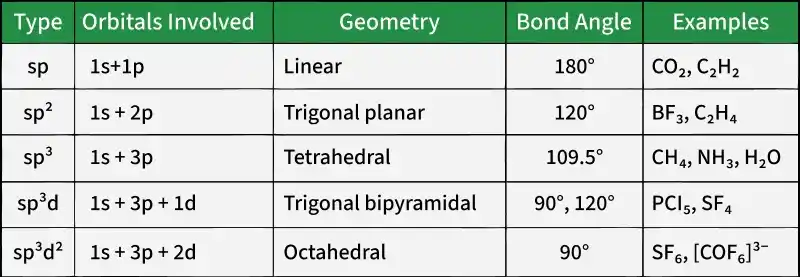
Based on the number of orbitals involved, hybridization is classified into types such as sp, sp2, sp3, sp3d, and sp3d2 .
1. sp Hybridization
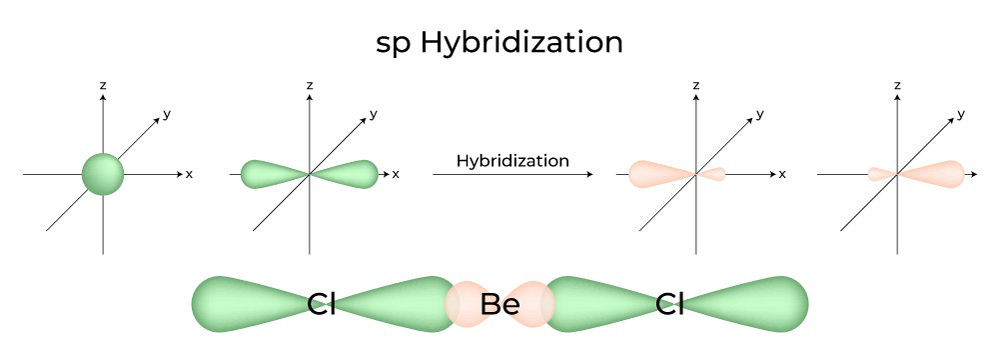
sp hybridization occurs when one s orbital and one p orbital of the same atom mix together to form two equivalent sp hybrid orbitals. The two sp hybrid orbitals are arranged in opposite directions to minimize repulsion. Therefore, the shape formed is linear.
In this process:
- 1s orbital + 1p orbital → 2 sp hybrid orbitals
- Two p orbitals remain unhybridized.
- Bond angle: 180°
- The remaining unhybridized p orbitals can form pi (π) bonds.
Example: BeF2 , BeH2 , BeCl2 , C2H2
2. sp2 Hybridization
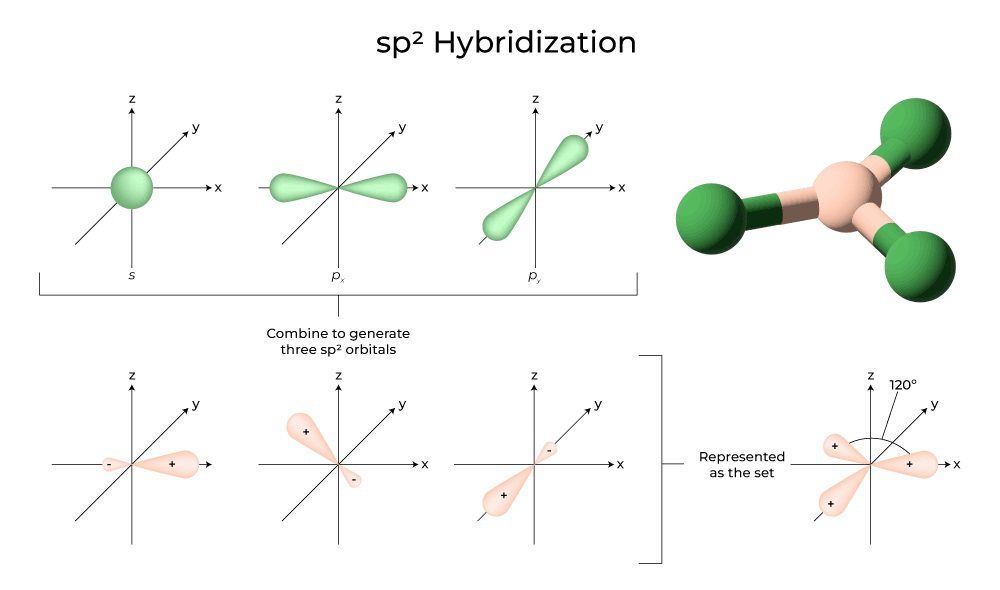
sp² hybridization occurs when one s orbital and two p orbitals of the same atom mix together to form three equivalent sp² hybrid orbitals. The three sp² hybrid orbitals lie in the same plane and are arranged at 120° to each other.
In this process:
- 1s orbital + 2p orbitals → 3 sp² hybrid orbitals
- One p orbital remains unhybridized.
- Shape: Trigonal planar
- Bond angle: 120°
- The remaining unhybridized p orbital forms a pi (π) bond.
Example: C2H4, BF3
3. sp3 Hybridization
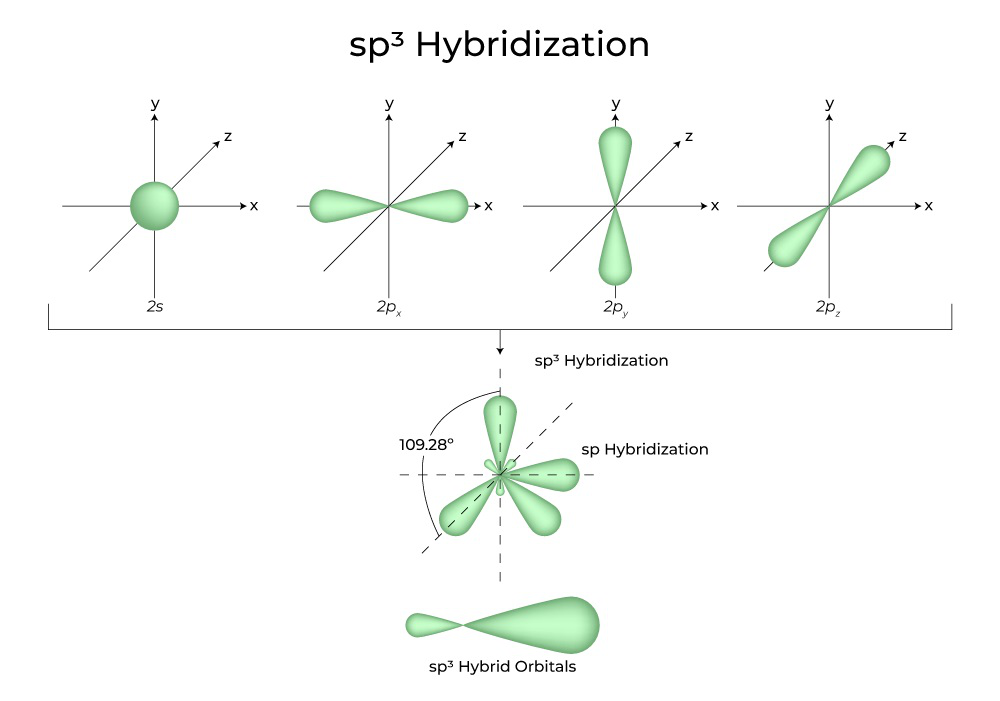
sp3 hybridization occurs when one s orbital and three p orbitals of the same atom mix together to form four equivalent sp3 hybrid orbitals. These four sp3 hybrid orbitals arrange themselves in space in such a way that repulsion between them is minimum. They point towards the four corners of a tetrahedron.
In this process:
- 1s orbital + 3p orbitals → 4 sp3 hybrid orbitals
- There are no unhybridized p orbitals left.
- Shape: Tetrahedral
- Bond angle: 109.5°
4. sp3d Hybridization
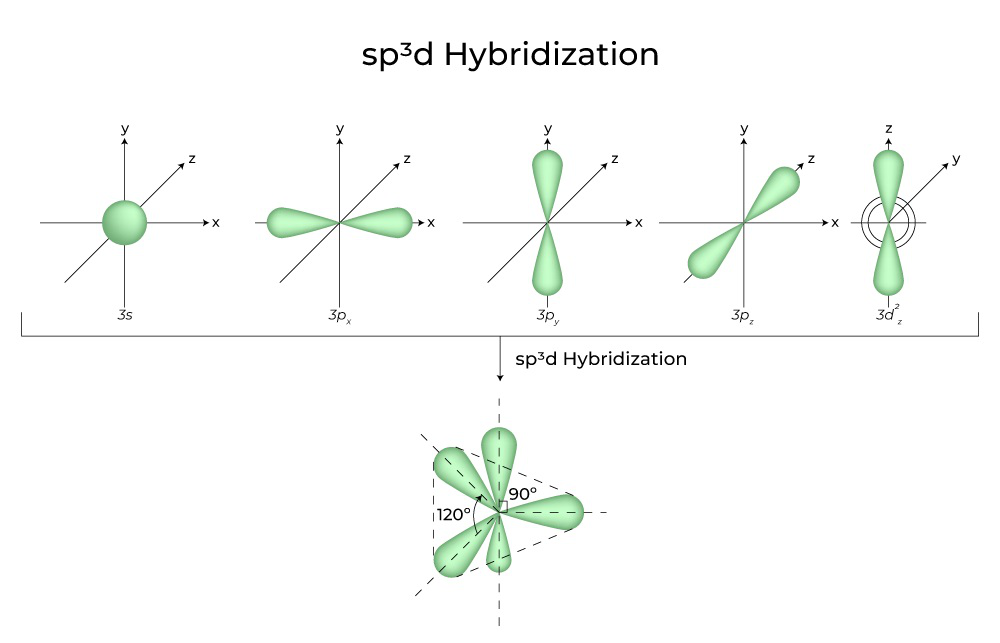
sp3d hybridization occurs when one s orbital, three p orbitals, and one d orbital mix together to form five equivalent sp3d hybrid orbitals. These five hybrid orbitals arrange themselves in space to minimize repulsion and form a trigonal bipyramidal shape.
In this process:
- 1s orbital + 3p orbitals + 1d orbital → 5 sp3d hybrid orbitals
- Shape: Trigonal bipyramidal
- Bond angles: 90° and 120°
- Three orbitals lie in one plane (equatorial positions) at 120°.
- Two orbitals lie above and below the plane (axial positions) at 90°.
Example: PCl5
5. sp3d2 Hybridization
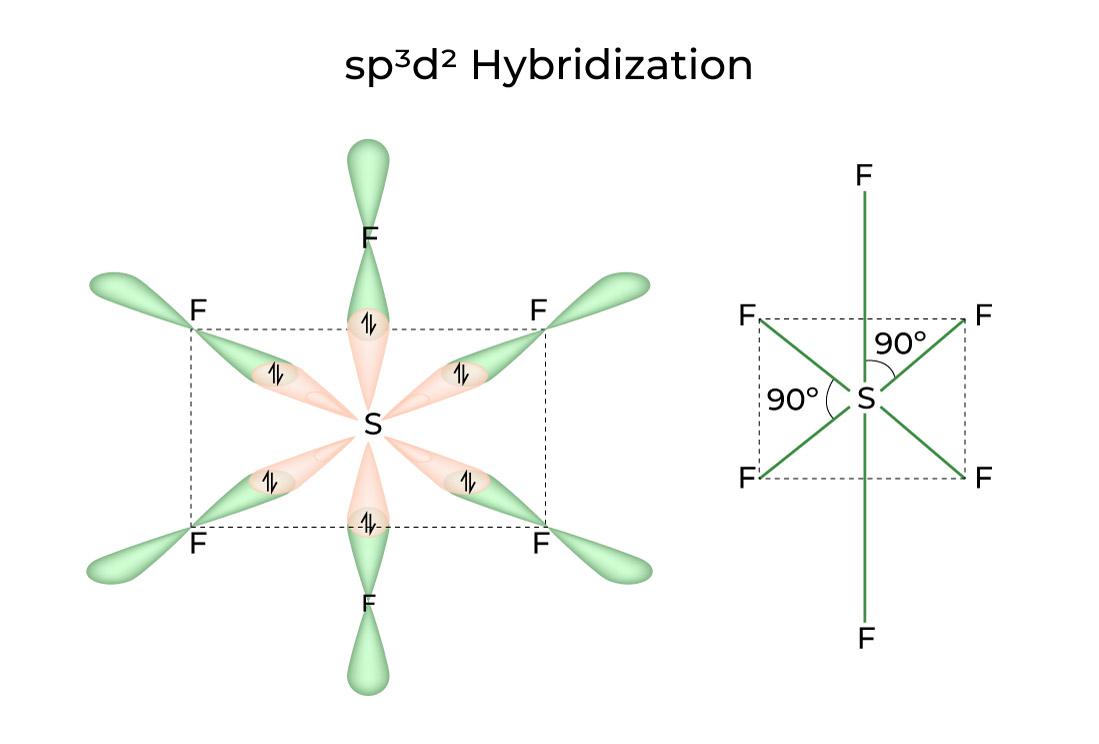
sp3d2 hybridization occurs when one s orbital, three p orbitals, and two d orbitals of the same atom mix together to form six equivalent sp3d2 hybrid orbitals. These six hybrid orbitals arrange themselves in space in such a way that repulsion between them is minimum. They point towards the six corners of an octahedron.
In this process:
- 1s orbital + 3p orbitals + 2d orbitals → 6 sp3d2 hybrid orbitals
- There are no unhybridized orbitals left after hybridization.
- Shape: Octahedral
- Bond angle: 90°
Example: SF6