
Ionic equilibrium is a part of chemical equilibrium that deals with equilibria involving ions in solution, especially in aqueous solutions. When electrolytes dissolve in water, they produce ions, and a dynamic equilibrium is established between the unionized molecules and the ions.
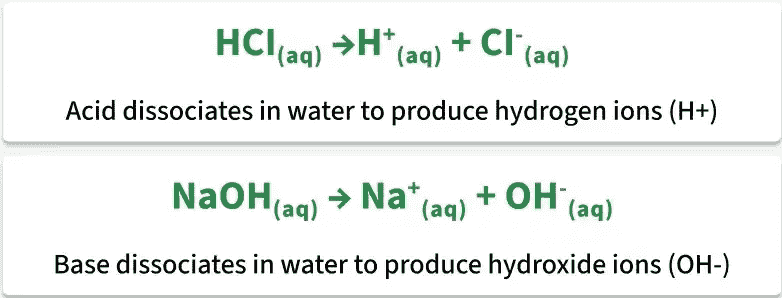
In aqueous solutions, substances behave differently depending on their ability to produce ions. On the basis of their ability to produce ions they are classified into two types:
- Non-electrolytes are substances that do not dissociate into ions when dissolved in water. Instead, they remain in the form of neutral molecules, so they cannot conduct electricity.
Examples: Glucose (C6H12O6), Urea , Ethanol
- Electrolytes are substances that dissociate into ions when dissolved in water and allow the solution to conduct electricity. It breaks into positive ions (cations) and negative ions (anions). These ions are responsible for the flow of electric current in the solution. They are classified into two types:
a) Strong electrolytes: They completely ionize in water.
Example: HCl, NaOH, NaCl
b) Weak electrolytes: They Partially ionize and establish equilibrium.
Example: CH3COOH, NH4OH
Ostwald’s Dilution Law: Degree of Dissociation
Ostwald’s Dilution Law explains the relationship between the degree of dissociation (α) of a weak electrolyte and its concentration. The degree of dissociation of a weak electrolyte increases with dilution (decrease in concentration).
For a weak electrolyte:
HA ⇌ H ⁺ + A ⁻
Let:
- Initial concentration = C
- Degree of dissociation = α
At equilibrium:
- [H⁺] = Cα
- [A⁻] = Cα
- [HA] = C(1 − α)
For a weak electrolyte:
K = (Cα × Cα) / C(1 − α)
So,
K = Cα² / (1 − α)
For weak electrolytes, α is very small, so:
(1 − α) ≈ 1
Therefore:
K ≈ Cα²
α = √(K / C)
Limitations of Ostwald’s Dilution Law
Although Ostwald’s dilution law successfully explains the behavior of weak electrolytes, it has certain limitations because it is based on ideal assumptions that are not valid for all types of electrolytes.
- Applicable only to weak electrolytes: Not valid for strong electrolytes (they are almost fully dissociated).
- Fails at high concentrations: Works only in dilute solutions.
- Does not consider interionic interactions: Assumes ions behave independently (which is not true in real solutions).
- Not accurate for strong acids and bases: Because they do not follow simple equilibrium behavior.
Degree of Ionization (α)
The degree of ionisation (α) is the fraction of total molecules that ionise into ions in a solution. It is defined as the ratio of the number of molecules ionised to the total number of molecules initially present.
\alpha = \frac{\text{Number of molecules ionised}}{\text{Total number of molecules}}
- If α = 1 → complete ionisation (strong electrolyte).
- If α < 1 → partial ionisation (weak electrolyte).
- α depends on concentration and temperature.
- For weak electrolytes, α increases on dilution.
- Helps determine strength of electrolyte.
Factors Influencing the Degree of Ionization
Degree of ionisation changes with conditions. These factors decide how much a substance ionises.
- Nature of Electrolyte: The degree of ionisation depends on whether the electrolyte is strong or weak. Strong electrolytes ionise almost completely. Weak electrolytes ionise only partially.
- Concentration: The degree of ionisation increases on dilution. When solution is diluted, ions move farther apart, so more molecules ionise . When concentration is high, ionisation is less.
- Temperature: Increase in temperature generally increases ionisation. Higher temperature provides energy to break bonds.More molecules convert into ions.
- Nature of Solvent: The solvent plays an important role in ionisation. Polar solvents (like water) stabilise ions. Non-polar solvents do not support ion formation.
- Presence of Common Ion: Addition of a common ion decreases ionisation. The equilibrium shifts backward (Le Chatelier’s principle). Fewer molecules ionise.
Ionization Constant
The ionisation constant is a measure of the extent to which an electrolyte ionises in solution. It is an equilibrium constant that represents the balance between ions and unionised molecules.
For a weak acid:
HA ⇌ H⁺ + A⁻
At equilibrium:
- Some molecules remain as HA.
- Some form ions H⁺ and A⁻.
The equilibrium constant for this reaction is called the ionisation constant (Ka).
Expression for Weak Acid
K_a = \frac{[H^+][A^-]}{[HA]}
Expression for Weak Base
For base:
BOH ⇌ B⁺ + OH⁻
K_b = \frac{[B^+][OH^-]}{[BOH]}
Common Ion Effect on Degree of Ionisation
The common ion effect is the decrease in the degree of ionisation (α) of a weak electrolyte when a strong electrolyte containing a common ion is added to the solution.
Consider a weak acid:
CH3COOH ⇌ CH3COO ⁻ + H ⁺
- When a salt like CH3COONa is added, it provides CH3COO ⁻ ions (common ion).
- This increases the concentration of one of the products.
- The reaction shifts backward.
- Less acid ionises.
- Hence, degree of ionisation decreases.