
As scientists discovered more and more elements, they tried to arrange them in a systematic way. Earlier classifications were mainly based on atomic mass, but they could not explain all the properties of elements correctly. Some elements were placed in the wrong positions, and isotopes could not be explained properly.
In 1913, after the discovery of atomic number by Henry Moseley, it was found that the properties of elements depend on their atomic number rather than their atomic mass. This discovery led to the formulation of the Modern Periodic Law, which forms the basis of the modern periodic table.
Statement
Dmitri Mendeleev observed a pattern among the elements: as their atomic masses increased, their chemical and physical properties repeated with prior elements. He named this property Mendeleev's Periodic Law. However, this law was not accurate for all elements, as only 63 were known at the time.
In an effort to improve upon Mendeleev's Periodic Law, Henry Moseley proposed the Modern Periodic Law, which states that
"The physical and chemical properties of the elements are periodic functions of their atomic numbers."
- It became clear that the properties of elements depend on their atomic number rather than their atomic mass.
- This discovery led to the formulation of the Modern Periodic Law, which forms the foundation of the modern periodic table.
Key Features
- It explains the periodic repetition of properties.
- When elements are arranged in increasing atomic number, similar electronic configurations repeat after regular intervals, and therefore, similar chemical properties also repeat.
- Another important feature is that it is based on the electronic configuration of atoms.
- Since atomic number determines the number of electrons in an atom, it directly controls the chemical behavior of elements.
- The Modern Periodic Law also successfully explains the correct position of isotopes, because isotopes have the same atomic number but different atomic masses.
- It also helps in understanding periodic trends such as atomic size, ionization energy, electronegativity, and metallic character across periods and down groups.
- Most importantly, this law forms the foundation of the Modern Periodic Table, which is the most accurate and widely accepted classification of elements today.
Modern Periodic Table
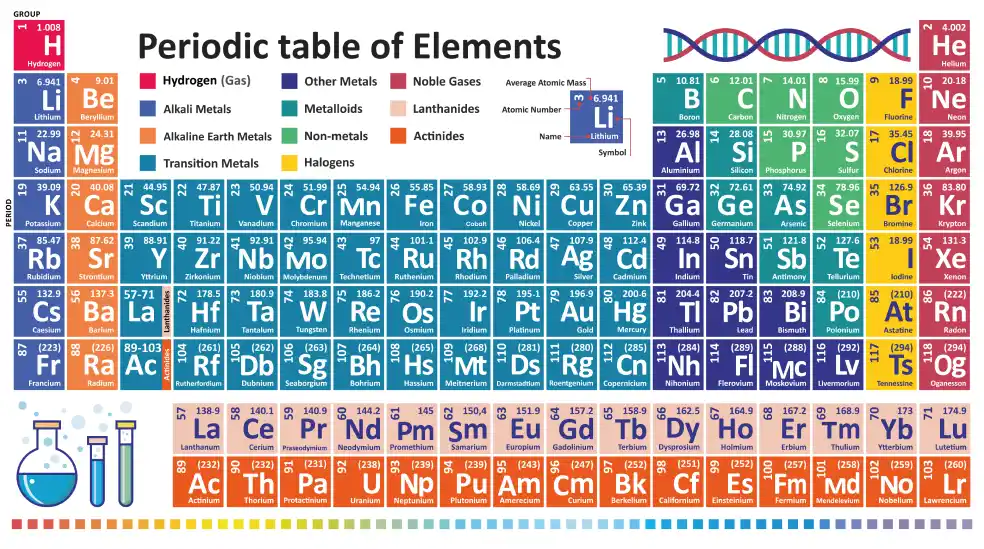
The Modern Periodic Table, also known as the long form of the Periodic Table, is a continuation of Mendeleev's work. The Modern Periodic Table is the systematic arrangement of elements based on their atomic number. It was developed after scientists discovered that the atomic number is the fundamental property that determines the chemical behaviour of an element.
In this table, elements are arranged in increasing order of atomic number, and elements with similar properties are placed in the same group. The Modern Periodic Table provides a clear and scientific way to study and compare the properties of elements.
Key Features
The Modern Periodic Table is based on the Modern Periodic Law given after the discovery of atomic number by Henry Moseley. Its main features are:
- Elements are arranged in order of increasing atomic number.
- The table has 18 groups and 7 periods.
- Elements in the same group have similar chemical properties.
- Elements in the same period have the same number of electron shells.
- The table is divided into s-block, p-block, d-block, and f-block elements.
- Isotopes occupy the same position because they have the same atomic number.
- It clearly shows periodic trends like atomic size, ionization energy, and metallic character.
- It is based on the Modern Periodic Law and gives a scientifically correct classification of elements.
Classification of the Elements in the Modern Periodic Table
The modern periodic table arranges elements according to their atomic numbers. To make the study of so many elements easier, scientists classify them into different groups based on their properties and electronic configuration. Elements that have similar properties are placed together. The four bases of classification are:
1. Classification Based on Groups
- Elements are arranged in vertical columns called groups.
- Elements in the same group have the same number of valence electrons and similar chemical properties.
Example: Group 1 elements (Li, Na, K) are all highly reactive metals.
2. Classification Based on Periods
- Elements are arranged in horizontal rows called periods.
- Elements in the same period have the same number of electron shells.
Example: All elements in Period 2 (Li to Ne) have 2 shells.
3. Classification Based on Blocks (Electronic Configuration)
- Elements are divided into s, p, d, and f blocks depending on the orbital in which the last electron enters.
Example:
4. Classification Based on Nature of Elements
- Elements are classified as metals, non-metals, and metalloids based on their physical and chemical properties.
Example: