
A thermodynamic system in equilibrium has a state variable called internal energy (E). According to the First Law of Thermodynamics, the change in internal energy equals the heat added to the system minus the work done by the system. Energy can only be transferred or converted; it can't be created or destroyed. Heat is a form of energy, so all thermodynamic processes follow the principle of energy conservation.
The equation for the first law of thermodynamics is given as
where
- ΔU is the change in the internal energy of the system.
- q is the net heat exchanged between the system and its surroundings
- W is the work done by or on the system during the process
Significance of the First Law of Thermodynamics: The first law of thermodynamics is based on the principle of energy conservation. This indicates that energy cannot be generated or destroyed, but it can shift into different forms without loss. The process affects both dQ and dW when a system transitions from one state to another. dU, on the other hand, is the same for all operations.
First Law of Thermodynamics for a Closed System
In a closed system, the work done is given by the product of the external pressure and the volume change:
W = − P ΔV
where P is the constant external pressure, and ΔV is the change in volume of the system. This type of work is known as pressure-volume work.
The internal energy of a system changes due to heat and work interactions across its boundaries. It increases when work is done on the system or heat is supplied and decreases when work is done by the system or heat is lost.
The law of energy conservation says that energy that moves between the system and its surroundings is equal and opposite:
ΔUsystem = −ΔUsurroundings
Where ΔUsystem is the change in the total internal energy of the system, and ΔUsurroundings is the change in the total energy of the surroundings.
Applications
1. Isothermal process
The temperature of an ideal gas remains constant during an isothermal process. This means that the heat supplied to the system is utilized to do work against the environment. So,
dQ = dU + dW
⇒ dQ = dW
2. Melting process
When a solid melts to a liquid, its internal energy increases. Let m = mass of the liquid and L = latent heat of the solid. Amount of heat absorbed by the system, dQ = mL.
A small amount of expansion occurs, i.e., ΔV = 0.
⇒ dW = PΔV = 0
So,
dQ = dU + dW
⇒ dU = mL
Thus, internal energy increases during the melting process.
3. Heat engines
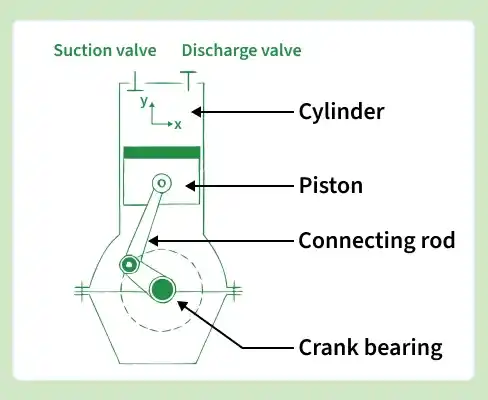
A heat engine is a common application of the First Law of Thermodynamics. It changes heat energy into mechanical energy. Most heat engines use a working fluid, usually a gas whose pressure, volume, and temperature change during a cycle.
When a gas is heated, it expands. If it is kept in a closed container, its pressure increases. In engines with a movable piston, this high pressure pushes the piston and makes it move. The movement of the piston produces mechanical work.
4. Refrigerators, air conditioners, and heat pumps
Refrigerators and heat pumps are devices that convert mechanical energy into heat. Most of them work as closed systems. When a gas is compressed, its temperature rises, and it can release heat to the surroundings. When the gas expands, its temperature drops, allowing it to absorb heat from the environment.
This is how air conditioners work; they don’t create cold but remove heat. A pump moves the working fluid outside to be compressed and heated, then the heat is released via an exchanger. Indoors, the fluid expands and cools, absorbing heat from the room.
A heat pump works like a reverse air conditioner. The compressed fluid releases heat to warm a building, then moves outside, expands, and absorbs heat from the air, even in winter when the outside air is colder than the fluid.
Limitations of the First Law of Thermodynamics
- It cannot tell whether a process will occur spontaneously. Eg: it cannot explain why heat flows from hot to cold.
- It only quantifies energy transfer but cannot determine if a reaction or process is possible under given conditions.
- The law does not provide information about the final state or equilibrium of a system.
- It accounts for the quantity of energy but not its usability or quality. Eg: Some energy may be lost as unusable heat.
Solved Problems
Question 1: 1 kg of water is heated from 20°C to 80°C. The specific heat capacity of water is 4200 J/kg·K. Calculate the heat absorbed and the change in internal energy if no work is done.
Solution: Since no work is done, ΔU = Q.
Q = mc\Delta T
Q = 1 \times 4200 \times (80 - 20)
Q = 1 \times 4200 \times 60
Q = 2.52 \times 10^5 \, \text{J} Answer:
\Delta U = Q = 2.52 \times 10^5 \, \text{J}
Question 2: A gas in a piston expands against a constant external pressure of 2 × 10⁵ Pa. Its volume increases from 0.01 m³ to 0.03 m³. Calculate the work done by the gas.
Solution: Work done
W = P \Delta V
W = 2 \times 10^5 \times (0.03 - 0.01)
W = 2 \times 10^5 \times 0.02
W = 4000 \, \text{J} = 4.0 \, \text{kJ}
Question 3: A gas absorbs 500 J of heat and does 200 J of work on its surroundings. Calculate the change in internal energy of the gas.
Solution:
\Delta U = Q - W
\Delta U = 500 - 200
\Delta U = 300 \, \text{J}
Question 4: 1 kg of ice at 0°C is melted to water at 0°C. The latent heat of fusion of ice is 3.36 × 10⁵ J/kg. Determine the change in internal energy if no work is done.
Solution:
Since volume change is negligible, W ≈ 0 → ΔU = Q.
Q=mL
Q = 1 \times 3.36 \times 10^5
Q = 3.36 \times 10^5 \, \text{J}
Unsolved Problems
Question 1: 500 g of water is heated from 25°C to 75°C. The specific heat capacity of water is 4200 J/kg·K. Calculate the heat absorbed and the change in internal energy of the water.
Question 2: A gas in a piston expands from 0.02 m³ to 0.05 m³ against a constant external pressure of 1 × 10⁵ Pa. Calculate the work done by the gas.
Question 3: 2 kg of a gas is heated, and its temperature rises from 300 K to 500 K. During the process, it does 1 × 10⁴ J of work. Specific heat at constant volume is 800 J/kg·K. Calculate the change in internal energy and heat supplied.
Question 4: 2 kg of ice at 0°C melts completely into water at 0°C. The latent heat of fusion of ice is 3.34 × 10⁵ J/kg. Calculate the change in internal energy of the ice.
Question 5: A gas is compressed in a piston-cylinder assembly from 0.05 m³ to 0.02 m³ under a constant external pressure of 2 × 10⁵ Pa. During compression, 5 × 10³ J of heat is lost to the surroundings. Calculate the change in internal energy of the gas.