
The mole concept is a way to measure the amount of a substance. Experiments have indicated that one gram atom of any element or one gram molecule of any substance contains the same number of particles. This number is called Avogadro’s number and is 6.022 × 10²³. The mole concept makes it easier to calculate the number of atoms or molecules in a given substance and helped solve the problem of finding the absolute atomic masses of elements.
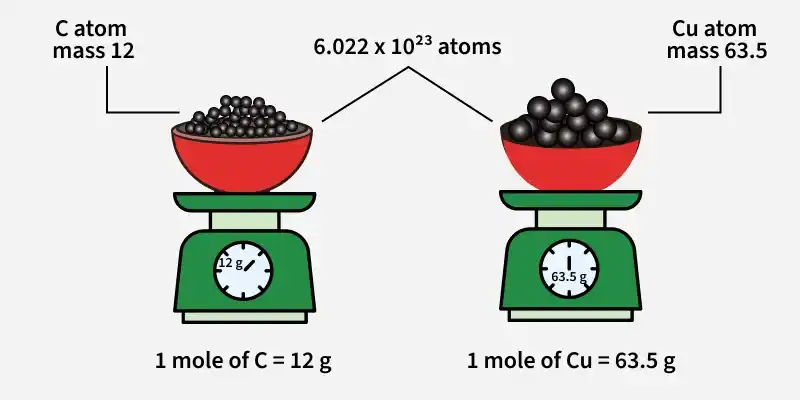
Mole
A mole is the amount of a substance that contains 6.022 × 10²³ particles (atoms, molecules, or ions). Avogadro's number is named after Amedeo Avogadro.
- Molecules and atoms are so minute that they cannot be counted.
- Scientists therefore use a special number to make it easy to count them, which is known as the mole.
- One gram atom of any element and one mass of substance weighed have an equivalent count of particles.
- This fixed number is 6.022×10²³ this is what is referred to as Avogadro's Number (NA).
- The concept of the mole assisted researchers to determine the actual mass of molecules and atoms.
The following formula may be used to calculate the number of moles of a chemical in a given pure sample:
n = \frac{m}{M}
where:
- n = number of moles
- m = given mass of substance (in grams)
- M = molar mass (in g/mol)
Example:
1 mole of oxygen molecules (O₂) contains
6.022 \times 10^{23} oxygen molecules.If we have 18 g of water (H₂O):
Molar mass of water = 18 g/mol
n = \frac{18}{18} = 1 \text{ mole} So, 18 g of water = 1 mole of water molecules.
Mole Concept
- The mole concept is a method used to measure the amount of a substance in chemistry.
- A mole is the amount of a substance that contains 6.022 × 10²³ particles (atoms, molecules, or ions).
- This number is called Avogadro’s number, named after Amedeo Avogadro.
- Scientists defined 1 mole as the number of atoms present in 12 grams of carbon-12 (¹²C).
Avogadro's Number (NA)
- Value = 6.022×10²³ .
- It informs us of the number of particles that are in 1 mole of any substance.
Example:
- 1 mole of oxygen molecules (O₂) = 6.022 × 10²³ molecules
- 1 mole of water molecule = 6.022 x 10²³water molecules.
Mole Concept Formulas
The mole concept is a method where we identify the mass of chemical substances as per requirement. The entire mole concept revolves around 12 g (0.012 kg) of the 12C isotope. In the SI system, the unit of the fundamental quantity 'the amount of substance' is the mole. The symbol of the mole is "mol." Following are the formulas used in the mole concept:
1) Atomic Mass and Molecular Mass
- The atomic mass of an element is the mass of its one atom. The unit of atomic mass is amu .
- The atomic mass is roughly the sum of protons and neutrons present in the atom.
- One atomic mass unit (amu) is said to be exactly equal to one-twelfth the mass of one carbon-12 atom.
The value of one amu is 1 g / NA = 1.66056 × 10⁻²⁴ g.
- In the present era, the atomic mass unit is known as the unified mass unit.
- Hence, amu has been replaced by u.
For example, the atomic mass of carbon is 12.011 amu since carbon mostly contains the carbon-12 isotope. Carbon-12 is 98.9 % & carbon-13 is merely 1.1%, . The atomic mass of these isotopes is different.
- Molecular mass is the sum of the masses of the atoms present in a given molecule.
- The unit of molecular mass is amu.
- The molecular mass of a molecule is defined as the relative mass of its molecule when compared to the mass of a 12C atom divided into 12 units. It denotes the number of times a molecule of the relevant material is heavier than an atom.
For example:
The molecular mass of water (H2O) =18.015 amu
The atomic mass of a hydrogen atom is 1.007 amu and the atomic mass of oxygen is 15.99 amu.
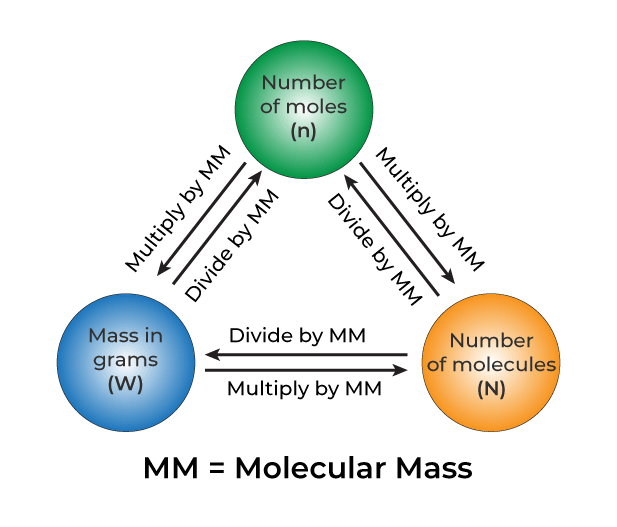
2) Molar Mass
- Molar mass is defined as the total mass of one mole of the substance. It is frequently expressed in terms of ‘grams per mole' (g/mol).
- The SI unit of molar mass is kg/mol.
Molar mass of a Substance =
\frac{\text{Mass of the substance in grams}}{\text{Number of Moles}}
For Example: The molar mass of water is 18.015 g/mol, which is the mass of NA number of water molecules.
3) Gram Atomic Mass and Gram Molecular Mass
Gram atomic mass is the mass of one mole of an atom. Gram molecular mass is the mass of one mole of a molecular substance expressed in grams. It is also known as molar mass. This amount of a substance is also called one gram molecule.
Example: For Hydrogen
Atomic mass = 1 u
Gram atomic mass = 1 gBut molecular hydrogen is H2
Gram molecular mass = 2 g
4) Gram Molecular Volume
The volume occupied by one gram mole of a substance in a vapor state or gaseous state at STP is called gram molecular volume. The standard temperature to obtain GMV is 273K, and the standard pressure is 1 atm. The ideal gas equation is utilized to calculate the corresponding gram molar volume (GMV = 22.4 L).
5) Relative Molecular Mass (RMM)
Relative molecular mass is the molecular weight of an element or molecule; it is expressed as RMM. It is the number of times a single molecule of a substance remains heavier than one-twelfth the mass of a carbon atom (12C).
Related Formulas
- Number of Moles = Mass of the Sample/Molar mass
- Number of atoms or molecules = Number of moles × (6.023 × 10²³)
- 1 amu = 1 gram/(6.023 × 1023) = 1.66 × 10⁻²⁴ grams
Solved Examples
Example 1: Calculate the molecular mass of Ammonium Sulphate (NH₄)₂SO₄.
Solution: Since, the relative atomic masses of N = 14, H = 1, S = 32, O =16
Therefore, the molecular mass of the given compound is,
= 2 (14 × 1 + 1 × 4) + 32 + 16 × 4
= 2(14 + 4) + 32 + 64
= 2 × 18 + 32 + 64
= 36 + 32 + 64
= 132 amu
Example 2: How many moles are present in 200 g of NaOH?
Solution: The mass of 1 mole of NaOH = 23 + 16 + 1= 40 g
Therefore, in 200g of NaOH the number of moles present = 200g / 40g mol-1 = 5 mol
Example 3: Calculate the mass of an atom of the oxygen element.
Solution: Mass of 1 mole of oxygen = 16g
No. of atoms in 1 mole of oxygen = NA
Therefore, mass of one atom of oxygen = 16g / NA = 16 / (6.022 × 10²³) = 2.657 × 10⁻²³ g
Example 4: Find the ratio of moles of oxygen atoms present in the compounds H₂SO₄, H₂SO₃, and SO₂..
Solution: 1 mole of H2SO4 contains 4 × NA atoms of oxygen
1 mole of H2SO3 contains 3 × NA atoms of oxygen
1 mole SO2 contains 2 × NA atoms of oxygen
Therefore the required ratio is 4 × NA : 3 × NA : 2 × NA = 4 : 3 : 2
Example 5: How many moles of hydrogen and oxygen gas are required to produce 13 moles of water?
Solution: Chemical equation of water formation:
H2 + O2 ⇢ H2O
Now the balanced equation is
2H2 + O2 ⇢ 2H2O
Thus we can deduce that 2 moles of hydrogen gas and 1 mole of oxygen gas combine together to form 2 moles of water. We can write the equation as :
H2 (1 mole) + O2 (1/2 mole)⇢ H2O (1 mole)
Hence, for production of 13 moles of water the required chemical equation would be:
H2 (13 moles) + O2 (13/2 moles) ⇢ H2O (13 moles)
Hence, for production of 13 moles of water we need 13 moles of hydrogen and 6.5 moles of oxygen gas.
Example 6: Calculate the moles of electrons present in 104 g of acetylene gas.
Solution: Now, formula for acetylene gas is C2H2. It's structure is H—C≡C—H. Therefore, number of electrons present in 1 molecule of acetylene are 14.
Now, mass of 1 mole of acetylene is 26g ⇒ 104g of acetylene are 4 moles.
Now, 1 mole of acetylene = NA molecules
⇒ NA molecules have 14 × NA electrons
⇒ 4 moles of acetylene have 4 × 14 × NA electrons = 56 × NA electrons = 56 moles of electrons.