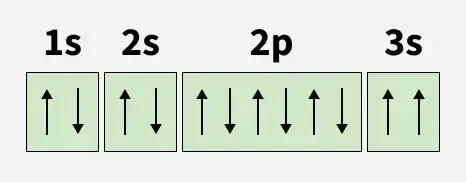
Electronic configuration means the arrangement of electrons in different energy levels (shells and subshells) of an atom. It tells us how electrons are distributed around the nucleus. This arrangement is important because the chemical properties and reactivity of an element depend on how its electrons are placed. Understanding electronic configuration helps us explain valency, bonding, and periodic trends in the periodic table.
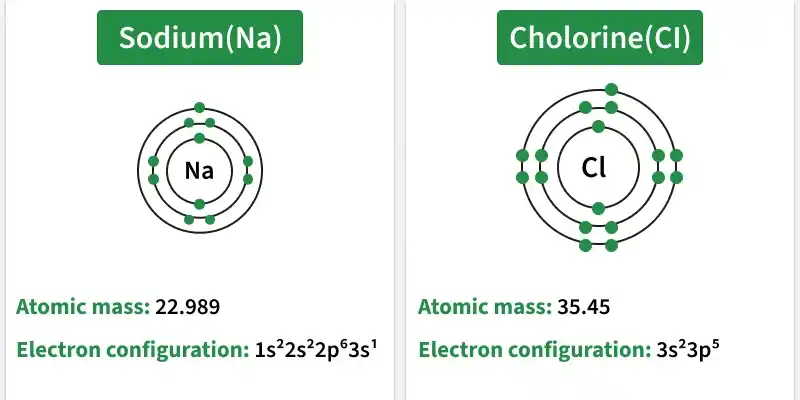
The representation of electrons distributed in the atomic shells of an element is known as the electronic configuration. The electrons are mathematically located in these subshells, and the notations help in locating the position of these electrons as well as the electronic configuration.
Example: the specific notation for germanium (Ge) would be,1s2 2s2 2p6 3s2 3p6 4s2 3d10 4p2.
Distribution of Electrons in Atomic Orbits
The distribution of electrons in atomic orbitals explains how electrons are arranged within an atom. Electrons do not move randomly around the nucleus; they occupy specific regions of space called orbitals. Each orbital has a fixed energy and can hold a limited number of electrons. The arrangement of electrons in these orbitals follows certain rules, which help us understand the structure and chemical behaviour of elements.
1) Shells
Shells are the different energy levels in an atom where electrons are arranged around the nucleus. These energy levels represent the distance of electrons from the nucleus. Electrons present in different shells have different energies.
- The shell nearest to the nucleus has the lowest energy.
- As the shell number increases, the energy of electrons increases.
- Electrons first fill the inner shells before moving to outer shells.
- The maximum number of electrons that can be present in a shell is given by the formula:
N = 2n^2 where:
n = shell number
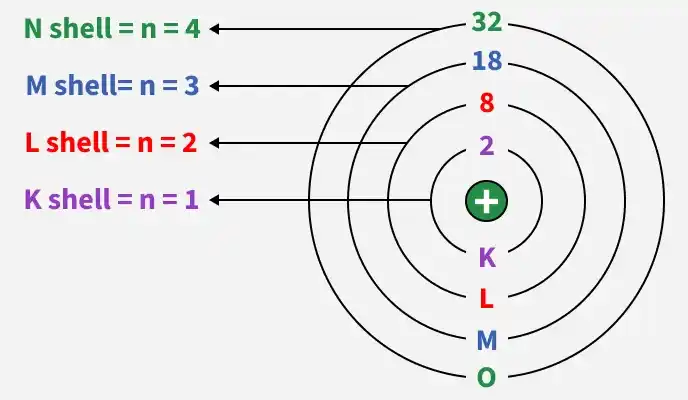
Example:
Shells and 'n' values | Maximum Electron Present in shell |
|---|---|
K shell, n=1 | 2n = 2(1)2 = 2 electrons |
L shell, n=2 | 2n = 2(2)2 = 8 electrons |
M shell, n=3 | 2n = 2(3)2 = 18 electrons |
N shell, n=4 | 2n = 2(4)2 = 32 electrons |
2) Subshells
Each shell is further divided into smaller parts called subshells. These subshells help in arranging electrons more accurately within a shell. They are represented by the letters s, p, d, and f. Each subshell has a specific shape, energy, and capacity to hold electrons.
a) Number of Orbitals in Each Subshell
Each subshell contains a certain number of orbitals:
- s subshell → 1 orbital
- p subshell → 3 orbitals
- d subshell → 5 orbitals
- f subshell → 7 orbitals
b) Maximum Number of Electrons in Each Subshell
Each orbital can hold a maximum of 2 electrons.
So:
- s subshell → 1 × 2 = 2 electrons
- p subshell → 3 × 2 = 6 electrons
- d subshell → 5 × 2 = 10 electrons
- f subshell → 7 × 2 = 14 electrons
c) Azimuthal Quantum Number (l)
- The azimuthal quantum number explains the shape of the orbital and identifies the subshell in which an electron is present.
- It is also called the angular momentum quantum number.
- It determines the subshell (s, p, d, f).
- It tells us the shape of the orbital.
- It depends on the principal quantum number n.
| Value of (l) Azimuthal Quantum Number | Subshell |
|---|---|
| 0 | s |
| 1 | p |
| 2 | d |
| 3 | f |
| Value of principal quantum number | Azimuthal quantum number | Electronic configuration |
|---|---|---|
n=1 | I=0 | 1s |
n=2 | I=0 | 2s |
| I=1 | 2p |
n=3 | I=0 | 3s |
| I=1 | 3p |
| I=2 | 3d |
n=4 | I=0 | 4s |
| I=1 | 4p |
| I=2 | 4d |
| I=3 | 4f |
Example:
In the second shell (n = 2) I= 0 ,I=1:
It has two subshells:
- 2s
- 2p
2s can hold 2 electrons.
2p can hold 6 electrons.So total electrons in second shell = 8.
3) Notation
Notation is the representation of the number of electrons present in the subshell. It is written with the shell number, name of the subshell, and a total number of electrons present in the subshell.
Example: the electronic configuration of Oxygen can be written as 1s2 2s2 2p4.
.png)
The below table consists of the electronic configuration of the first 20 elements.
Atomic Number | Name of Elements | Electronic Configuration |
|---|---|---|
| 1 | Hydrogen | 1s1 |
| 2 | Helium | 1s2 |
| 3 | Lithium | 1s2 2s1 |
| 4 | Beryllium | 1s2 2s2 |
| 5 | Boron | 1s2 2s2 2p1 |
| 6 | Carbon | 1s2 2s2 2p2 |
| 7 | Nitrogen | 1s2 2s2 2p3 |
| 8 | Oxygen | 1s2 2s2 2p4 |
| 9 | Fluorine | 1s2 2s2 2p5 |
| 10 | Neon | 1s2 2s2 2p6 |
| 11 | Sodium | 1s2 2s2 2p6 3s1 |
| 12 | Magnesium | 1s2 2s2 2p6 3s2 |
| 13 | Aluminum | 1s2 2s2 2p6 3s2 3p1 |
| 14 | Silicon | 1s2 2s2 2p6 3s2 3p2 |
| 15 | Phosphorus | 1s2 2s2 2p6 3s2 3p3 |
| 16 | Sulfur | 1s2 2s2 2p6 3s2 3p4 |
| 17 | Chlorine | 1s2 2s2 2p6 3s2 3p5 |
| 18 | Argon | 1s2 2s2 2p6 3s2 3p6 |
| 19 | Potassium | 1s2 2s2 2p6 3s2 3p6 4s1 |
| 20 | Calcium | 1s2 2s2 2p6 3s2 3p6 4s2 |
Filling of Atomic Orbitals
Electrons do not fill orbitals randomly; they occupy them in a specific order based on their energy levels. This order of filling is explained by certain rules and principles, which help us write the correct electronic configuration of an atom.
1) Aufbau Principle
The principle states that the electrons will occupy the orbits with lower energy and then the orbits with higher energy levels. The word Aufbau is a German word which means “building up.”
Electrons fill orbitals in order of increasing energy.
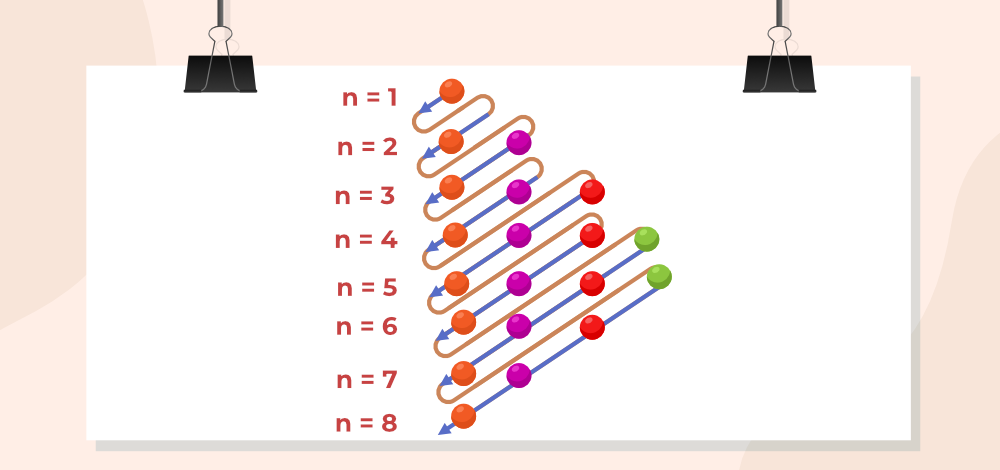
Order of Filling of Orbitals
The order is: 1s < 2s < 2p < 3s < 3p < 4s < 3d < 4p < 5s < 4d < 5p < 6s
4s is filled before 3d because 4s has slightly lower energy than 3d.
The energy of an orbital depends on:
- Principal quantum number (n)
- Azimuthal quantum number (l)
The energy order is decided by the (n + l) rule:
- The orbital with smaller (n + l) value fills first.
- If (n + l) is same, the orbital with smaller n fills first.
Example:
Oxygen (Atomic Number = 8)
Oxygen has 8 electrons.
1s → can hold 2 electrons
2s → can hold 2 electrons
2p → can hold 6 electronsStep-by-step filling:
1s2→ 2 electrons
2s2→ 2 electrons
2p2 → 4 electronsSo electronic configuration is:
1s2 2s2 2p4
2) Pauli Exclusion Principle
The Aufbau Principle explains the order in which electrons fill different orbitals based on energy. However, it does not tell us how many electrons can stay in one orbital or how electrons are arranged within orbitals of the same energy this was explained by this principle.
An orbital can hold a maximum of 2 electrons, and they must have opposite spins.
If two electrons are present in the same orbital:
- One must have spin up (↑)
- The other must have spin down (↓)
Example:
Consider the 1s orbital.
It can hold only 2 electrons:
1s2
Orbital diagram:
↑↓
You cannot put a third electron in the same orbital
3) Hund's Rule
Pauli Exclusion Principle could not explain how are electrons arranged in orbitals of the same subshell. This is explained by Hund’s Rule. This states that electrons first occupy empty orbitals singly before pairing up in any orbital. It's the rule that determines the order of electrons in the sub-shell.
First fill each orbital with one electron, then start pairing.
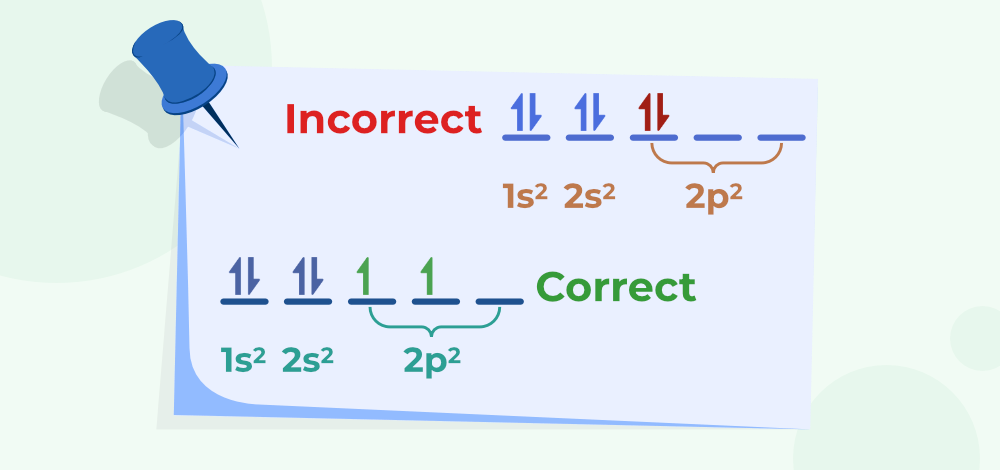
Example: p Subshell (3 Orbitals)
A p subshell has 3 orbitals.
If we have 3 electrons:
Correct filling (Hund’s Rule):
↑ ↑ ↑
Wrong filling :
↑↓ ↑ —
Electrons should not pair until all orbitals have one electron.
Electronic Configuration of Elements
Electronic configuration represents the way in which electrons are filled inside the orbital of any atom. Electronic configuration of various elements are:
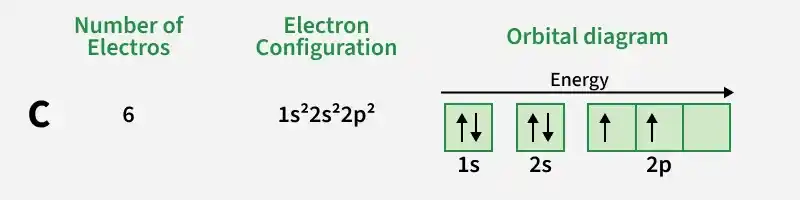
1) Carbon
Carbon has six electrons.
Electronic configuration: 1s 2 2s 2 2p 2
2) Neon
Neon has ten electrons.
Electronic configuration: 1s2 2s2 2p6

3) Magnesium
Magnesium has twelve electrons.
Electronic configuration: 1s2 2s2 2p6 3s2