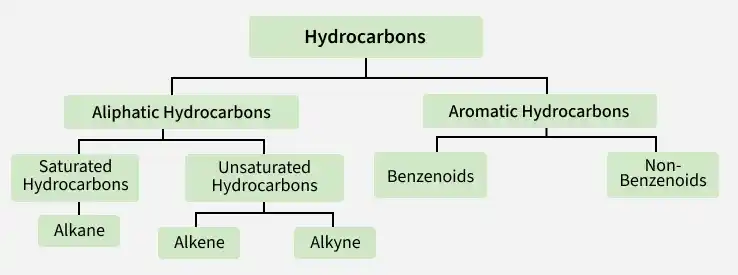
Hydrocarbons are organic compounds composed only of carbon and hydrogen atoms. They form the basic framework of organic chemistry and are widely found in natural resources such as petroleum, natural gas and coal. On the basis of structure and bonding, hydrocarbons are classified into different categories such as aliphatic hydrocarbons and aromatic hydrocarbons.
1. Aliphatic Hydrocarbon
Aliphatic hydrocarbons are hydrocarbons in which carbon atoms are arranged in the form of open chains. These chains may be straight or branched. They may contain single, double or triple bonds between carbon atoms.
Aliphatic hydrocarbons are mainly classified into two types:
a) Saturated Hydrocarbons
Saturated hydrocarbons are hydrocarbons in which all carbon-carbon bonds are single covalent bonds. These compounds are known as alkanes.
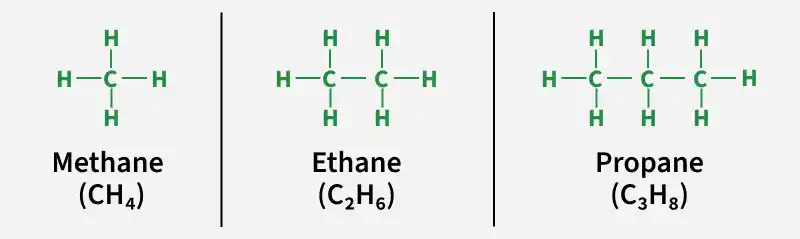
General Formula: CnH2n+2
- They are comparatively less reactive
- These compounds Undergo substitution reactions
- They are also known as paraffins
b) Unsaturated Hydrocarbons
Unsaturated hydrocarbons are hydrocarbons that contain one or more multiple bonds between carbon atoms, such as double bonds or triple bonds. These are more reactive than saturated hydrocarbons.
Unsaturated hydrocarbons are further classified into alkenes and alkynes.
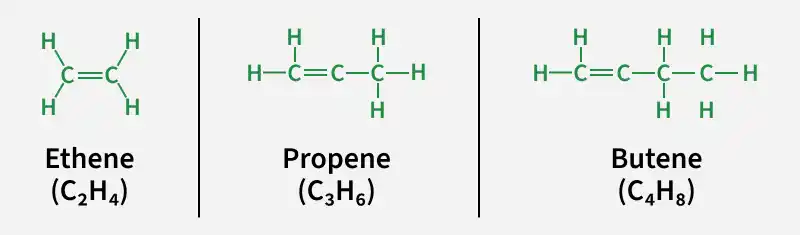
- Alkenes: Alkenes are unsaturated hydrocarbons containing at least one carbon-carbon double bond (C=C). The general formula is CnH2n
Examples: Ethene (C2H4) , Propene (C3H6)
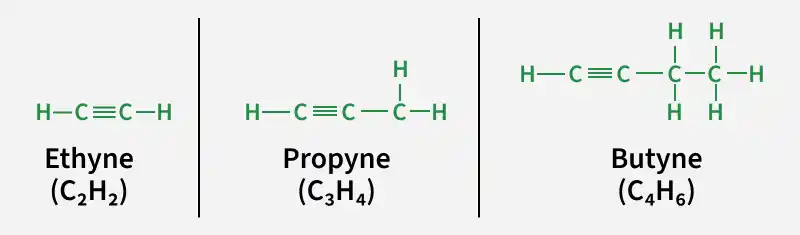
- Alkynes: Alkynes are unsaturated hydrocarbons containing at least one carbon-carbon triple bond (C≡C). The general formula is CnH2n−2
Examples: Ethyne (C2H2) , Propyne (C3H4)
2. Aromatic Hydrocarbons
Aromatic hydrocarbons are cyclic hydrocarbons that contain one or more benzene rings in their structure. These compounds possess a special type of stability due to the delocalization of π-electrons in the ring system. Aromatic hydrocarbons are also called arenes.
Aromatic hydrocarbons are broadly classified into two types:
1. Benzenoid Aromatic Compounds
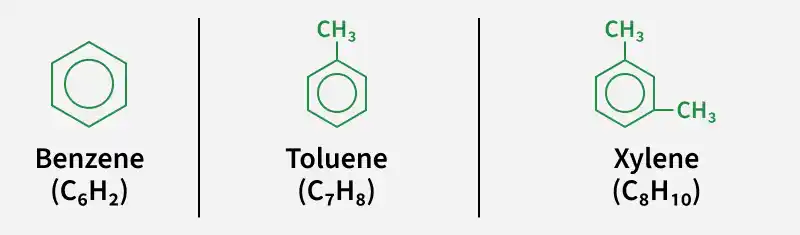
Benzenoid compounds are aromatic compounds that contain one or more benzene rings in their structure.
Examples: Benzene ,Toluene , Xylene , Naphthalene
2. Non-Benzenoid Aromatic Compounds
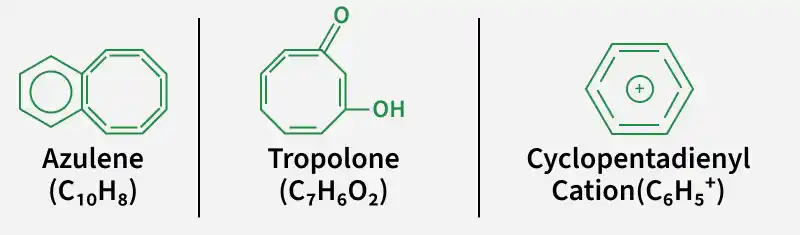
Non-benzenoid aromatic compounds are aromatic compounds that do not contain a benzene ring but still exhibit aromatic character because of delocalized π-electrons. These compounds are generally studied at a higher level of organic chemistry.
Examples: Azulene ,Tropolone