
Organic chemistry is the branch of chemistry that deals with the study of carbon compounds, their structure, properties, composition, reactions, and synthesis. Organic compounds are widely found in nature and are essential for life processes as well as various industrial applications.
Tetravalency and Catenation of Carbon
Carbon shows unique properties such as tetravalency and catenation, which are responsible for the vast number of organic compounds.
- Carbon has four valence electrons, so it forms four covalent bonds to complete its octet. This property is called tetravalency.
- Due to tetravalency, carbon can form single, double, and triple bonds with other atoms like H, O, N, and even with other carbon atoms.
- Catenation is the ability of carbon atoms to bond with each other, forming long chains, branched chains, and rings. This occurs because C–C bonds are strong and stable.
Classification of Organic Compounds
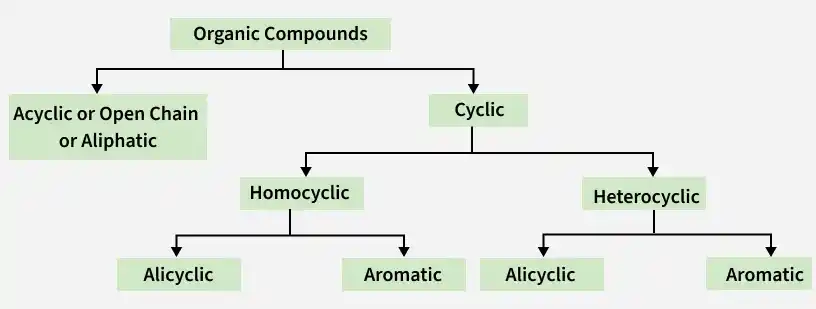
Organic compounds are classified based on the arrangement of carbon atoms into open-chain and closed-chain compounds.
1. Acyclic (Open Chain) Compounds:
These compounds have straight or branched chains of carbon atoms. They do not contain rings and include compounds like alkanes, alkenes and alkynes.
2. Cyclic (Closed Chain) Compounds:
These compounds have carbon atoms arranged in the form of a ring. They are further divided into two types:
a) Homocyclic Compounds:
These are cyclic compounds in which the ring is made up of only carbon atoms.
- Alicyclic Compounds: These resemble aliphatic compounds in their properties and do not show aromatic character.
- Aromatic Compounds: These contain benzene rings and show special stability due to delocalised π-electrons.
b) Heterocyclic Compounds:
These are cyclic compounds in which the ring contains atoms other than carbon such as nitrogen, oxygen or sulfur. They may be alicyclic or aromatic in nature depending on their structure.
Functional Groups
Functional groups are specific atoms or groups of atoms present in an organic compound that determine its characteristic chemical properties and reactions. Compounds having the same functional group show similar chemical behaviour.
Examples:
• –OH (hydroxyl group) , Alcohols
• –CHO (aldehyde group) , Aldehydes
Homologous Series
A homologous series is a group of organic compounds having the same functional group and similar chemical properties, in which successive members differ by a –CH2– unit.
- All members have the same general formula.
- Successive members differ by a –CH2– group and show a difference of 14 units in molecular mass.
- They have similar chemical properties due to the same functional group.
Example:
Alkanes: CH4 , C2H6 , C3H8, C4H10 …
IUPAC Nomenclature of Organic Compounds
IUPAC nomenclature is a systematic method of naming organic compounds so that each compound has a unique and universally accepted name. It is based on the structure of the compound.
- Select the parent chain: Choose the longest continuous carbon chain containing the principal functional group.
- Numbering of carbon atoms: Number the chain from the end nearest to the functional group or multiple bond to give the lowest number.
- Identify and name substituents: Side chains or groups attached to the main chain are named as prefixes along with their position.
- Identify the functional group: The principal functional group is indicated by a suffix (–ol, –al, –one, –oic acid, etc.).
- Multiple substituents: Use prefixes like di-, tri-, tetra- and arrange substituents in alphabetical order.
- Double and triple bonds: Indicated by suffixes –ene and –yne, along with their positions.
Isomerism
Isomerism is the phenomenon in which two or more compounds have the same molecular formula but different arrangements of atoms, resulting in different properties. Such compounds are called isomers.
a) Structural (constitutional) isomerism: Isomers differ in the connectivity of atoms.Types include chain isomerism (different carbon skeleton), position isomerism (different position of functional group or multiple bond) and Functional isomerism (different functional groups).
b) Stereoisomerism: Isomers have the same connectivity but differ in the spatial arrangement of atoms. Includes geometrical isomerism (cis–trans). Isomers have similar chemical properties but may differ in physical properties.
Structural Representation of Organic Compounds
Organic compounds can be represented in different ways to show the arrangement of atoms, bonding, and spatial orientation of molecules. These representations help in understanding both the structure and behaviour of organic compounds.
1. Complete (Expanded) Structure: In this representation, all atoms and all covalent bonds are shown explicitly. It gives a clear idea of how each atom is connected but becomes lengthy for large molecules.
2. Condensed Structure: Here, atoms are grouped together in a compact form without showing all individual bonds. It is simpler and commonly used for writing organic compounds in a short form.
3. Bond-line (Skeletal) Structure: In this form, only the carbon skeleton is represented by lines. Each line represents a bond, and each vertex or end represents a carbon atom. Hydrogen atoms attached to carbon are not shown explicitly. This method is very useful for complex molecules.
4. Three-dimensional Representation: This representation shows the spatial arrangement of atoms in space. Solid wedge (▲) shows bond coming out of the plane. Dashed wedge (---) shows bond going behind the plane. Straight line shows bond in the plane
Electronic Effect
Electronic effects refer to the displacement or movement of electrons in a molecule, which influences its reactivity, stability, and physical properties.
- Inductive Effect (–I / +I): It is the permanent displacement of σ-electrons along a carbon chain due to electronegativity difference. Electron withdrawing groups show –I effect. Electron-releasing groups show +I effect.
- Resonance Effect (Mesomeric Effect): It involves the delocalisation of π-electrons within a molecule through conjugation. It increases the stability of the molecule. Represented by multiple resonance structures
- Hyperconjugation: It is the delocalisation of σ-electrons (C–H bond) into an adjacent π-system or empty orbital. Also called “no-bond resonance”. Contributes to stability of alkenes and carbocations
Purification Method
Purification methods are techniques used to separate and remove impurities from organic compounds based on differences in their physical properties such as solubility, boiling point, or adsorption.
- Crystallisation: Used to purify solid organic compounds. It is based on the difference in solubility of the compound and impurities in a suitable solvent. The pure compound forms crystals on cooling.
- Distillation: Used to purify liquids based on difference in boiling points. Simple distillation is used when boiling points differ widely, while fractional distillation is used when they are close.
- Sublimation: Used for compounds that directly change from solid to vapour state without melting. Impurities do not sublime.