
Oxidation and reduction are chemical reactions that always occur together, known as redox reactions. They involve a wide variety of processes. For example, oxidation-reduction reactions are so common that occur in processes like respiration, combustion, burning of wood, rusting, fruit ripening, photosynthesis, and many more. Generally, these redox reactions involve the transfer of oxygen or hydrogen atoms.
- One substance undergoes oxidation, and another substance undergoes reduction.
- There is a change in oxidation number.
- Electrons are transferred from one substance to another.
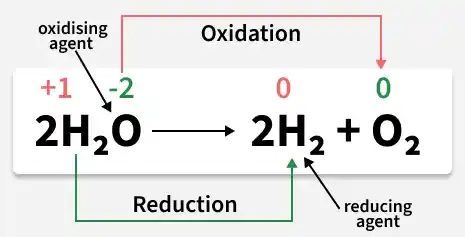
1. Oxidation
Oxidation is defined as the gain of oxygen or the loss of electrons or hydrogen. When an atom or molecule loses one or more electrons, an oxidation reaction occurs. Some elements lose electrons faster than others, such as sodium, magnesium, and iron.
Example:
2Mg + O_2 \rightarrow 2MgO
2. Reduction
Reduction is a process that involves the addition of hydrogen or any other electropositive element or the removal of oxygen or any other electronegative element, according to classical or older concepts. The process through which an atom or an ion gains one or more electrons is known as reduction, according to the electronic concept.
Example:
CuO + H_2 \rightarrow Cu + H_2O
3. Oxidant (Oxidizing Agent)
An oxidant, also known as an oxidizing agent, is a substance that accepts electrons from another substance and causes oxidation. During the reaction, the oxidant itself gets reduced.
Examples: Molecules of electronegative elements (oxygen) and halogens (fluorine, chlorine, bromine, and iodine) and common compounds i.e., K₂Cr₂O₇, KMnO₄, HClO₄, H₂SO₄, and KClO₄.
4. Reductant (Reducing Agent)
A reductant, which is also known as a reducing agent, is a substance that donates electrons to another substance and causes reduction. During the reaction, the reductant itself gets oxidized.
Examples: Metals such as sodium, aluminum, and zinc and non-metals like calcium , sodium, and hydrogen gas are strong reducing agents, i.e., H₂C₂O₄, FeSO₄ , SnCl₂, H₂S, and SO₂.
Common Redox Reactions
These reactions involve the breaking and forming of chemical bonds, leading to changes in the composition and properties of matter. Understanding different types of chemical reactions helps us study how substances interact in nature and in everyday life, such as digestion, rusting, combustion, and industrial processes.
1. Displacement Reaction
A reaction in which the displacement of the components happens is usually known as a displacement reaction.
A + BC ⇢ AB + C
Example: Here copper sulfate reacts with zinc, and displacement happens, which results in the formation of copper and zinc sulfate: CuSO₄ + Zn ⇢ Cu + ZnSO₄.
2. Combustion Reaction
A reaction in which a substance reacts with oxygen and produces heat (and usually light) is called a combustion reaction.
A + O2 ⇢ Oxides + Heat + Light
Example: Here methane reacts with oxygen, and combustion happens, which results in the formation of carbon dioxide and water: CH₄ + 2O₂ ⇢ CO₂ + 2H₂O + heat
3. Rusting Reaction
A reaction in which iron reacts with oxygen and moisture to form rust is called a rusting reaction.
Fe + O2 + H2O ⇢ Fe2O3·xH2O
Example: Here iron reacts with oxygen and water, and rusting happens, which results in the formation of hydrated iron(III) oxide (rust): 4Fe + 3O₂ + xH₂O ⇢ 2Fe₂O₃·xH₂O.
Oxidation and Reduction Half Reactions
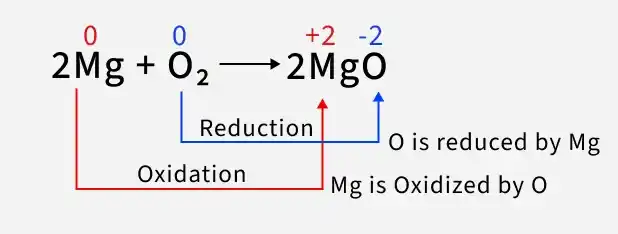
- A reduction half and an oxidation half, which always occur together, make up redox reactions.
- While the oxidation half undergoes electron loss and increases the oxidation number, the reduction half obtains electrons, and the oxidation number decreases.
- The mnemonics used are OIL, which stands for "oxidation is loss," and RIG, which stands for "reduction is gain."
- The total number of electrons in a redox reaction remains unchanged.
- In the reduction half reaction, another species absorbs those that were released in the oxidation half reaction.
Uses of Redox Reactions
- Redox reactions play a vital role across a wide range of fields, including biology, industry, pharmaceuticals, metallurgy, and agriculture.
- In industrial processes, they are fundamental to applications such as electroplating, extraction of metals like aluminium, production of chemical substances like caustic soda, bleaching of wood pulp, metal corrosion, and battery operation, among many others.
- Beyond industry, redox reactions are also closely linked to several significant environmental challenges, most notably the depletion of the ozone layer.
Oxidation vs Reduction
| Basis of Difference | Oxidation | Reduction |
|---|---|---|
| Definition (Electronic concept) | Loss of electrons | Gain of electrons |
| Definition (Classical concept) | Gain of oxygen | Loss of oxygen |
| Hydrogen | Loss of hydrogen | Gain of hydrogen |
| Oxidation Number | Oxidation number increases | Oxidation number decreases |
| Electron Transfer | Electrons are given away | Electrons are accepted |
| Role in Redox Reaction | Substance gets oxidized. | Substance gets reduced |
| Example (Oxygen Transfer) |