Functional groups are specific atoms or groups of atoms present in an organic molecule that determine its chemical properties and reactions. Attaching these groups to hydrocarbons significantly alters the compound's functionality, reactivity, and physical properties.
A functional group is an atom or a group of atoms that makes a carbon compound or an organic compound reactive and determines its properties.
List of Functional Groups
All the useful functional groups can be listed as follows:
1. Hydrocarbons
An alkene group is a carbon-carbon double bond. The compounds containing the alkene group are known as alkenes. The homologous series of alkenes has the general formula CnH₂n, where n is the number of carbon atoms in one molecule.
An alkyne group is a carbon-carbon triple bond. The compounds containing the alkyne group are known as alkynes. The homologous series of alkynes has the general formula CnH2n-2, where n is the number of carbon atoms in one molecule.
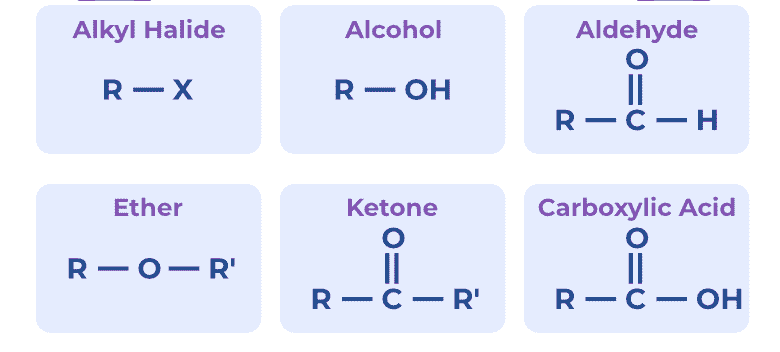
2. Halo (Alkyl Halide) Group
Depending on whether a chlorine, bromine, or iodine atom is attached to a carbon atom of the organic compound, the halo group can be chloro (-Cl), bromo (-Br), or iodo (-I). Since the elements chlorine, bromine, and iodine are collectively known as halogens, the Chloro, Bromo, and Iodo groups are referred to as halo groups and are denoted by the symbol -X.
Haloalkanes are formed when one hydrogen atom in an alkane is replaced with a halogen atom. Haloalkanes have the general formula CnH₂n+₁X, where X represents the halogens. R-X is the formula for haloalkanes, where R is an alkyl group and X is the halogen atom.
3. Alcohol Group
One oxygen and one hydrogen atom are joined together to form the alcohol group (-OH), and they are also known as the hydroxyl group. Any class of organic compounds that include one or more hydroxyl (OH) groups linked to a carbon atom of the alkyl group is an alcoholic group.
Alcohols are organic water (H₂O) derivatives in which one of the hydrogen atoms has been replaced by an alkyl group, which is often represented by R in organic structures.
Ethanol [C₂H₅OH] and methanol [CH₃OH] are the most common examples of alcohol. The homologous series of alcohols has the general formula CnH2n+1OH.
4. Aldehyde Group
One carbon atom, one hydrogen atom, and one oxygen atom are joined together to form the aldehyde group (-CHO). Any organic compound in which a carbon atom has a double bond with an oxygen atom, a single bond with a hydrogen atom, and a single bond with another atom or group of atoms (designated R in general chemical formulas and structure diagrams) is called an aldehyde.
Aldehydes have the general molecular formula CnH₂nO, where n is the number of carbon atoms in one molecule. Many aldehydes have pleasant scents, and they are created by dehydrogenation from alcohols, which is how the term "aldehyde" was derived. The two simple aldehydes are formaldehyde (HCHO), also known as methanal, and acetaldehyde (CH₃CHO), also known as ethanal.
5. Ketone Group
One carbon atom and one oxygen atom make up the ketone group (-CO-). The presence of a carbonyl group, in which the carbon atom is covalently bonded to an oxygen atom, distinguishes ketone from other organic molecules. Other than oxygen, carbon is attached to the alkyl groups or hydrocarbon radicals (R) that form the remaining two bonds.
Since a ketone group is always found in the middle of a carbon chain, a ketone must have at least three carbon atoms in its molecule: one ketone group carbon atom and two carbon atoms on both sides. A ketone has the general molecular formula CnH₂nO, where n is the number of carbon atoms in one molecule. The simplest ketone is acetone (CH₃COCH₃), also known as propanone.
6. Carboxylic Acid Group
Carboxylic acids, often known as organic acids, are organic molecules that include the carboxylic acid group. Carboxylic acids are sometimes known as alkanoic acids.
The carbonyl (C=O) and hydroxyl (-OH) groups together make up the carboxyl (-COOH) group, where carbon from carbonyl group is attachd to hydroxyl group with single bond.
The homologous series of carboxylic acids have the general formula R-COOH, where R represents an alkyl group. Acetic acid, CH₃COOH, also known as ethanoic acid, is the most common carboxylic acid.
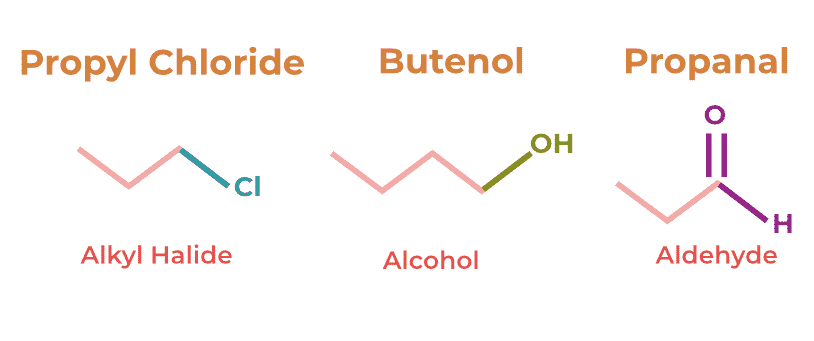
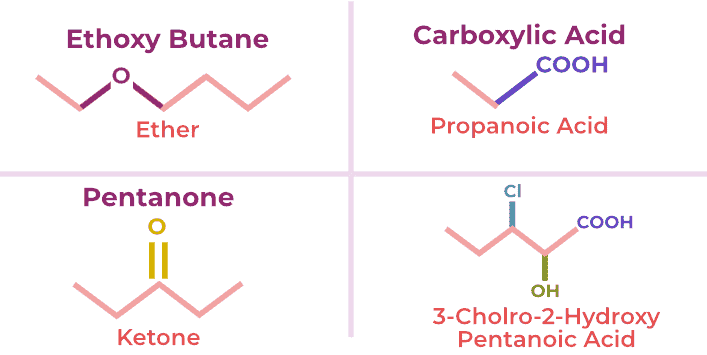
The image added below shows the nomenclature of the various functional groups.
7. Ether group
The ether group is similar to alcohols, but instead of hydrogen, there is an alkyl group attached to oxygen. The oxygen molecule (-O-) is attached to two alkyl groups (R and R') with a single bond, forming the ether group. R-O-R' is the general formula for the ether group. Ethers are very useful and diverse compounds as they are used in the formation of resins, dyes, plastics, paints, oils, etc.
Functional Group Table
The table of most of the useful functional groups is as follows:
Functional Group and Formula
Suffix
Example
Halo Alkanes, R-X
Alkyl Halide
Ethyl Chloride
Alcohol, R-OH
-ol
Butanol, Propanol
Aldehyde, R-CHO
-al
Methanol (Formaldehyde)
Carboxylate, R-COO–
-oate
Sodium Ethanoate (Sodium Acetate)
Carboxylic Acid, R-COOH
-oic acid
Ethanoic Acid (Acetic Acid)
Ester, R-(CO)-O-R’
Alkyl Alkanoate
Ethyl Butanoate (Ethyl Butyrate)
Acyl Halide, R-(CO)-X
-oyl halide
Ethanoyl Chloride (Acetyl chloride)
Ether, R-O-R’
Alkyl Ether
Diethyl Ether (Ethoxyethane)
Nomenclature of Common Functional Groups
The nomenclature is the systematic way of naming organic molecules with a set of rules established by the IUPAC (International Union of Pure and Applied Chemistry).
Firstly, identify the longest chain in the organic compound.
Number the chain of carbon from the side that contains a higher-priority functional group.
Name the chain with the prefix meth, eth, prop, but, pent, etc. with respect to the number of carbons present in the longest chain.
Name the functional group of the compounds using the appropriate suffixes according to the present functional group.
If there is more than one functional group present in the chain, the highest priority functional group decides the suffix, and other functional groups are used as a prefix, with alphabetic order (if there is still more than one functional group left after deciding the suffix)
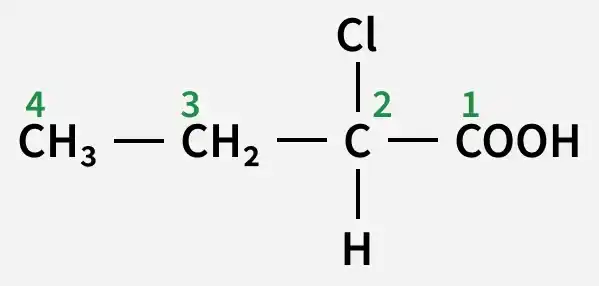
Example: Name the organic compound CH₃CH₂CHClCOOH.
Solution:
Number the carbon atoms in the given compound, from -COOH side as it is the most reactive group in the given compound. i.e.,
As, there are 4 carbon in the longst present chain. It's name starts with bute, and there is chlorine at second carbon.
Thus, its name is 2-chloro buten-1-oic acid.
Sample Questions
Question 1: Write the molecular formula for thealcohol group with 4 carbon atoms.
Answer: The molecular formula for the alcohol group is CnH2n+1OH. If there are 4 carbon atoms then n=4, this means C4H2(4)+1OH or C4H9OH. So the required molecular formula is C4H9OH
Question 2: Can the compound C₂H₄O be a ketone group?
Answer: A ketone must have at least three carbon atoms in its molecules, one ketone group carbon atom, and two carbon atoms on both sides. Ketones with less than three carbon atoms are not really possible. In the given compound, we have 2 carbon atoms, so it is not a ketone group.
Question 3: What is the molecular formula of the aldehyde that is derived from butane?
Answer: Aldehydes have the general molecular formula CnH2nO, where n is the number of carbon atoms in one molecule. Since butane C4H10 has 4 carbon atoms, so n=4, this means C4H2(4)O or C4H8O. Hence the molecular formula of aldehyde which is derived from butane is C4H8O.
Question 4: Identify the functional group present in the compound C₃H₈O.
Answer: In the given compound C3H8O, the number of carbon atoms is 3, so n=3. First check if it satisfies the molecular formula of alcohol, aldehyde, ketone, or carboxylic acids. Since it has only one oxygen atom, so it cannot be a carboxylic group. Alcohol has the general molecular formula CnH2n+1OH, where n is the number of carbon atoms in one molecule. Put n=3 in this formula, we get C3H2(3)+1OH or C3H7OH or C3H8O which matches the given compound. So the given compound have alcohol as its functional group.
Question 5: Write the molecular formula for the alkene group and alkyne groups containing 5 carbon atoms.
Answer: Given that there are 5 carbon atoms, so n=5. Alkenes have the general formula CnH2n, where n is the number of carbon atoms in one molecule. Put n=5 in this formula, C5H2(5) or C5H10.
Alkynes have the general formula CnH2n-2, where n is the number of carbon atoms in one molecule. Put n=5 in this formula, so C5H8 or C5H8.
Hence the molecular formula for the alkene group is C5H10 and the alkyne group is C5H8.
Unsolved Problems
Why do functional groups determine the chemical properties of organic compounds?
Two compounds have the same molecular formula but different functional groups. What type of isomerism do they show? Explain with an example.
Give the IUPAC names of the following compounds: (a) CH₃–CH₂–OH (b) CH₃–CO–CH₃ (c) CH₃–CH (d) CH₃–COOH
A compound contains both –OH and –COOH groups. How will its properties differ from a compound having only one of these groups?