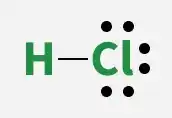
Lewis structure is a way of representing the arrangement of valence electrons in an atom or molecule. In this representation, valence electrons are shown as dots, and bonds between atoms are shown as lines or shared pairs of electrons. It helps us understand how atoms combine by sharing, losing, or gaining electrons to achieve a stable electronic configuration (octet rule).
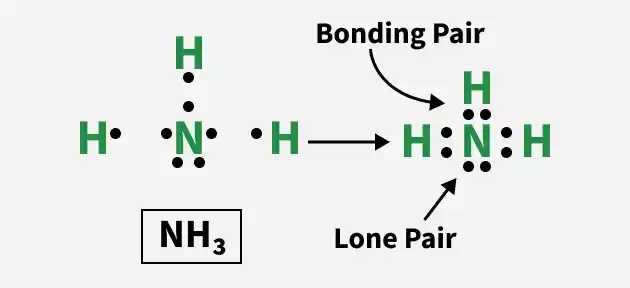
It helps in understanding how atoms combine to form chemical bonds. In molecules, the shared pair of electrons between atoms is shown either as a pair of dots or a line, representing a covalent bond.
- A pair of electrons shared between two atoms forms a bond
- A bond can be shown as two dots (••) or A line (—)
- Lone pairs (unshared electrons) are also shown as dots
Examples:
- Hydrogen molecule (H2 ) → H : H (one shared pair)
- Oxygen molecule (O2 ) → O = O (double bond)
Lewis Electron Dot Structure
In this method, the valence electrons are shown as dots around the symbol of the element. It helps in understanding how atoms will combine with other atoms to form molecules.
- Each dot (•) represents one valence electron
- Dots are placed around the symbol of the element
- The number of dots equals the number of valence electrons
Examples:
- Hydrogen (H) → 1 valence electron
- Oxygen (O) → 6 valence electrons
Steps to draw Lewis Dot Structure
To represent a molecule using Lewis electron dot structure, the following steps are followed:
Step 1: Determine the number of valence electrons in each atom using its electronic configuration.
Step 2: Add the valence electrons of all atoms present in the molecule.
Step 3: Select the least electronegative atom as the central atom (except hydrogen, which is always terminal).
Step 4: Connect atoms by forming single bonds (one shared pair of electrons between atoms).
Step 5: Distribute remaining electrons to complete the octet of outer atoms (duplet for hydrogen).
Step 6: Place the remaining electrons on the central atom to complete its octet.
Step 7: If the octet is not satisfied, convert lone pairs into double or triple bonds.
Examples
Some examples of Lewis structures are as follows:
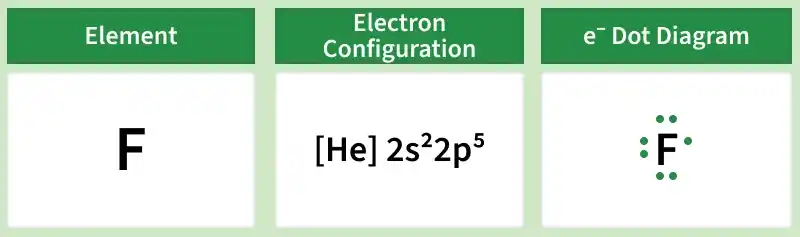
1. Fluorine
- Atomic number = 9.
- Electronic configuration = 2, 7.
- Valence electrons = 7.
2. Neon
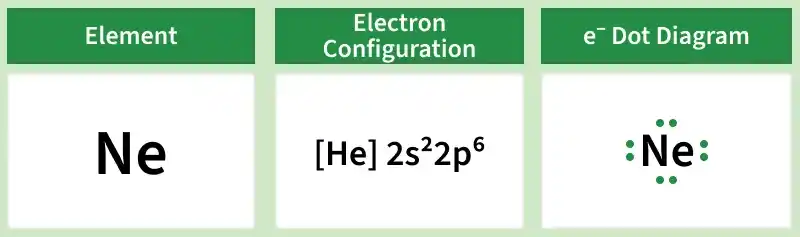
For the electron dot structure of neon,
- Atomic number = 10.
- Electronic configuration = 2, 8.
- Valence electrons = 8.
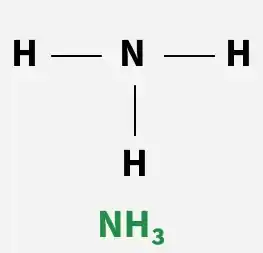
3. Ammonia
- Nitrogen (N) has 5 valence electrons.
- Each Hydrogen (H) has 1 valence electron.
- Nitrogen forms 3 single bonds with 3 hydrogen atoms.
- 1 lone pair remains on nitrogen.
- Nitrogen completes its octet, hydrogen completes duplet.
4. Hydrochloric Acid
- Hydrogen (H), 1 valence electron.
- Chlorine (Cl), 7 valence electrons.
- One single bond between H and Cl .
- Chlorine has 3 lone pairs (6 electrons).
- Hydrogen completes duplet, chlorine completes octet.