
A chemical reaction is a process in which one or more substances, called reactants, are converted into new substances, called products, with different properties. During a chemical reaction, there is a rearrangement of atoms involving breaking and formation of chemical bonds.
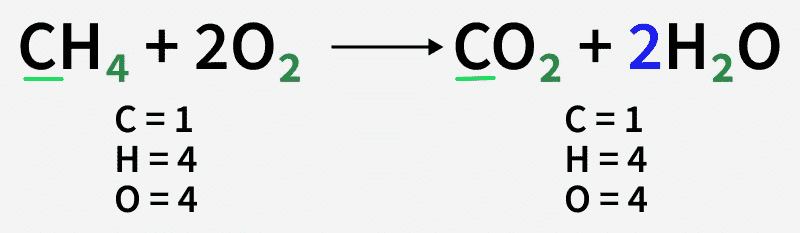
A balanced chemical equation is a chemical equation in which the number of atoms of each element is equal on both the reactant and product sides. Balancing a chemical equation ensures that the reaction is represented accurately and quantitatively, showing the correct proportions of substances involved.
Importance of Balancing a Chemical Equation
A chemical equation must be balanced to satisfy the law of conservation of mass, which states that matter is neither created nor destroyed during a chemical reaction.
- Ensures the same number of atoms of each element on both sides
- Satisfies the law of conservation of mass
- Gives the correct stoichiometric ratio of reactants and products
- Helps in quantitative calculations (amounts of substances involved)
- Makes the chemical equation a true and complete representation of the reaction
Methods to Balance a Chemical Equation
A chemical equation can be balanced using different methods to ensure that the number of atoms of each element is equal on both sides.
1. Hit and Trial Method
This is the simplest and most commonly used method for balancing chemical equations.
Step 1: Write the skeletal (unbalanced) equation using correct formulas.
Step 2: Count the number of atoms of each element on both sides.
Step 3: Start balancing one element at a time by adjusting coefficients.
Step 4: Follow the order: metals, non-metals, hydrogen and then oxygen.
Step 5: Balance polyatomic ions as a whole if they remain unchanged.
Step 6: Check whether all atoms are equal on both sides.
Step 7: Simplify coefficients to the smallest whole number ratio.
2. Algebraic Method
This method uses a systematic mathematical approach to balance chemical equations.
Step 1: Write the skeletal equation.
Step 2: Assign variables (a, b, c, …) to the coefficients of each compound.
Step 3: Form equations for each element by equating atoms on both sides.
Step 4: Solve the equations to find the values of variables.
Step 5: Substitute these values into the equation.
Step 6: Convert the values into smallest whole numbers if required.
Step 7: Verify that the equation is balanced.
Examples of Balancing chemical equation
Example 1: H2 and O2 are reactants in this reaction, whereas H2O is the product. Count how many hydrogen and oxygen atoms there are in the reactants and products.
H2 + O2 → H2O
No. of atoms | In reactants | In products |
|---|---|---|
No. of H atoms | 2 | 2 |
No. of O atoms | 2 | 1 |
On both sides, the number of hydrogen atoms is the same. However, the number of oxygen atoms on both sides is not equal. On the left side, there are two oxygen atoms, but only one on the right. Multiply H2O by 2 to get 2 oxygen atoms on the right side, and so the reaction becomes.
H2 + O2 → 2H2O
The total number of atoms on both sides is now,
No. of atoms | In reactants | In products |
|---|---|---|
No. of H atoms | 2 | 4 |
No. of O atoms | 2 | 2 |
Although oxygen atoms are balanced, hydrogen atoms are not.
On the left side, there are two hydrogen atoms, whereas, on the right side, there are four hydrogen atoms. Multiply H2 by 2 to get 4 hydrogen atoms on the left side, and the reaction becomes.
2H2 + O2 → 2H2O
No. of atoms | In reactants | In products |
|---|---|---|
No. of H atoms | 4 | 4 |
No. of O atoms | 2 | 2 |
This chemical equation is balanced because it contains an equal number of hydrogen and oxygen atoms on both sides.
Example 2: Sodium chloride is formed when sodium combines with chlorine.
Na + Cl2 → NaCl
The reactants in this reaction are Na and Cl2, whereas the product is NaCl. Count how many sodium and chlorine atoms there are in the reactants and products.
No. of atoms | In reactants | In products |
|---|---|---|
No. of Na atoms | 1 | 1 |
No. of Cl atoms | 2 | 1 |
However, because the ratio of Na to Cl is one to one, there is only one Cl atom on the product's side. As a result, a coefficient must be added to the NaCl on the product side to balance the reaction. Add a 2 in front of the NaCl to balance the reaction.
Na + Cl2 → 2NaCl
No. of atoms | In reactants | In products |
|---|---|---|
No. of Na atoms | 1 | 2 |
No. of Cl atoms | 2 | 2 |
On each side of the process, there are now two chlorine atoms. On the reactant's side, there is now one sodium atom and two sodium atoms on the product's side. As a result, on the reactant's side, multiply the sodium atom by 2.
2Na + Cl2 → 2NaCl
No of atoms | In reactants | In products |
|---|---|---|
No. of Na atoms | 2 | 2 |
No. of Cl atoms | 2 | 2 |
On each side, two sodium atoms and two chlorine atoms are now present. As a result, the reaction is in balance.