
Suspension and colloid are both heterogeneous mixtures in which particles are dispersed in another substance; however, in a suspension the particles are large and settle down on standing, while in a colloid the particles are smaller and remain uniformly distributed without settling.
Suspension
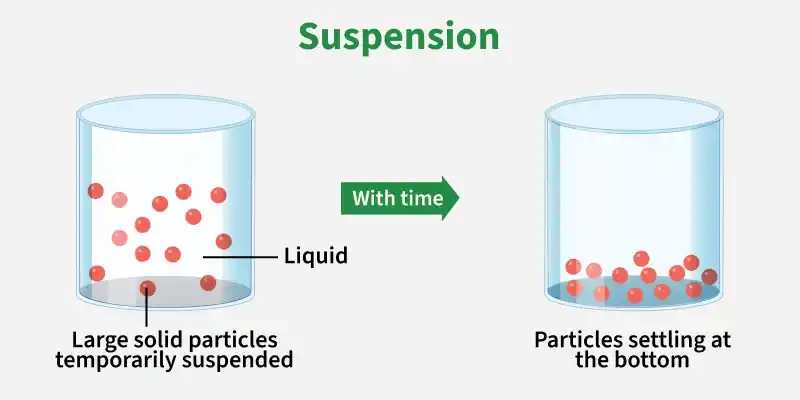
A suspension is a type of heterogeneous mixture in which solid particles are dispersed in a liquid or sometimes in a gas, but the particles are large enough to be seen with the naked eye.
- The particles do not dissolve completely in the medium and remain temporarily mixed.
- Commonly seen in everyday life and in many chemical processes.
- They are important in fields such as medicine, food, and environmental science.
Properties of Suspension
Suspensions exhibit some distinct properties because of the presence of large, undissolved particles.
- The particles of a suspension are large (greater than 1000 nm).
- The particles are visible to the naked eye.
- They are not stable.
- When standing, the particles settle down at the bottom due to gravity.
- The components of a suspension can be separated by ordinary filtration.
- A suspension scatters light and hence shows the Tyndall effect.
- The mixture is heterogeneous, and the composition is not uniform throughout.
- Suspension consists of two phases: dispersed phase and dispersion medium.
Examples: Muddy water, Chalk powder in water, Sand in water, Flour in water
Colloid
A colloid or colloidal solution is a type of mixture in which insoluble particles of one substance are uniformly dispersed in another substance. Colloids play an important role in our daily life, although we often use them without realizing it.
- Substances like milk, jelly, mayonnaise, soap solution, blood, and many cosmetic products are common examples of colloids.
- The particles are so small that they cannot be seen with the naked eye but are large enough to scatter light.
- A colloid is a mixture in which the size of the dispersed particles lies between that of a true solution and a suspension.
- In simple words, a colloid is a mixture where one substance is broken into very fine particles and evenly spread throughout another substance.
Properties of Colloids
Colloidal solutions exhibit certain characteristic properties due to the small size of their particles and their uniform distribution in the dispersion medium. These properties distinguish colloids from true solutions and suspensions.
- Colloids have a particle size of between 1 and 1000 nm, meaning that they cannot be filtered using normal filtration.
- It is done by special means such as ultrafiltration, centrifugation, or dialysis.
- Colloids are very stable, and they do not subside.
- These are heterogeneous mixtures in that there is a difference between the dispersed phase and the dispersion medium, which are distinct substances.
- Although colloids are heterogeneous, they can be seen to be homogeneous with the naked eye due to the minute size of the particles.
- Brownian motion occurs in colloidal particles, and it contributes to their stability.
- Colloids have the Tyndall effect, i.e., they scatter light.
Components of Colloids
A colloid is a heterogeneous mixture in which very small particles are uniformly dispersed in another substance. A colloidal solution mainly consists of two components, which are responsible for its properties and behavior.
A colloid has two main components:
1. Dispersed Phase
- The substance that is present in small particles in the mixture.
- These particles are spread throughout the medium.
- It is similar to the “solute” in a solution.
Example: In milk, fat particles act as the dispersed phase.
2. Dispersion Medium
- The substance in which the dispersed phase is uniformly spread.
- It acts as the continuous phase of the colloid.
- It is similar to the “solvent” in a solution.
Example: In milk, water acts as the dispersion medium.
Classification of Colloids
Colloids can be classified into different types based on the nature of the dispersed phase and the dispersion medium. This classification helps in understanding their properties and applications.
1. Based on Physical States
Colloids are classified into different types based on the physical states of the dispersed phase and the dispersion medium.
| Dispersion Medium | Dispersed Phase | Type of Colloid | Examples |
|---|---|---|---|
Solid | Solid | Solid sols | Coloured Glass, Gemstones, Rock Salt, some alloys. |
Solid | Liquid | Gels | Jellies, Cheese, curd, shoe-polish. |
Solid | Gas | Solid foam | Pumice stone, rubber, cake. |
Liquid | Solid | Sol | Paints, inks, gold sol, silver sol, starch. |
Liquid | Liquid | Emulsion | Milk, butter, cod liver oil |
Liquid | Gas | Foam | Soap lather, soda (CO₂ is dissolved in water) water, whipped cream |
Gas | Solid | Aerosol | Smoke, dust storms, and exhaust from industries and automobiles. |
Gas | Liquid | Aerosol | Fog and Mist |
2. Based on Interaction
Based on the interaction between the dispersed phase and the dispersion medium, colloids are classified into different types.
a) Lyophilic Colloids
- In lyophilic colloids, the dispersed phase has a strong attraction for the dispersion medium.
- These colloids are stable and easily formed.
Examples: Starch, gum, gelatin, proteins
b) Lyophobic Colloids
- In lyophobic colloids, the dispersed phase has little or no attraction for the dispersion medium.
- These colloids are less stable.
Examples: Gold sol, silver sol, ferric hydroxide sol.
Based on Properties of Sol Particles
Depending on the nature and properties of sol particles, such as the presence of electrical charge, colloids can be divided into different categories.
a) Multimolecular Colloids
- Formed when a large number of small molecules or atoms combine to form colloidal particles.
b) Macromolecular Colloids
- Formed by large molecules like proteins or polymers.
- These molecules themselves are of colloidal size.
Examples: Starch, cellulose, rubber, proteins
c) Associated Colloids
- Formed by substances having both hydrophilic and hydrophobic parts.
- They behave as normal electrolytes at low concentration and as colloids at high concentration.
Examples: Soap, detergents, Sulphur sol
Preparation of Colloids
Colloidal solutions can be prepared by various methods depending on the nature of the substance and the desired properties of the colloid. These methods involve either breaking down larger particles or building up smaller particles to colloidal size.
1. Condensation Method
In the condensation method, smaller particles such as atoms or molecules combine to form particles of colloidal size. This method is used to prepare colloids by building up particles
- Oxidation: Small particles (atoms or molecules) in condensation methods are combined to create colloidal-size particles. Oxidation of hydrogen sulfide gas is done to form colloidal sulfur. Oxidizing agents such as oxygen, HNO₃, Br₂ water, etc., are used.
2H2S + O2 ⇢ 2H2O + 2S
- Reduction: The salts of metals are in this process decreased with the help of appropriate reducing agents to create metallic sols. Typical reducing agents: formaldehyde, stannous chloride (SnCl₂), and hydrogen peroxide. Metals that were extracted were gold, silver, and platinum.
2AuCl3 + 3SnCl2 ⇢ 3SnCl4 + 2Au
- Double Decomposition: Two compounds are involved in this process to produce a colloidal precipitate. The hydrogen sulfide is passed through a cold solution of arsenic oxide in water.
As2O3 + 3H2S ⇢ As2S3 + 3H2O
- Hydrolysis: Certain salts appear as colloids as their solutions in water are boiled.
FeCl3 + 3H2O ⇢ Fe(OH)3 + 3HCl
2. Dispersion Method
In the dispersion method, larger particles of a substance are broken down into smaller particles of colloidal size. This method is used to prepare colloids by reducing the size of coarse particles.
Mechanical Dispersion: The substances are initially reduced to rough particles. A dispersion medium is then added to them. The colloidal mill (two metal discs rotating opposite to each other) is used to pass the mixture. Solutions of paints, inks, varnishes, and dyes were prepared for use.
- In this method, the substance is first ground into coarse particles using a mortar or grinder.
- These particles are then mixed with a suitable dispersion medium (like water) to form a suspension.
- The suspension is passed through a colloidal mill.
- A colloidal mill consists of two hard metal discs rotating in opposite directions at high speed.
- Due to strong shearing force and friction, the large particles are broken down into colloidal-sized particles.
- The fine particles remain evenly dispersed in the dispersion medium, forming a colloidal sol.
Electrical or Bredig's Arc method: In this method, the metal to be changed into solution is made as a two-electrode, which is immersed in a dispersion medium. An electric arc is used between the electrodes and ice to keep the dispersion medium cool. Here, the excessive amount of heat gives a colloidal solute substance.
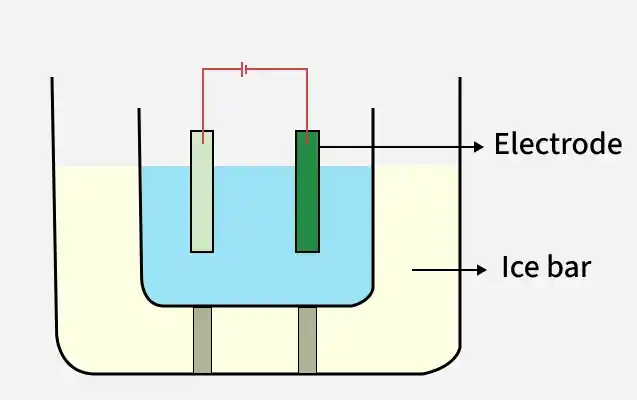
- In this method, two metal electrodes (of the same metal) are immersed in a suitable dispersion medium (usually water).
- A high electric current is passed between the electrodes.
- An electric arc is produced between the electrodes.
- The intense heat of the arc vaporizes the metal into very small particles.
- These metal vapors condense in the cold medium to form colloidal particles.
- The formed particles remain uniformly dispersed, forming a metal sol.
Tyndall Effect: The Optical Properties of Colloidal Solutions
- Colloids show a phenomenon known as the Tyndall effect.
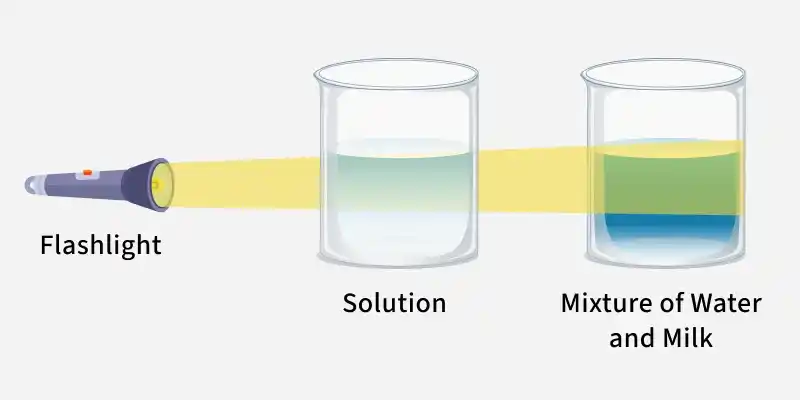
- When we shine a bright converging beam of light through a dark colloidal solution, the path of the beam is lit, and we can see the path.
- This is due to the scattering of light by the colloidal particles, and this is referred to as the Tyndall effect, and the lighted route is called the Tyndall cone.
- In a true solution, the particles are very small and do not scatter light, so the path of light is not visible.
- However, in colloids and suspensions, the particle size is comparatively larger, which allows them to scatter light and make the beam visible.
Application of Colloids
Due to their distinctive properties, colloidal solutions find numerous applications in fields like medicine, industry, and environmental processes
Daily Life
- Milk is a colloid (fat-in-water emulsion).
- The cleaning of the clothes is done by the use of soaps and detergents, which create colloidal solutions that trap the dirt particles.
- Colloids are food stuffs such as jelly, ice cream, custard, and mayonnaise.
- Face creams, lotions, toothpaste, and shampoos are some of the cosmetic products that are colloidal solutions.
Medicine
- Most medicines are colloidal, and therefore, they are more effective.
- Colloidal gold and silver are applied in drugs.
- Dettol and iodine solution are antiseptics, which are colloids.
- Blood is a colloidal suspension in which the cells are suspended in plasma.
- Colloidal drug delivery aids medicines to be better absorbed in the organism.
In Industry
- Colloids include paints, inks, and varnishes, which provide smooth and even coatings.
- Colloidal latex can be used in the rubber industry to produce tires and rubber products.
- Colloidal dyes are used in the textile industry to bring an even coloring to the fabrics.
- Colloidal silver bromide is used in photographic films.
- Colloids are also used in the paper and leather industries.
Environment and Nature
- Clouds, fog, and mist are colloidal suspensions of liquid droplets.
- Smoke is a hazy suspension of particles of solid matter in the air.
- The soil has particles of colloidal size that aid in the retention of water and nutrients.
- Natural water treatment takes place because of coagulation of colloidal contaminants.
Purification of Water
- Colloidal impurities in water are electrically charged and are not easily settled.
- Alum is put in water to result in coagulation of colloidal particles.
- The sediments are cleared, and clean water is retrieved.
Suspensions vs Colloids
Suspensions and colloids are both heterogeneous mixtures, but they differ in the size of their particles and their properties. These differences help in distinguishing between the two types of mixtures.
| Suspension | Colloid |
|---|---|
| Particles are large in size | Particles are smaller in size |
| Particles are visible to the naked eye | Particles are not visible to the naked eye |
| Particles settle down on standing | Particles do not settle down |
| Unstable mixture | Stable mixture |
| Particles do not pass through filter paper | Particles pass through ordinary filter paper |
| Clearly heterogeneous | Appears homogeneous but is actually heterogeneous |
| Example: Muddy water, chalk in water | Example: Milk, fog, smoke |