
Bleaching powder is commonly used as a disinfectant and as an oxidizing agent. It is also known as Calcium Hypochlorite and is represented by the formula CaOCl2. It is a versatile chemical with strong oxidizing, bleaching, and antiseptic properties.
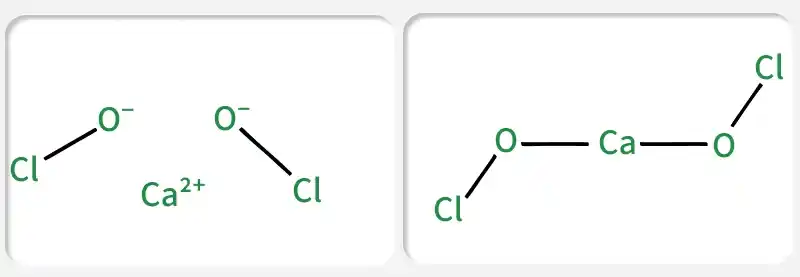
Bleaching powder is a mixture consisting of:
- One calcium ion (
{Ca}^{2+} ) - One chloride ion (
{Cl}^- ) - One hypochlorite ion (
{OCl}^- )
The hypochlorite ion
Preparation of Bleaching Powder
Bleaching powder is prepared by passing chlorine gas over dry slaked lime
{Ca(OH)}_2 + Cl_2 \rightarrow \text{CaOCl}_2 + H_2O
Properties
- Pale yellowish-white powder.
- Strong chlorine-like smell.
- Slightly soluble in water.
- Releases chlorine in moist air.
- Strong oxidizing agent.
Applications
Bleaching powder has a matte white snow like color and a distinct chlorine-like odor. When dissolved in water, it acts as a sanitizer, disinfectant, and bleaching agent due to the addition of chlorine.
1. Water Purification
- Disinfection Process: Bleaching powder, primarily chlorine, plays an integral role in water treatment since it has a disinfecting function.
- Microorganism Elimination: Being a disinfectant, it helps in removing microorganisms like bacteria and viruses that cause harm and thus, making water safe for drinking ̣.
- Public Health Assurance: Bleaching powder used in water treatment during water purification helps in avoiding waterborne diseases and ensuring the good health of humans.
2. Textile Industry
- Fabric Whitening: It is commonly used in the textile industry to be able to bleach natural fibers like cotton and linen, through them being prepared to undergo other steps of processing.
- Impurity Removal: Bleaching powder aids in taking out natural shades and stains from fibers, and it gives a clean white appearance after the bleaching is completed.
- Preparation for Processing: The pre-treatment stage of fabric with bleaching powder holds great significance when it comes to subsequent dyeing, printing, or finishing work. This helps in uniform coloring and visual appeal of the fabric.
3. Household Cleaning
- Disinfectant and Cleaner: Besides being a popular cleaning agent in the kitchen, bleaching powder is in demand as a general-purpose disinfectant and cleaner suitable for most cleaning operations, such as dish cleaning and laundry.
- Elimination of Odors and Bacteria: It successfully cleanses surfaces of the smell of bacteria and mold, and so making the environment at home gives you the impression of cleanliness and hygiene.
- Maintenance of Hygiene Standards: Constant use of bleaching powder in the households cleaning is one of the guarantees for the prevention of diseases which result in high level of sanitation aiding the residents to enjoy healthy living conditions.
Real-Life Experiments
1. Disinfection of Water
- Materials: Water samples (contaminated), bleaching materials, measurement devices (such as pipettes and beakers), microbial density testing gadget, and chlorine residual test kit.
- Procedure: Take collection of contaminated water samples in different containers. Put proportional mixture of bleaching powder into the previously made samples. Monitor microbial levels and chlorine residual over time, which would be at intervals to a certain period.
- Explanation: The aim of this experiment is to investigate the suitability of bleaching powder as an agent used for water disinfection. Based on the concentrations of microbes and residual chlorine samples, we can quantify the level of chemical-physical disinfection which had been obtained over the time. This step facilitates a perfect cleaning, meaning that microorganisms that may cause harm to human health and well-being are removed completely.
2. Fabric Bleaching
- Materials: Container, bleaching powder solutions of varying concentrations, fabric samples, water and measuring needed instruments.
- Procedure: For the test, carefully wring out the fabric samples, soak them in the solutions of bleaching powder for various concentrations and keep them for a prescribed period of time. Record color changes and stains removal during regular scanning of fabric samples.
- Explanation: The present experiment highlights bleaching potency of bleaching powders at various concentrations by applying on fabric. By simply observing the changing colours and lack of stains, we can see the differences in bleaching that take place at different concentrations.
3. Surface Disinfection
- Materials: Petri plates, microorganisms cultures, bleaching powder reagents of different quantities, and a micrometer are used in this experiment.
- Procedure: Bacteria grown onto agar plates using bacterial cultures. Pour a certain amount of doses of hypochlorite solution onto the plates with different concentrations.
- Explanation: This experiment expects to present the effect of bleach on microbial cells. Based on the size of the surface, the antimicrobial activity of bleaching powder observed at varying concentrations. This ensures bleaching powder works as a surface disinfectant.