
Amines are organic compounds formed by substituting an alkyl or aryl group for one or more hydrogen atoms in an ammonia (NH₃) molecule. They can be found in nature in proteins, vitamins, alkaloids, and hormones.
Amines can be prepared by several methods depending on the type of starting compound and the desired product. Some common methods are
1. From Reduction of Nitro Compound
By passing hydrogen gas through finely divided nickel, palladium, or platinum, as well as by reducing it with metals in an acidic medium, nitro compounds are reduced to amines. Nitroalkanes can also be reduced to the corresponding alkanamines in the same way.
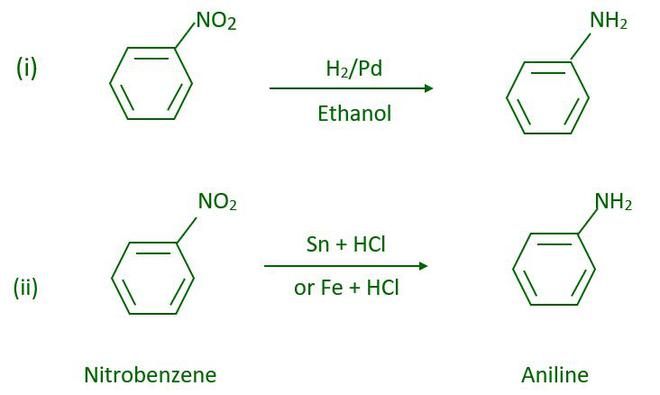
Reduction with iron scrap and hydrochloric acid is preferred because the FeCl₂ formed during the reaction is hydrolyzed, releasing hydrochloric acid. As a result, only a trace of hydrochloric acid is required to initiate the reaction.
2. From Ammonolysis Alkyl Halide
The bond between carbon-halogen and alkyl or benzyl halides can be easily broken by a nucleophilic reaction. As a result, when an alkyl or benzyl halide reacts with an ethanolic solution of ammonia, a nucleophilic substitution reaction occurs in which the halogen atom is replaced by an amino (–NH₂) group. Ammonolysis is the process by which an ammonia molecule cleaves the C–X bond. The reaction takes place in a sealed tube at 373 K. The resulting primary amine is a nucleophile and can react with an alkyl halide to form secondary and tertiary amines and, finally, a quaternary ammonium salt.
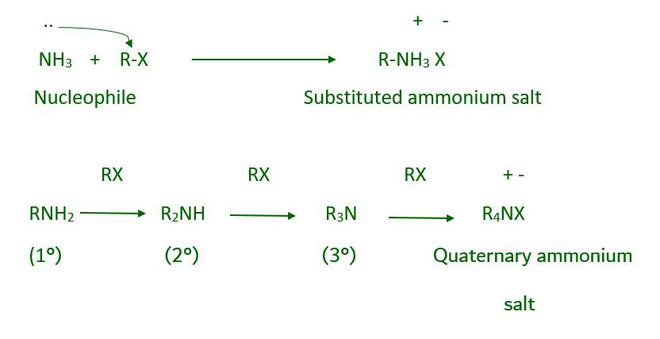
By treating the ammonium salt with a strong base, the free amine can be obtained:

Ammonolysis of alkyl halides has one disadvantage: during the reaction, it produces a mixture of primary, secondary, and tertiary amines, as well as quaternary ammonium. To obtain a primary amine as the major product, we pass a large excess of ammonia.
3. From Reduction of Nitriles
Primary amines are formed when nitriles are reduced using LiAlH₄ or catalytic hydrogenation. This reaction is used to prepare amines with one more carbon atom than the starting amine, which is known as amine series ascent.
\text{R-CN} \xrightarrow[\text{Na(Hg)/C}_2\text{H}_5\text{OH}]{\text{H}_2/\text{Ni}} \text{R-CH}_2\text{-NH}_2
4. From Reduction of Amide
When amides are reduced with lithium aluminum hydride, amines are formed.
\text{R-CO-NH}_2 \xrightarrow[(ii)\ \text{H}_2\text{O}]{(i)\ \text{LiAlH}_4} \text{R-CH}_2\text{-NH}_2
From Gabriel Phthalimide Synthesis
Gabriel synthesis is a method for producing primary amines. When phthalimide is treated with ethanolic potassium hydroxide, it forms a potassium salt of phthalimide, which, when heated with an alkyl halide and then alkaline hydrolyzed, yields the corresponding primary amine. Gabriel's phthalimide synthesis method does not produce aromatic primary amines because aryl halides do not undergo nucleophilic substitution reactions with the anion formed by phthalimide.

From Hoffmann Bromamide Degradation Reaction
Hoffmann developed a method for producing primary amines by treating an amide with bromine in an aqueous or ethanolic sodium hydroxide solution. An alkyl or aryl group migrates from the amide's carbonyl carbon to the nitrogen atom during this degradation reaction. The amine thus formed has one fewer carbon atom than the amide.
\text{R-CO-NH}_2 + \text{Br}_2 + 4\text{NaOH} \longrightarrow \text{R-NH}_2 + \text{Na}_2\text{CO}_3 + 2\text{NaBr} + 2\text{H}_2\text{O}\text{(Amide)} \hspace{1cm} \text{(Sodium Hydroxide)} \hspace{3cm} \text{(Amine)}
Reductive Animation of Aldehydes and Ketones
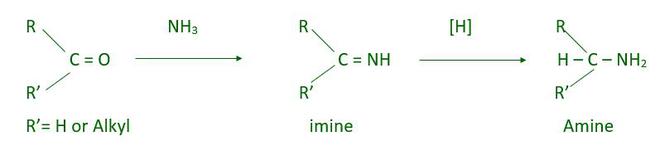
Reductive animation of aldehydes and ketones produces 1°, 2°, and 3° amines. This reaction takes place in 2 steps: the first is nucleophilic addition, which provides imine, and the second step is the reduction of imine, which produces amine.
Curtius Reaction
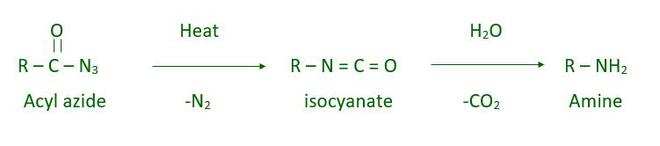
The Curtius reaction is also called the Curtius rearrangement. In this reaction, the decomposition of acyl azide takes place, which forms isocyanate. Isocyanate is unstable and, upon hydrolysis, yields an amine.
Schmidt Reaction
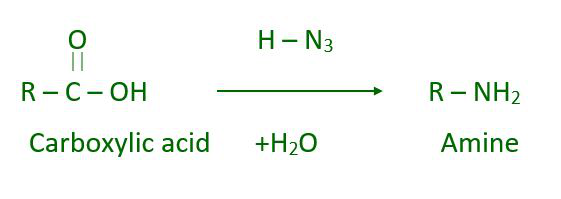
In the Schmidt reaction, amines can be prepared with azide and a carboxylic acid.
Related Articles
Sample Problems
Question 1: What are primary, secondary, and tertiary amines? Give examples.
Answer: One hydrogen atom of NH3 is replaced with an alkyl or aryl group in primary or 1° amine. Two hydrogen atoms of NH3 are replaced with an alky or aryl group in secondary or 2° amine. Three hydrogen atoms of NH3 are replaced with an alkyl or aryl group in tertiary amine.
Example: CH3-NH2, CH3-NH-CH3, CH3-N-(CH3)2
Methyl Amine (1°) Dimethyl Amine (2°) Trimethyl Amine (3°)
Question 2: Write the IUPAC name of,
- CH₃–CH₂–NH₂
- CH₃–CH₂–CH₂–NH₂
- C₆H₅-NH₂..
Answer: The IUPAC name are-
- CH3–CH2–NH2 - Ethanamine
- CH3–CH2–CH2–NH2 - Propan-1-amine
- C6H5-NH2 - Benzenamine.
Question 3: What happens when nitrobenzene is reduced? Write the chemical equation of the reaction.
Answer: Reduction of nitro benzene gives aniline as final product. Chemical equation-

Question 4: What is the method of preparing ethylamine in the lab?
Answer: Hofmann's bromide reaction is used In the laboratory, we can make ethylamine using Hofmann's bromide reaction. Bromine and potassium hydroxide solution are used to heat the propionamide.
Question 5: Which is more soluble in water, a primary amine or a tertiary amine? Give a reason.
Answer: Tertiary amines are more soluble in water because primary amines can form hydrogen bonds with water but tertiary amines cannot, primary amines are less soluble.
Unsolved Problems
- Describe any four methods for the preparation of amines with suitable chemical equations.
- Explain the Hoffmann Bromamide Reaction.
- Why does ammonolysis of alkyl halides often give a mixture of primary, secondary, and tertiary amines?
- How will you carry out the following conversions:
a) Nitrobenzene → Aniline
b) Ethyl bromide → Ethylamine
c) Acetamide → Methylamine - Explain the Hoffmann Bromamide Reaction.