
Plaster of Paris is a fine white chemical compound made from calcium sulfate hemihydrate (CaSO₄·½H₂O). It is obtained by heating gypsum (CaSO₄·2H₂O) and is known for its quick-setting property, forming a durable solid when mixed with water. Due to its ease of use and versatility, it is widely used in sculpting, construction, and medical applications.
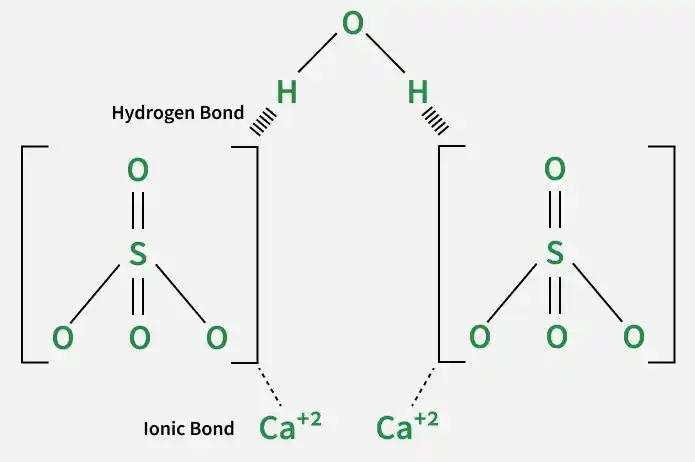
Formula
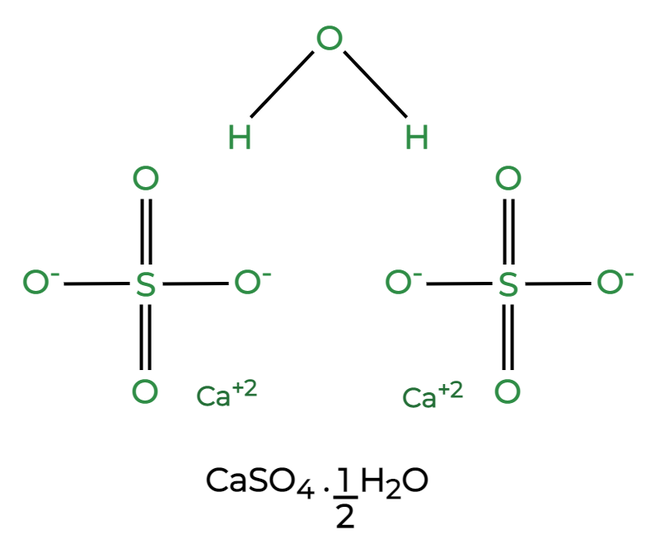
- Chemical Formula: CaSO₄·½H₂O
- It is formed by the partial removal of water of crystallization from gypsum (calcium sulphate dihydrate)
- On adding water, it reverts back to gypsum, releasing heat in the process
Preparation
Plaster of Paris is prepared by heating gypsum at about 373 K (100°C–120°C), which removes about three-fourths of its water of crystallization:
\boxed{ \mathrm{CaSO_4 \cdot 2H_2O \xrightarrow{\text{Heat}} CaSO_4 \cdot \tfrac{1}{2}H_2O + \tfrac{3}{2}H_2O \ (steam)}}
- The water is released as steam
- If heated above 473 K, it forms anhydrous calcium sulphate, which loses its setting property
- It is stored in moisture proof containers to prevent premature hydration
Properties
- White, fine powder that forms hard gypsum on adding water
- Quick-setting and slightly expands on setting
- Does not shrink or crack after drying
- Fire-resistant and forms a smooth, durable surface
- Easy to mold, spread, and level
Uses of Plaster of Paris
- Making statues, molds, and decorative items
- Used in false ceilings and interior decoration
- Medical casts for broken bones
- Fireproofing materials
- Used in 3D printing and architectural designs
Gypsum | Plaster of Paris |
|---|---|
| Gypsum is a hydrated calcium sulphate mineral with the molecular formula CaSO4·2H2O. | Plaster of Paris is a commonly used mineral obtained from Gypsum and has a chemical formula of CaSO₄·1/2H₂O. |
| It is a dihydrate compound. | However, this is a hemihydrate compound. |
| Gypsum is a soft crystalline crystal. | While Plaster of Paris is a white powder. |
| Gypsum cannot be molded into different shapes. | Plaster of Paris can be molded into different shapes when moistened. |
| Gypsum can be found naturally. | However, It is a man-made compound. |