
Aldehydes and ketones are compounds containing a carbonyl group; these compounds are collectively called carbonyl compounds. There is a double bond between carbon and oxygen. Due to the difference in electronegativity of C and O, the bond is polar.
In aldehydes, carbonyl groups are bonded to two hydrogens or to one hydrogen and one alkyl or aryl group, whereas in ketones they are bonded to alkyl and aryl groups.
- The general formula for aldehydes is R—CH=O.
- The general formula for ketones is R—CR'=O.
Carboxylic acids are the compounds that contain a carboxyl functional group in their molecules. The name "carboxyl" is derived from 2 words: "carbo," which means "carbonyl," and "oxyl," which means "hydroxyl group." The carboxylic acids are aliphatic (R-COOH) or aromatic (Ar-COOH) depending upon whether the —COOH group is attached to the aliphatic alkyl chain or aryl group. The general formula is

The physical properties of aldehydes and ketones are:
Physical State
Methanal is a pungent-smelling gas. Aldehydes and ketones containing up to eleven carbon atoms are colorless liquids, while higher members are solids.
Smell
Lower aldehydes have unpleasant odors; aldehydes and ketones have pleasant smells. When the size of the molecule increases, the odor becomes less pungent and more fragrant. Many aldehydes and ketones have been used in blending perfumes and flavoring agents.
Solubility
Aldehydes and ketones with up to 4 carbon atoms are miscible in water because of the presence of hydrogen bonding between the polar carbonyl group and water molecules. The solubility of aldehydes and ketones decreases by increasing the length of the alkyl chain. All aldehydes and ketones are fairly soluble in organic solvents, and ketones are good solvents themselves.
Boiling Points
The boiling points of aldehydes and ketones are higher than non-polar compounds or weak polar compounds of comparable molecular masses. The boiling points are lower than alcohols or carboxylic acids because aldehydes and ketones are polar compounds having sufficient intermolecular dipole-dipole interactions between opposite ends of C=O dipoles.
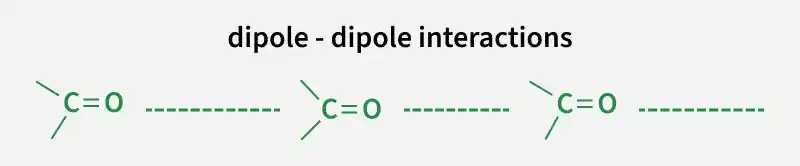
Therefore, dipole-dipole interactions are weaker than the intermolecular hydrogen bonding in alcohols and carboxylic acids. Boiling points of aldehydes and ketones are lower than those of the alcohols and carboxylic acids of the same molecular masses.
Among these carbonyl compounds, ketones have higher boiling points than isomeric aldehydes because of the presence of two electron-releasing groups around the carbonyl carbon, which makes them more polar.
Vander Waals dispersion forces
As the molecule lengthens, the number of electrons increases, and the attraction between the molecules increases. The boiling points of aldehydes and ketones increase as the number of carbon atoms increases.
Vander Waals dipole-dipole attraction
The presence of carbon-oxygen double bonds in both aldehydes and ketones. They are polar in nature. There are also attractive forces between permanent dipoles and molecules. This is why aldehydes and ketones have a higher boiling point than hydrocarbons.
The physical properties of carboxylic acids are:
Physical State
The first 3 members of carboxylic acids are colorless liquids and have pungent smells. They are colorless waxy solids. Benzoic acids are colorless solids.
Solubility
The first four members are very soluble in water, and solubility decreases with rising molecular masses. All are soluble in alcohol. Benzoic acid is soluble in cold water, but it is more soluble in hot water and ether.
The solubility of lower members of carboxylic acids is due to hydrogen bonding. The solubility of carboxylic acids decreases with an increase in the size of the alkyl group or molecular masses because of reduced polarity and hindrance provided by large bulky groups to the carboxylic group for taking part in hydrogen bonding. e.g., pentanoic acids and hexanoic acids are soluble in water.
Aromatic acids are almost insoluble in water. e.g., Benzoic acid is the simplest aromatic carboxylic acid that is insoluble in cold water. Both aliphatic and aromatic carboxylic acids are soluble in less polar organic solvents such as benzene.
Boiling Points
The carboxylic acids have higher boiling points because of the presence of intermolecular hydrogen bonding. The hydrogen bonds are not broken completely in the vapor phase. Mostly carboxylic acids exist as dimers in the vapor phase and in aprotic solvents. They have higher boiling points than the aldehydes, ketones, and alcohols.
e.g., The boiling point of ethanoic acid is 391 K, whereas that of propanol is 370 K.
There are two reasons that the boiling points of carboxylic acids are higher than those of alcohols:
- When we compared them to alcohols, the O—H bond in carboxylic acid is more strongly polarized because of the presence of an adjacent electron-withdrawing carbonyl group. That's why carboxylic acids can form stronger hydrogen bonds.
- The molecules of carboxylic acids are held together by two hydrogen bonds and form cyclic dimers.
In the monocarboxylic acids, the boiling point increases with the increase in molecular masses because as the size of the alkyl group increases, the magnitude of attractive forces increases, and hence boiling points increase.
e.g., HCOOH acid has a boiling point of 373 K, CH₃COOH acid has a boiling point of 391 K, and C₂H₅COOH acid has a boiling point of 424 K.
Melting Points
The melting points of carboxylic acids increase irregularly with an increase in molecular masses. The first ten members of carboxylic acids that have melting points containing an even number of carbon atoms are higher than the next lower and higher members that contain an odd number of carbon atoms.
e.g., CH₃CH₂COOH acid contains 3 carbons that have a melting point of 251, and CH₃CH₂CH₂COOH acid contains four carbons that have a melting point of 267. The melting and boiling points of aromatic acids are higher than aliphatic acids of comparable molecular masses.