
A carboxyl group is a functional group with a carbonyl and hydroxyl group linked to a carbon atom by a single bond. A carboxylic acid is an organic substance that has a carboxyl group. Just to remember, a carbonyl group is a carbon double-bonded to oxygen and an OH group.
R-C(O)OH is the class's general formula. In this formula, R is the alkyl or aryl group. Natural sources of carboxylic acids abound. The majority of this group's members, however, are synthetically created.

Carboxylic acids are compounds that have a carbon atom bonded to the functional group COOH (carboxyl group). The attachment of a hydroxyl group to a carbonyl group, however, can result in the production of a carboxyl group, hence the name "carboxyl group."
Based on the group present, carboxylic acids can be classified as aliphatic or aromatic. Fatty acids are the C12-C18 members of the aliphatic carboxylic acids. Natural fats or glycerol esters. Furthermore, esters, acid chlorides, anhydrides, amides, and other essential organic molecules start with this group.
Carboxylic acid is found in a wide range of natural products. For example, formic acid can be found in insect stings, butyric acid in butter, carbonic acid in the bicarbonate system of blood and tissues, the lauric acid in coconut oil, palmitic acid in palm oil, arachidic acid in peanut oil, and stearic acid in chocolate, waxes, soaps, and oils.
Examples of Carboxylic acid
- A carboxylic acid is one of the most well-known carbon-based carboxyl group examples. Amino acids and acetic acids, which are utilized to create proteins, contain carboxylic acids.
- The molecule is most usually found as a carboxylate anion, R-COO⁻, because the hydrogen ion detaches so easily. The anion is given its name due to the suffix "-ate." An acetate ion is formed when acetic acid (a carboxylic acid) is converted.
Nomenclature of Carboxylic Acid
One of the first organic compounds to be isolated from nature belongs to this class. As a result, several compounds in this class have more common names.
Common Names
- Many of the carboxylic acid group's common names are derived from their natural sources' Latin or Greek names. The suffix "-ic acid" is commonly used in common names. HCOOH is formic acid, for example.
- The word "formica" means "ant" in Latin. Red ants are the primary source of formic acid. The Latin term "acetum" refers to vinegar, which is a source of acetic acid (CH₃COOH). Butyric acid, which is referred to in Latin as butyrum, is also found in rancid butter.
IUPAC Names
By replacing the "e" of the respective alkane with –oic acid, the IUPAC system makes naming aliphatic carboxylic acids simple. In a carboxylic acid, the carboxylic carbon is the first carbon atom to be numbered. As a result, the first carbon in the parent chain will always be carboxylic carbon.
If a molecule has more than one carboxyl group, it is critical to number the alkyl chain. By adding the multiplicative prefix to the name of the parent alkyl chain, such as dicarboxylic acid, tricarboxylic acid, and so on, you may determine the number of carboxylic acids contained in the chemical. In order to specify the position of –COOH groups in a given compound.
Methanoic acid, ethanoic acid, propanoic acid, butanoic acid, and other simple members of this family of substances have names like these: Aromatic carboxylic acids, on the other hand, do not always have a uniform nomenclature. They even have a unique IUPAC-approved nomenclature like benzoic acid. The compounds can alternatively be named according to their position and alphabetical order in relation to the main compound.

When a chemical has multiple functional groups, the carboxyl group is used instead of the other functional groups in the nomenclature. Carboxylic groups are valued more highly than other functional groups.
Instead of alcohol, the molecule in the following example is known as carboxylic acid.

Carboxylic Acid Naming
These designations are given by chemists to describe the compound's source of formation. The source name of the compound is suffixed with –ic. The following are a few of these chemicals:
Formula | Common Name | IUPAC Name |
|---|---|---|
HCOOH | Formic acid | Methanoic acid |
CH3COOH | Acetic acid | Ethanoic acid |
CH3CH2COOH | Propionic acid | Propanoic acid |
CH3(CH2)2COOH | Butyric acid | Butanoic acid |
CH3(CH2)3COOH | Valeric acid | Pentanoic acid |
CH3(CH2)4COOH | Caproic acid | Hexanoic acid |
CH₃(CH₂)₅COOH | Enanthic acid | Heptanoic acid |
Structure of Carboxylic acid
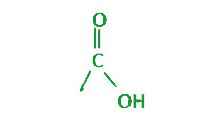
A functional organic compound is a carboxyl group. A carbon atom is joined to an oxygen atom by a double bond in this carboxyl group structure. It also has a single hydroxyl group with which it is bonded. Carboxylic acids are carboxylated compounds. Many organic acids, such as acetic acid and amino acid, fall under this category.
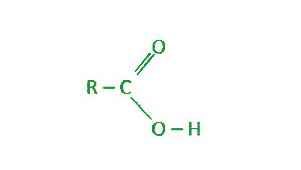
On the sides of the molecules, the carboxyl group is usually present. The H atom contained in the hydroxyl group portion ionizes and is released as a free H⁺ ion or proton by the carboxyl group. The rest of the component, which is O, has a negative charge on it. The charge flows forward and backward in the space between the two oxygen molecules, keeping the ionization state stable.
Resonance Structure
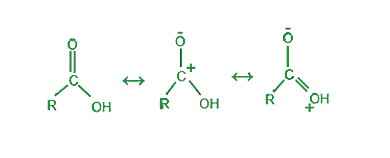
Carboxylic acids have all of the bonds in the carboxyl carbon in one plane. Carboxyl carbon bonds have an angle of about 120 degrees. The carboxyl carbon is less electrophilic than carbonyl carbon because of its resonance structure.
Sample Questions
Question 1: Write the common name and IUPAC name of the following structures:
- CH₃CH₂COOH
- CH₃(CH₂)₄COOH
- CH₃(CH₂)₅COOH
1. CH3CH2COOH
- Common Name - Propionic acid
- IUPAC Name - Propanoic acid
2. CH3(CH2)4COOH
- Common Name - Caproic acid
- IUPAC Name - Hexanoic acid
3. CH3(CH2)5COOH
- Common Name - Enanthic acid
- IUPAC Name - Heptanoic acid
Question 2: Write the IUPAC name of the following compound.

Answer: Heptane is the parent chain, which contains seven carbon atoms. So we've got heptanoic acid on our hands. On the priority list of functional groups, halogens and nitrile groups are at the bottom. As a result, they are treated as substitutes and are assigned a prefix. In alphabetical sequence, the prefix "fluoro" is applied to fluorine, whereas the prefix "cyano" is applied to nitrile.
Hence, IUPAC name of compound is,
3-cyano-6-fluoroheptanoic acid

Unsolved Examples
- Draw the structures of the following compounds:
a) 2-Methylpropanoic acid
b) But-2-enoic acid
c) 3-Chlorobutanoic acid - Why is the carbon of –COOH always given position 1?
- Why do we use the suffix “-oic acid” in naming carboxylic acids?
- Explain the difference between “-oic acid” and “-carboxylic acid."