
Hess's Law is an important principle that helps us calculate enthalpy changes in chemical reactions. It is based on the law of conservation of energy, which states that energy can neither be created nor destroyed. According to Hess’s Law, the total enthalpy change (ΔH) of a reaction depends only on the initial and final states of the system, and not on the path by which the reaction takes place.
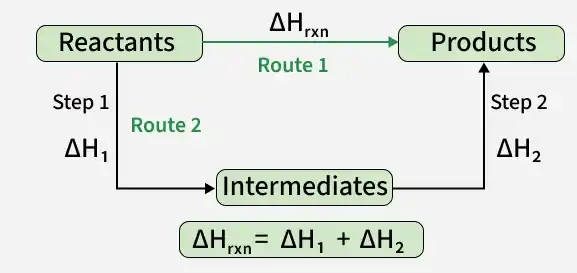
Statement of Hess's Law
According to Hess's Law,
The total enthalpy change (ΔH) of a chemical reaction is the same whether the reaction takes place in a single step or in multiple steps.
The heat change depends only on the initial and final states of the system and is independent of the path followed by the reaction
Mathematical Expression
According to Hess's Law, if a chemical reaction takes place in several steps, the total enthalpy change (ΔH) is equal to the sum of the enthalpy changes of each individual step.
ΔH = ΔH1 + ΔH2 + ΔH3 + …
Where,
- ΔH = overall enthalpy change of the reaction
- ΔH₁, ΔH₂, ΔH₃ = enthalpy changes of different steps
Enthalpy of Formation
Enthalpy of formation is an important concept used along with Hess's Law to calculate heat changes of reactions. It tells us how much heat is released or absorbed when a compound is formed from its basic elements
- The standard enthalpy of formation (ΔHf°) is defined as the heat change when one mole of a compound is formed from its elements in their standard states (most stable form at 1 atm pressure and 298 K temperature).
- It is represented as ΔHf°
- It is measured in kJ/mol
- Elements in their standard state have ΔHf° = 0
Examples:
- Formation of water:
H2 + ½O2 → H2O- Formation of carbon dioxide:
C + O2 → CO2
Enthalpy Change of Reaction
The enthalpy change of a reaction is the amount of heat released or absorbed during a chemical reaction at constant pressure. It tells us how much energy changes when reactants are converted into products.
- It is represented as ΔH and is measured in kJ/mol.
- If ΔH is negative, the reaction gives out heat and forms more stable products.
- If ΔH is positive, reaction takes in heat.
ΔH°reaction = ∑n × ΔHf°(products) − ∑n × ΔHf°(reactants)
Where,
- ΔH°reaction is the enthalpy change for the reaction of interest,
- ΔH°products is the standard enthalpy of formation of the products,
- ΔH°reactants is the standard enthalpy of formation of the reactants, and
- ∑n is the coefficient of each substance in the balanced chemical equation.
Applications of Hess's Law
This law is very useful for calculating heat (energy) changes in different chemical reactions in a simple way.
- It helps in calculating the enthalpy change (ΔH) of reactions easily by using known values, without doing the actual experiment.
- It is useful for reactions that are slow, complex, or not possible to perform directly in the laboratory.
- It is used to find the standard enthalpy of formation (ΔHf°) of compounds by combining other known reactions.
- It helps in calculating the enthalpy of combustion (heat released when a substance burns).
- It is used to determine bond energies, which tell how strong chemical bonds are.
- It allows us to add, subtract, or reverse chemical equations and calculate the total enthalpy change easily.
- It is widely used in thermochemistry problems and numerical calculations in exams.
Related Articles:
Solved Examples
Problem 1: Calculate the reaction’s standard enthalpy change using the following reaction.
CO2(g) + H2(g) → CO(g) + H2O(g)
Given that, ΔrHo for CO(g), CO2(g), and H2O(g) as -110.5 kJ/mol, -393.5 kJ/mol, and 241.8kJ/mol respectively.
Solution:
ΔrHo for the reaction can be given as:
△rHo = Σ△fHo(Products) - Σ△fHo(Reactants)
Given:
- Δf H∘ (CO(g)) = −110.5kJ/mol
- Δf H∘ (CO2(g)) = −393.5kJ/mol
- Δf H∘ (H2O(g)) = -241.8kJ/mol
- We know, △f Ho (H2) = 0
Thus, △r Ho= [△f Ho (H2O) + △f Ho(CO)] - [△f Ho (CO2) + △f Ho (H2)]
⇒ △r Ho=[−110.5+(-241.8)]−[−393.5+0]
⇒ △r Ho= (-352.3) − (−393.5)
⇒ △r Ho = +41.2 kJ/mol
Problem 2: Hess’s law states that a chemical reaction is independent of the route of chemical reactions while keeping the same
(a) Initial and Final Conditions
(b) Initial conditions only
(c ) Final conditions only
(d) None of the above
Solution:
Hess’s law states that a chemical reaction is independent of the route of chemical reactions while keeping the same initial and final conditions.
Problem 3: Calculate the enthalpy change for the following reaction:
CH4 (g) + 2 O2 (g) ⟶ CO2 (g) + 2 H2O (l).
Given that enthalpies of formation of CH4, CO2 and H2O are 74.8 kJmol−1,− 393.5 kJ mol−1, and − 286 kJmol−1, respectively.
Solution:
We know, ΔHo = ΔHo(products) − ΔHo(reactants)
⇒ ΔHo = [ΔHo(CO2) + 2 x ΔHo(H2O)] − [ΔHo(CH4) + 2 x ΔHo(O2)]
⇒ ΔHo = [− 393.5 + 2 X (−286)] − [(-74.8) + 2 X 0]
⇒ ΔHo = − 393.5 – 572 - (-74.8)
⇒ ΔHo = − 890.7 kJ/mol