
Froth Flotation is a very important process in the field of mineral processing which is utilized for the purpose of extraction of minerals from Ore. It is a part of surface chemistry in which we selectively separate the minerals from the unwanted material. This process is used in a variety of industries and is very crucial in each one of them. In this article we will look at this process in great detail.
Table of Content
What is Froth Flotation ?
Froth flotation is a method used to separate and concentrate ores by using the differences in surface properties between minerals. In this process, finely ground ore particles are suspended in water and introduced into a tank or flotation cell. A reagent (collecting agent) is added to the water, which selectively binds to the desired mineral particles, making them hydrophobic (repelled by water).
The idea behind froth flotation is that some minerals will stick to air bubbles in a slurry more than others, which will enrich those minerals during the froth phase. This phenomenon arises from the different surface properties exhibited by various minerals, particularly their ability to repel or attract water.

Types of Froth Flotation
There are three primary flotation technique types: bulk flotation, differential flotation, and conventional flotation. Let's discuss these types of froth flotation in detail below:
Conventional Flotation
Conventional flotation, sometimes referred to as direct flotation, is the method most frequently used method in mineral purification. Using this technique, minerals are isolated from gangue according to the differences in their surfaces.
Bulk Flotation
Bulk flotation involves floating several minerals together in a single bulk concentration. This method works especially well with ores that have several precious minerals with comparable flotation characteristics.
Differential Flotation
Differential flotation, sometimes referred to as selective flotation, extracts particular minerals from a complicated combination of ore. In order to achieve separation, this approach depends on variations in the surface characteristics of minerals.
Principle of Froth Flotation
Froth Flotation is a popular method for extracting precious minerals from their ores according to variations in their surface characteristics. The basic principle behind froth flotation is that hydrophobic particles attach themselves to air bubbles, enabling the selective recovery of such particles.
Particle Size Reduction: Crushing and grinding decreases the ore's particle size. This makes them suitably exposed for flotation.
Conditioning: The ore is combined with water and several flotation reagents, such as modifiers, collectors, and frothers, after it has been processed. This makes the minerals become hydrophobic due to the selective adsorption of collectors, which are surface-active compounds.
Air Injection: In this a layer of froth is created on the pulp's surface by injecting air into the flotation cell. The hydrophobic mineral particles rises up to the surface of flotation cell as a froth by the air bubbles that stick to them. The hydrophilic gangue minerals are released as residue.
Froth Collection: As the residue are released from the bottom of the flotation cell, the froth containing the valuable mineral particles is continuously skimmed from the cell's surface. To extract the precious mineral concentration from the water and froth components, the froth is subjected to additional processing.
Selective Recovery: The fundamental idea of froth flotation is the selective attachment of air bubbles to hydrophobic mineral particles. The differentiation between particles of complex ore combinations based on characteristics like agitation speed, pH, and reagent dosage allows for the selective recovery of desired minerals.
Mechanism of Froth Flotation
A number of procedures are involved in the froth flotation process, which functions to extract valuable minerals from gangue material. The detailed description of the mechanism of Froth Flotation method is discussed below:
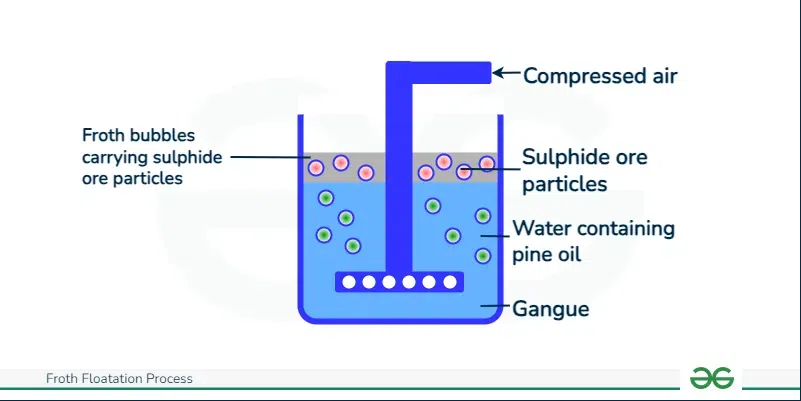
Preparation: The first step in the procedure is to crush the ore and combine it with water in a flotation cell or tank to create a finely ground ore slurry.
Air's Introduction: The flotation cell is filled with air, commonly by means of mechanical agitation or mechanisms for sparging. The air is distributed throughout the slurry by the agitation, which produces a froth-forming environment.
Connectivity of Air Bubbles: As the air bubbles rise through the slurry, they come into contact with the hydrophobic mineral particles coated with collector molecules.
Creation of Froth: Because of its low density, the froth carries the hydrophobic mineral particles to the surface of the flotation cell. The more air bubbles that adhere to the mineral surfaces, the more of this froth layer is created.
Skimming: Mechanical devices such as paddlers or scrappers are used to continually remove the froth containing the hydrophobic mineral particles from the top of the flotation cell. After that, this froth—which contains the important minerals—is collected as the concentrate.
Rejecting Gangue: The gangue minerals stay in the flotation cell as part of the tailings or waste stream because they are hydrophilic and do not stick to the air bubbles. These gangue minerals are released from the cell.
Technique of Froth Flotation
There are primarily two techniques of froth flotation method
- Direct Flotation Technique
- Reverse Flotation Technique
These two techniques of froth flotation are discussed below:
Direct Flotation Technique
In direct flotation technique precious minerals can be isolated from the gangue minerals that are present in an ore slurry. The gangue minerals stay in the pulp during the direct flotation process, which floats the target mineral directly. This technique is used when the gangue minerals are hydrophilic and the target mineral is hydrophobic.
By adding collectors, the target mineral particles in direct flotation are specifically made hydrophobic. By sticking to the target mineral particles' surface, these collectors increase their hydrophobicity and make it possible for them to stick to air bubbles. The hydrophobic mineral particles are carried by the air bubbles to the surface of the flotation cell, where they create a froth layer that is scraped off to recover the precious mineral concentrate.
Reverse Flotation Technique
Reverse Flotation Technique is used in order to distinguish valuable minerals from gangue minerals in an ore slurry. In reverse flotation, the valuable minerals stay in the pulp while the gangue minerals float, in contrast to direct flotation, which floats the target mineral directly.
By adding collectors, the gangue minerals in reverse flotation are selectively made hydrophobic. These collectors increase the hydrophobicity of the gangue mineral particles by adhering to their surface and enabling them to stick to air bubbles. The hydrophobic gangue minerals are carried by the air bubbles and rise to the surface of the flotation cell where they create a froth layer that is scraped off to remove the gangue minerals.
Froth Flotation Equipment
The various equipment used in froth flotation method are discussed below:
Grinders and Crushers
Crushers and Grinders are used to prepare ores for flotation. Large chunks of ore are broken down into smaller particles by crushers, and then the valuable minerals are separated from the gangue by further reducing the particle size in grinding mills.
Separation Cells
The main piece of machinery utilized in the flotation process are flotation cells. These are cylinder-shaped tanks used for mineral flotation. Agitators in the flotation cells ensure complete mixing of reagents with the ore slurry by generating turbulence in the pulp. Various varieties of separation cells are Pneumatic, column, and mechanical flotation cells.
Mixers and Agitators
The ore slurry in the flotation cells is stirred by agitators and mixers, which encourages the interaction of the reagents and minerals. They help air bubbles stick to hydrophobic mineral particles and guarantee that the reagents are distributed evenly throughout the pulp.
Collectors of Froth
Chemicals known as "froth collectors" are added to the flotation cells with the specific goal of making the target minerals more hydrophobic. These collectors adsorb onto the surface of the mineral particles, allowing them to attach to air bubbles and rise to the surface as a froth.
Dispensing System
To precisely distribute flotation reagents into the flotation cells, reagent dispensing devices are employed. By ensuring exact control over reagent dosage, these systems maximize flotation process efficiency and recovery.
Froth Flotation Column
Froth flotation column is a type of flotation device used for the separation and concentration of minerals from ore slurries. Unlike conventional flotation cells, which operate with mechanical agitation to generate air bubbles and mix the slurry, flotation columns utilize a tall vertical vessel with a continuous flow of water and air.

The key components of a froth flotation column include:
Feed Inlet: Where the ore slurry is introduced into the column.
Sparger: A device that injects air or gas bubbles into the bottom of the column to create a rising column of bubbles.
Collection Zone: The upper section of the column where the froth containing the hydrophobic mineral particles is collected.
Wash Water Inlet: Where clean water is introduced into the column to wash the froth and improve the grade of the concentrate.
Residue Outlet: Where the gangue particles, which are hydrophilic (attracted to water), are discharged from the column.
List of Chemicals in Froth Flotation
Reagents are important to the froth flotation process since they are chemical additions that alter the surface characteristics of minerals and improve the effectiveness of flotation process. The three primary reagent types utilized in froth flotation are depressants, collectors, and frothers. Each has a unique purpose in maximizing flotation performance.
Collectors
Collectors are surface-active compounds that adsorb onto the surface of the target minerals and make them more hydrophobic and more easily attached to air bubbles. It helps them float while reducing the flotation of gangue minerals. Typical categories of collectors include of:
Xanthates: In sulfide mineral flotation, xanthate-based collectors, such as potassium amyl xanthate (PAX) and sodium ethyl xanthate (SEX), are frequently utilized. They enhance the floatability of minerals by forming hydrophobic complexes with metal ions on their surfaces.
Fatty Acids: In the flotation of oxide minerals, fatty acids like oleic and stearic acids are used as collectors. Through chemisorption, they adhere to mineral surfaces, increasing their hydrophobicity and encouraging bubble attachment.
Amines: Non-sulfide minerals like feldspar and quartz are frequently floated using amines as collectors. Through electrostatic attraction, they interact with mineral surfaces to increase their hydrophobicity and promote flotation.
Frothers
Frothers is added to the flotation process to stabilize the froth layer and encourage the development of fine bubbles. Frothers are surface-active agents. Hydrophobic mineral particles are carried by these bubbles and are made easier to go to the froth phase. The following are the main duties of frothers:
Commonly used frothers include alcohols (e.g., methyl isobutyl carbinol, MIBC), glycols, and polyglycol ethers.
Depressant
In froth flotation, a depressant is a reagent used to inhibit the flotation of certain minerals or undesirable components in the ore, allowing for the selective recovery of valuable minerals. Depressants work by selectively adsorbing onto the surface of specific minerals, making them less hydrophobic and less likely to attach to air bubbles during flotation. This prevents these minerals from floating with the desired minerals and allows for their separation from the concentrate.
Inorganic Depressants include compounds such as sodium cyanide, sodium sulfide, sodium silicate, and sodium carbonate while Organic Depressants include starch, tannins, quebracho, and lignin
Examples of Froth Flotation
We have learnt that Froth Flotation is an important method is purifying mineral based on their surface properties. The various examples where froth flotation method is used in purification of mineral is discussed below:
Froth Flotation of Copper
- Copper is one of the many precious minerals that may be extracted from their ores via froth flotation.
- Froth flotation is used to recover copper sulfide minerals including chalcopyrite (CuFeS2), bornite (Cu5FeS4), and chalcocite (Cu2S).
- The ore is crushed in the copper froth flotation process in order to separate the copper minerals from the gangue minerals.
- After that, the resulting slurry is floated, a process in which air bubbles are added to the slurry and the copper particles cling to the bubbles, rising to the surface as froth. The gangue minerals stay in the slurry while the copper-enriched froth is scraped out.
- The slurry is mixed with collectors, like xanthates or dithiophosphates, to specifically increase the hydrophobicity of minerals containing copper sulfide to encourage the minerals' adhesion to air bubbles.
- To maintain the froth layer and enhance the effectiveness of bubble-particle attachment, frothers are also added.
Froth Flotation of Sulphide
- Froth flotation is a typical method used to extract sulfide minerals, such as copper, lead, zinc, and other sulfides.
- Copper flotation and sulfide mineral froth flotation share many of the same principles.
- To extract the valuable minerals from the gangue minerals, the sulfide ore is crushed and pulverized.
- The precious sulfide minerals are then separated from the gangue by flotation.
- Collectors are introduced to the sulfide minerals during the froth flotation process to specifically increase their hydrophobicity, which enables them to cling to air bubbles and float to the top as froth.
- To maintain the froth layer and enhance the effectiveness of bubble-particle attachment, frothers are also added.
Froth Flotation of Coal
- Coal smelting uses froth flotation to remove coal particles from mineral contaminants.
- Coal is crushed in the froth flotation process in order to separate the coal particles from the mineral content.
- After that, air bubbles are added to the coal slurry by a process called flotation.
- Because they are hydrophobic, the coal particles stick to the air bubbles and froth up to the surface, leaving the mineral stuff in the slurry.
- Collectors, like kerosene or diesel oil, are frequently employed to increase the hydrophobicity of coal particles in a targeted manner.
- Additionally, frothers are added to stabilize the froth layer and increase the bubble-coal particle's efficiency.
Advantages of Froth Flotation
The various advantages of froth flotation method are discussed below:
Selective Separation: Froth flotation makes it possible to separate precious minerals from undesired material (gangue) in a way that is specific to the differences in their surface characteristics. This makes it possible to produce high-grade concentrates and concentrate important minerals.
Versatility: Froth flotation is a procedure that is useful in the mining sector since it can be used with a variety of minerals and ores. It is employed in the beneficiation of a range of ores, such as oxide, sulfide, and industrial minerals.
Efficiency: Froth flotation has low operating costs and high recovery rates, making it a very effective method for separating minerals. It makes it possible to recover fine and ultrafine particles that would be challenging to recover with conventional techniques.
Environmental Compatibility: When compared to other methods of mineral processing, froth flotation is comparatively eco-friendly. Large-scale harmful chemical use is avoided, and the reagents and water used in the procedure are frequently recyclable.
Disadvantages of Froth Flotation
The various disadvantages of Froth flotation methods are discussed below:
Reagent Costs: Especially for large-scale operations, the use of chemical reagents in froth flotation can result in considerable operational costs. Reagent costs might change based on the kind and amount needed for a certain mineral.
Complexity: The process of foam flotation is complicated and need precise adjustment and management of a number of variables, such as pH, agitation speed, particle size distribution, and reagent dose. Reaching peak performance might be difficult and necessitate specific knowledge.
Sensitivity to Ore Characteristics: Changes in the mineral composition, liberation, and size of the particles can have an impact on how well froth flotation performs. Variations in the characteristics of the ore feed could call for modifications to the flotation procedure, which could result in performance swings.
Consumption of Water and Energy: Froth flotation usually uses a lot of water and energy, especially during the grinding and flotation processes. This may lead to excessive operational expenses and negative environmental effects from energy and water use.
Applications of Froth Flotation Method
Froth flotation method is used in extracting valuable minerals from gangue material. Hence, it is used in many different sectors. The following are some important uses for froth flotation:
Mining Sector: To recover ores that contain precious minerals, froth flotation is widely utilized in the mining sector. For the concentration of sulfide ores, such as copper, lead, zinc, nickel, and molybdenum ores, it is especially useful. By separating precious minerals from the gangue, the method creates concentrates from which metals can be extracted through additional processing.
Mineral Processing: To recover valuable minerals from low-grade ores or ore bodies with complicated mineral compositions, froth flotation is a commonly used technique in mineral processing plants. Phosphorus, potash, and graphite are just a few of the industrial minerals that are beneficiated using it.
Environmental Remediation: To remediate contaminated soil and water, foam flotation is used in environmental remediation operations. It can be applied to wastewater streams produced by mining operations or industrial processes to eliminate contaminants like organic compounds and heavy metals. Froth flotation facilitates the removal and disposal of pollutants by helping to concentrate and separate them.
Wastewater Treatment: The removal of suspended particles, oils, and greases from wastewater streams is one of the functions of foam flotation in wastewater treatment procedures. To raise the standard of wastewater released into water bodies or municipal treatment systems, it can be used as a primary or secondary treatment technique.
Paper Recycling: During the deinking process, pulp fibers and ink particles are separated using froth flotation in the paper recycling sector. Higher-quality paper products are produced as a result of the process, which removes impurities from recycled paper pulp by forming a froth layer containing ink particles.
Oil and Gas Sector: In produced water treatment systems, froth flotation is used to separate oil from water in this sector. It lessens the influence on the environment and maximizes the use of resources by assisting in the recovery of valuable hydrocarbons from produced water streams.
Conclusion
In summary, the froth flotation process is a fundamental component of mineral processing, providing a flexible and effective means of separating precious minerals from their ores. Froth flotation minimizes the extraction of undesirable gangue materials whale concentrating valuable minerals through the control of surface characteristics and the selective attachment of air bubbles. To maximize flotation efficiency and achieve target concentrate grades, it is essential to optimize operational variables such as temperature, agitation speed, pH, and particle size.
Also, Check