
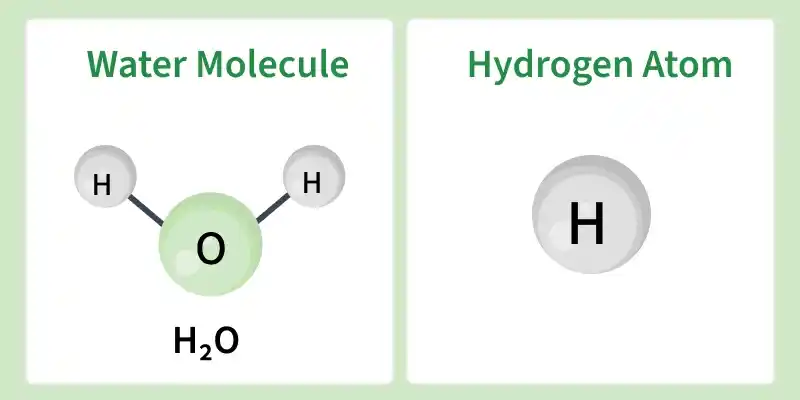
Molecules are the smallest particles of a substance that can exist independently and show their chemical properties. They are formed when atoms join together. A compound is a substance formed when atoms of two or more different elements chemically combine in a fixed ratio. All compounds are molecules, but not all molecules are compounds
Molecules
- Molecules consist of one or more atoms that are attached by chemical bonds, typically covalent bonds.
- The atom can be depicted as a central nucleus with electrons that move in predetermined orbits or shells around it.
- When atoms combine into a definite structure, they combine to compose a molecule.
A substance can be multiplied many times, but it still will be the same substance provided that its molecules are not split.
Compounds
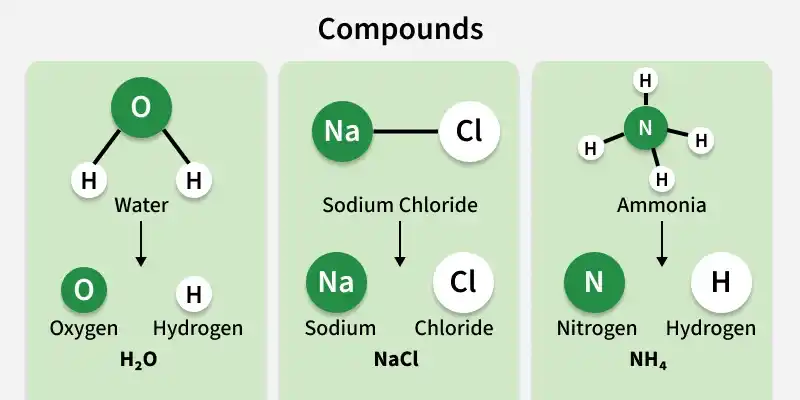
- The compounds are the substances formed when two or more elements which are different, come together and form a substance in a fixed ratio.
- Chemical bonds between atoms hold together the atoms of a compound.
- The chemical bonds can be of three types predominantly: Covalent bond , Ionic (electrovalent) bond and Metallic bond.
Compounds are substances formed by the combination of two or more types of elements.
Examples
- Water is a chemical compound which has a chemical formula C 2H O.
- It is composed of the combination of two hydrogen atoms and one oxygen atom.
- When the oxygen and hydrogen mix chemically, it forms a new substance known as water whose properties are different as compared to the two elements.
Compounds vs Molecules
| Molecule | Compound |
|---|---|
| The smallest unit of a substance that can exist independently. | A substance formed when two or more different elements combine chemically in a fixed ratio. |
| May consist of atoms of the same element or different elements. | Always consists of atoms of different elements. |
| Can be elemental or compound in nature. | Always a pure substance. |
| May or may not represent a compound. | Always has a definite chemical formula. |
| Properties may be similar to the element itself. | Properties are different from those of its constituent elements. |
| O₂, N₂, H₂O | H₂O, CO₂, NaCl |