
Corrosion is a common chemical process in which metals react with air, moisture, or acids to form more stable compounds such as oxides or hydroxides. This process leads to the gradual destruction and weakening of metals. A common example is the rusting of iron, where iron reacts with oxygen and moisture to form iron oxide (rust). Corrosion is essentially a redox (oxidation) reaction, where the metal loses electrons and gets converted into its compounds.
Corrosion Behaviour of Metals
Almost all metals can corrode, but the rate of corrosion varies depending on their position in the reactivity series.
- Metals higher in the reactivity series corrode more easily
- Metals lower in the series are less reactive and resist corrosion
For example:
- Iron corrodes easily, whereas copper corrodes slowly by forming a protective layer.
- Gold and platinum hardly corrode.
- Aluminium is an exception—it is reactive but resists corrosion due to the formation of a protective oxide layer.
Factors Influencing Corrosion
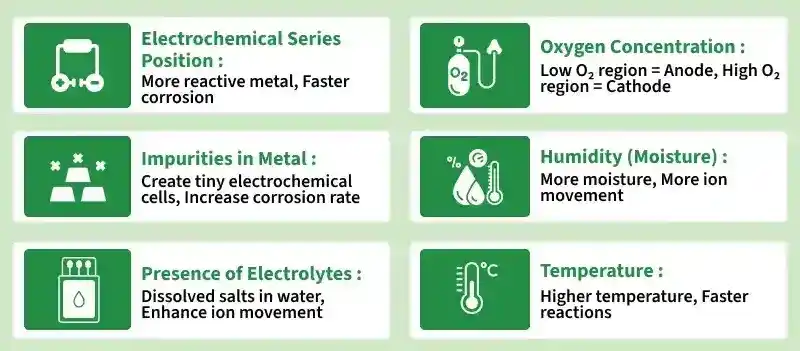
1. Position of Metals in Electrochemical Series: In corrosion, the electrochemical series is crucial. Reactive metals lose electrons more quickly and corrode more quickly. Iron, for example, is quickly oxidized, but gold is not because gold is less reactive than iron.
2. Impurities in Metals: In general, the presence of contaminants in metals accelerates corrosion because these impurities operate as the microscopic electrochemical cells that cause corrosion.
3. Presence of Electrolytes: Because they carry ions, dissolved salts in water act as electrolytes. Corrosion is accelerated when electrolytes are present in water.
4. Concentration of Oxygen: Corrosion is accelerated by an increase in oxygen content. An anode is a location with less oxygen concentration, whereas a cathode is a region with a higher oxygen concentration. Corrosion happens as a result.
5. Humidity in Weather: When the weather is humid, the presence of moisture with a high temperature accelerates corrosion because ions gain energy and begin moving quicker in a higher temperature, causing them to collide more frequently.
6. Temperature: The rate of corrosion increases with temperature.
Types of Corrosion
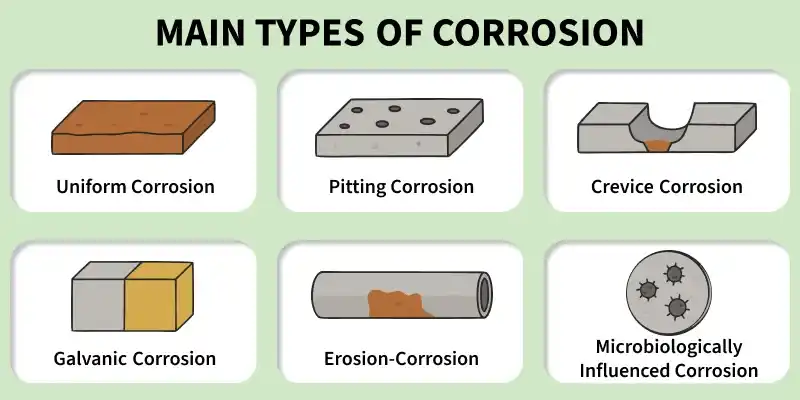
1. Uniform Corrosion
Corrosion that occurs evenly over the entire surface of a metal, leading to a uniform loss of material. It is the most common and predictable type.
Example: Rusting of iron, tarnishing of silver.
2. Pitting Corrosion
A localized form of corrosion that creates small pits or holes on the metal surface. Though small in size, these pits can cause serious damage and sudden failure.
Example: Stainless steel exposed to chloride solutions like NaCl.
3. Crevice Corrosion
Occurs in narrow gaps or crevices where stagnant solution accumulates and oxygen supply is limited, accelerating corrosion in those regions.
Example: Corrosion under gaskets, bolts, and joints.
4. Galvanic Corrosion
Takes place when two different metals are in electrical contact in the presence of an electrolyte, causing the more reactive metal to corrode faster.
Example: Zinc coatings protect iron in galvanized iron.
5. Erosion Corrosion
This is caused by the combined effect of corrosion and mechanical wear from fast-moving fluids that remove protective layers from the metal surface.
Example: Damage in pipelines due to turbulent flow.
Prevention from Corrosion
1. Painting: Painting iron items, such as gates and rails, prevents metal from being exposed to air and water. Painting metallic items protects them from corrosion.
2. Oiling and Greasing: Oiling and greasing, like painting, provide a protective coating on the metal surface that protects it from corrosion.
3. Galvanization: Galvanization is the process of coating iron and steel things with a thin layer of zinc to protect them. The galvanized products are protected against corrosion or rusting even after the zinc coating has been broken.
4. Alloying: Alloys are made up of a homogeneous combination of metals and non-metals. We may achieve the required characteristics of metals by alloying them. Iron, for example, is a very useful metal, yet it rusts fast. As a result, when this iron is combined with nickel and chromium, stainless steel is created. Stainless steel is now widely utilized in the manufacture of kitchenware.
Examples of Rusting
1. Rusting of Iron
Rusting is the process related to iron metal; the corrosion of iron in the presence of air and water is called rusting. It results in the formation of a reddish-brown surface. When iron oxide is formed in the presence of oxygen and water, we say that rusting has occurred. The chemical formula of the rust is Fe₂O₃.xH₂O.
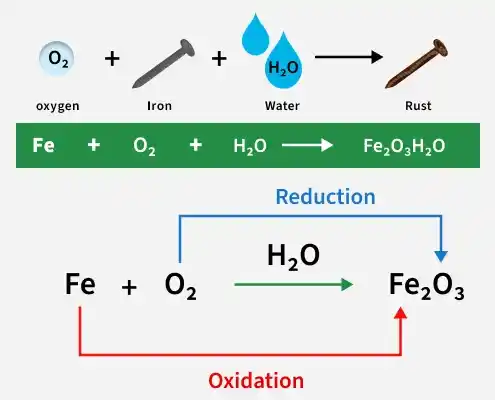
Reactions taking place
At Cathode:
4H+ + O2 + 4e– → 2H2O
At Anode:
2Fe → 2Fe2+ + 4e–
Oxidation Half-reaction
Fe(s) → 1/2Fe2+(aq) + 2e–
Reduction Half-reaction
4H+ + O2 + 4e–→ 2H2O
Overall Cell reaction
2Fe(s) + 4H+ + O2 → 2Fe2+(aq) + 2H2O
Fe2O3 + xH2O → Fe2O3.xH2O(rust)
2. Corrosion of Copper
- When exposed to moist air, copper metal or alloys of copper corrode, i.e., they form a pale-looking copper oxide layer, and the shiny copper surface tarnishes, i.e., it turns dark brown or black, then green.
- The blue-green color of the "Statue of Liberty" is an example of the corrosion of copper metal.
- The copper oxidized over time and reacted with sulfur trioxide, carbon dioxide, and water in the atmosphere to generate a new chemical that gave the Statue of Liberty its distinctive blue-green patina.
Cu + H2O + CO2 + O2 → Cu(OH)2 + CuCO3
3. Tarnishing of Silver
Tarnishing is the process of the silver metal becoming black due to a covering of silver sulfide. Chemical interaction between the silver and sulfur-containing compounds in the air causes the silver to tarnish. Silver sulfide is formed when silver is mixed with sulfur.
2Ag + H2S → Ag2S + H2