
Agile Methodology is a way to manage projects by breaking them into smaller parts. It focuses on working together and making constant improvements. Teams plan, work on the project, and then review in a repeating cycle.
- It focuses on delivering smaller pieces of work regularly instead of one big launch.
- This allows teams to adapt to changes quickly and provide customer value faster.
- Major companies like Facebook, Google, and Amazon use Agile because of its adaptability and customer-focused approach.
- Prioritize flexibility, collaboration, and customer satisfaction.
- In the traditional waterfall model, we first get all client requirements and do not allow changes during the project. Please refer Agile vs Tradition Waterfall for details.
Key Principles of Agile Methodology
Agile is guided by 12 simple principles that help teams work better, adapt quickly, and deliver value to customers. These focus on collaboration, flexibility, and continuous improvement.
- Customer Satisfaction: Deliver valuable software early and continuously to keep customers happy.
- Welcome Change: Accept changing requirements even in later stages of development.
- Frequent Delivery: Deliver working software in short, regular intervals.
- Collaboration: Ensure daily cooperation between business teams and developers.
- Motivated Teams: Build projects around skilled, trusted, and motivated individuals.
- Face-to-Face Communication: Prefer direct communication for better clarity and understanding.
- Working Software: Measure progress based on functional software, not just documentation.
- Sustainable Pace: Maintain a consistent and manageable development speed.
- Technical Excellence: Focus on good design and high-quality coding practices.
- Simplicity: Minimize unnecessary work and keep solutions simple.
- Self-Organizing Teams: Encourage teams to take ownership and make decisions.
- Continuous Improvement: Regularly reflect and improve processes for better results.
Agile Development Stages
The Agile (SDLC) breaks a project into six structured stages, enabling continuous improvement, faster delivery, and better adaptability to change.
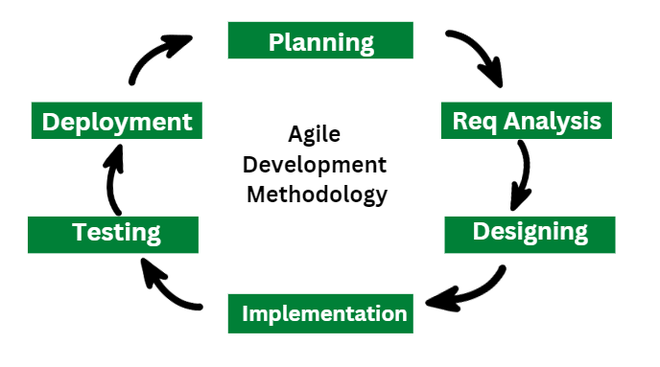
1. Requirement Gathering
- In this stage, the project team identifies and documents the needs and expectations of various stakeholders, including clients, users, and subject matter experts.
- It involves defining the Project's Scope, objectives, and requirements.
- Establishing a budget and schedule.
- Creating a project plan and allocating resources.
2. Design
- Developing a high-level system architecture.
- Creating detailed specifications, which include data structures, algorithms, and interfaces.
- Planning for the software's user interface.
3. Development (Coding)
- Writing the actual code for the software.
- Conducting unit testing to verify the functionality of individual components.
4. Testing
This phase involves several types of testing:
- Integration Testing: Ensuring that different components work together.
- System Testing: Testing the entire system as a whole.
- User Acceptance Testing: Confirming that the software meets user requirements.
- Performance Testing: Assessing the system's speed, scalability, and stability.
5. Deployment
- Deploying the software to a production environment.
- Put the software into the real world where people can use it.
- Make sure it works smoothly in the real world.
- Providing training and support for end-users.
6. Review (Maintenance)
- Addressing and resolving any issues that may arise after deployment.
- Releasing updates and patches to enhance the software and address problems.
Please refer Advantages of the Agile Model for detailed advantages of Agile Development
Types of Agile Methodologies
Agile is a flexible framework with several approaches, each suited for different project needs. Below are some of the most common Agile methodologies, formatted for clarity:
- Kanban: Uses a visual workflow and limits work-in-progress (WIP) to manage continuous tasks and improve delivery speed.
- Scrum: Works in short sprints with defined roles and meetings to deliver focused and incremental results.
- Extreme Programming (XP): Focuses on strong coding practices, continuous feedback, and frequent releases for fast-changing requirements.
- Adaptive Project Framework (APF): Adapts to changing requirements, timelines, and resources during project execution.
- Extreme Project Management (XPM): Designed for highly uncertain projects, using rapid iterations and constant adjustments.
- Adaptive Software Development (ASD): Follows Speculate–Collaborate–Learn cycle for continuous learning and flexibility.
- Dynamic Systems Development Method (DSDM): Provides a structured Agile approach covering the complete project lifecycle.
- Feature Driven Development (FDD): Focuses on building and delivering small, client-valued features incrementally.
Applications of the Agile Methodology?
If you want to know When to Use the Agile Methodology, then it is particularly well-suited for projects and organizations where the following conditions or needs are present:
- Unclear or Changing Requirements: Agile is great for projects with requirements that aren't well-defined or might change.
- Complex Projects: It's good for big, complex projects by breaking them into smaller pieces.
- Customer Focus: Use Agile when making customers happy is a priority and you want to involve them throughout.
- Quick Time-to-Market: If you need to get your product out fast, Agile can help.
- Small to Medium Teams: Agile works well for teams of a few to a few dozen people.
- Collaboration: Agile promotes working together and open communication.
- Regular Updates: If you want to check progress often and make changes as needed.
- Continuous Improvement: Agile fosters a culture of always getting better over time.
Limitations of Agile Methodology
The disadvantages of the agile model are as follows:
- Less Documentation: Agile methodologies focus on less documentation; it prioritizes working on projects rather than paperwork.
- Challenges in Large Organizations: Busy schedule of clients can make daily meetup and face-to-face communication difficult.
- Need for Senior Programmers: It may require experienced programmers to make critical decisions during the development of software.
- Limited Scope Control: It has less rigid scope control, which may not be suitable in certain situations.
- Predictability: Compared to more structured project management methods, it may lack predictability.
Popular Agile Tools for Software Development
Agile Tool for software development or platforms that help teams manage and track their Agile projects more effectively. These tools streamline collaboration, enhance productivity, and ensure that projects stay on track.
- Jira
- Trello
- Asana
- Pivotal Labs
- ClickUp
- Monday.com