
Agile software processes are designed to handle uncertainty and frequent changes in software development. They enable teams to adapt quickly while continuously improving through feedback and iteration.
- Handles changing requirements and evolving customer priorities effectively.
- Combines design and development for continuous verification.
- Promotes adaptability, feedback, and iterative improvement.
Agile Software Process
An Agile software process focuses on delivering software in small, iterative cycles while adapting to changing requirements. It integrates development, testing, and feedback to ensure continuous improvement and faster delivery.

- Inception: Initiate the project by defining goals, gathering initial requirements, and planning the overall approach.
- Construction Iteration: Develop and deliver working software in small increments with continuous testing and regular feedback.
- Transition: Release the product to users, deploy it in production, and ensure it meets user expectations.
- Continuous Cycle: Each release leads to the next iteration (N+1), enabling continuous enhancement based on feedback.
- Customer Feedback: Regular feedback helps refine features and align the product with user needs.
Agile Principles
Agile principles are a set of guidelines defined in the Agile Manifesto that help teams build software in a flexible, collaborative, and efficient way. These principles focus on delivering continuous value, adapting to change, and improving processes over time.
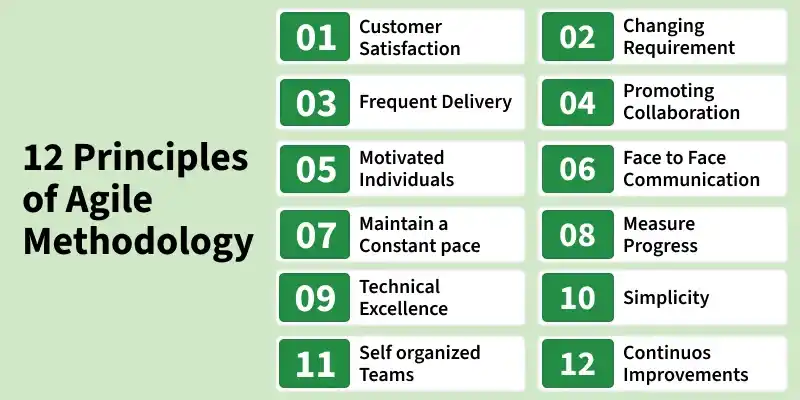
1. Customer Satisfaction through Early Delivery
Deliver valuable software early and continuously so customers can see progress and benefit from it quickly.
- Focus on delivering usable features in the initial stages of development.
- Provide frequent updates so customers get value without waiting for the full product.
- Use continuous feedback to align the product with customer expectations.
2. Welcome Changing Requirements
Agile accepts changes even in later stages of development to improve product quality and relevance.
- Adapt easily to evolving business needs, market trends, or user feedback.
- Modify plans and priorities without disrupting the overall workflow.
- Treat changes as opportunities to improve the final product.
3. Deliver Working Software Frequently
Software should be delivered in small, regular increments instead of one final release.
- Work in short iterations like sprints to ensure continuous delivery.
- Each release should provide some usable functionality to users.
- Helps in getting early feedback and reducing risks.
4. Business and Developers Must Collaborate Daily
Close collaboration between stakeholders and development teams ensures better understanding.
- Encourage regular communication between business users and developers.
- Reduce gaps in requirement understanding and expectations.
- Enables faster decision-making and smoother project execution.
5. Build Projects Around Motivated Individuals
Successful projects depend on motivated and empowered team members.
- Provide trust, support, and the right working environment.
- Give autonomy to teams to complete tasks in their own way.
- Motivated individuals improve productivity and quality of work.
6. Face-to-Face Communication is Best
Direct communication is the most efficient way to share information.
- Reduces misunderstandings and delays in communication.
- Helps resolve issues quickly and clearly.
- Improves collaboration and team coordination.
7. Working Software is the Primary Measure of Progress
The main indicator of success is functional software, not documentation.
- Focus on delivering features that actually work.
- Avoid unnecessary documentation and paperwork.
- Measure progress based on completed and tested functionality.
8. Maintain a Sustainable Development Pace
Teams should work at a consistent pace that can be maintained long-term.
- Avoid excessive workload and burnout among team members.
- Maintain steady productivity throughout the project.
- Balance speed with quality for better long-term results.
9. Continuous Attention to Technical Excellence
High-quality design and coding practices improve long-term agility.
- Write clean, maintainable, and efficient code.
- Continuously improve system design and architecture.
- Reduce technical debt to make future changes easier.
10. Simplicity is Essential
Focus on simplicity by doing only what is necessary.
- Avoid unnecessary features and over-engineering.
- Build only what adds real business value.
- Keep processes and solutions lightweight and efficient.
11. Self-Organizing Teams Deliver Best Results
Teams that manage themselves are more productive and innovative.
- Allow teams to decide how they will complete their work.
- Encourage responsibility and ownership of tasks.
- Promote creativity and better problem-solving.
12. Regular Reflection and Improvement
Teams should continuously review and improve their performance.
- Conduct retrospectives after each iteration or sprint.
- Identify strengths and areas of improvement.
- Adapt processes to become more efficient and effective.